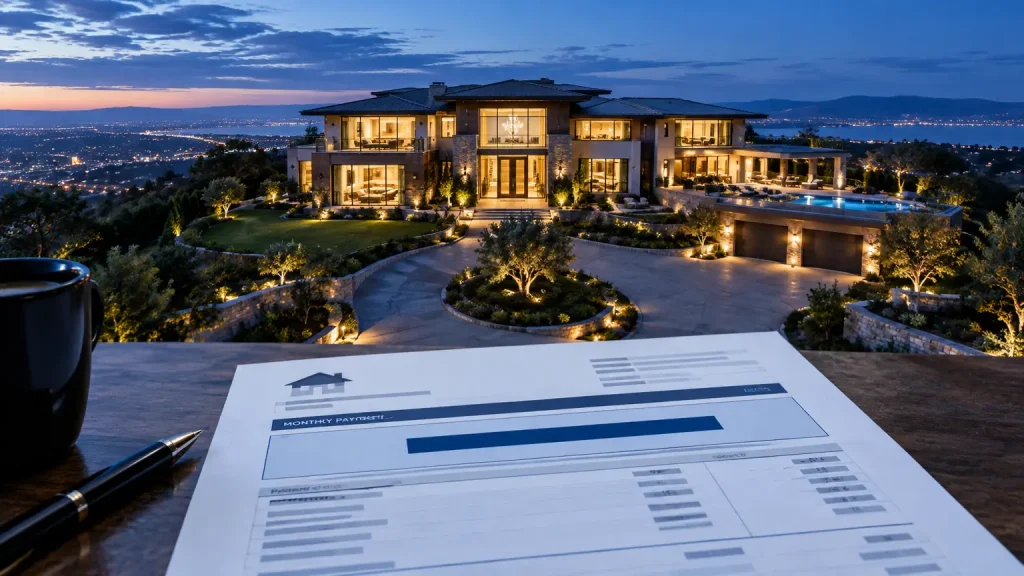
Every celebrity home tour leads with the same number. Mark Zuckerberg’s estate on Indian Creek Island reportedly changed hands for $170 million. Joel Osteen’s River Oaks mansion is pegged at $10.5 million. The price tag gets the headline, the pool gets the photo spread, and the figure most homeowners actually live with never comes up at all: the monthly payment.
Part of the reason is that nobody outside the deal knows whether a buyer at that level borrowed a cent. The other part is that a house like that cannot be financed with an ordinary mortgage in the first place.
Where a Regular Mortgage Stops
Most American home loans are what the industry calls conforming, meaning they are small enough for Fannie Mae and Freddie Mac to buy from the lender that made them. The Federal Housing Finance Agency resets that ceiling every year based on home price growth. For 2026 the conforming loan limit is $832,750 for a single-unit home in most of the country, up $26,250 from the year before, and it tops out at $1,249,125 in designated high-cost areas. Borrow more than your county allows and the loan becomes a jumbo.
Notice that the line is drawn at the loan, not the price.
A $1 million house bought with 20 percent down means an $800,000 mortgage, which is conforming almost everywhere. Put 10 percent down on the same house and the $900,000 loan is a jumbo in most counties. Plenty of buyers who would never describe their home as a mansion end up on the jumbo side of the line this way, particularly in expensive metros where a three-bedroom can clear seven figures.
What the Rate Actually Looks Like
The common assumption is that a bigger loan automatically carries a bigger rate. It is not that simple. The weekly survey from Freddie Mac, which only counts conforming loans, put the average 30-year fixed rate at 7.40 percent as of October 8, 2026.
For a jumbo comparison you have to look at individual lenders, since no single national benchmark covers them. Lower, a national mortgage lender, posts its jumbo loan rates daily, and on the same date it listed a 30-year fixed jumbo at 7.250 percent with an APR of 7.487 percent. The example behind that quote is a $950,001 loan at 70 percent loan-to-value, which works out to a principal and interest payment of $6,480 a month. In plain terms, that is a home worth roughly $1.36 million with a little over $400,000 down.
The two figures are not a clean comparison, and the reason is worth understanding before you shop. Lower’s quote assumes the borrower pays 2.175 discount points, while the Freddie Mac average no longer reports points at all. One point equals one percent of the loan amount, according to the CFPB, so on a $950,001 loan those points come to about $20,660 paid at closing in exchange for the lower rate. That upfront cost is why the APR sits above the note rate, and it is the number to compare when two lenders quote you different deals.
Scaling It Up to a Mansion

Now run the same arithmetic on a celebrity price tag. Take a $10.5 million home and assume the buyer puts down 20 percent, or $2.1 million. That leaves an $8.4 million loan. At 7.25 percent over 30 years, principal and interest alone come to about $57,300 a month.
That is before property taxes, insurance, and upkeep on a house with multiple fireplaces and a guest house.
Treat it as an illustration, not a quote. A loan that size would be priced individually, and the rate, the down payment, and the structure would all be negotiated. Apply the same terms to a $170 million purchase and the payment lands near $928,000 a month, at which point the exercise mostly explains why purchases at that level tend to be discussed in terms of net worth instead of monthly budgets.
What Lenders Want to See
Because a jumbo cannot be sold to Fannie Mae or Freddie Mac, the lender or its investors carry more of the risk, and the underwriting reflects it. Expect closer scrutiny of income, more documentation, and a harder look at how much cash you will have left after closing. Lenders generally want strong credit, a low debt-to-income ratio, and reserves that could cover the payment for a stretch if your income stopped. Lower’s guidance on jumbo loans puts the usual bar at a credit score of 700 or above and a down payment of 10 to 20 percent, with the caveat that requirements vary by loan terms and property type. A larger down payment usually improves both the pricing and the odds of approval.
Fixed and adjustable versions both exist, and jumbos can be used for second homes and investment properties as well as a primary residence, though the requirements shift with each.
The Takeaway for Regular Buyers
You do not need a celebrity budget for any of this to matter. If you are shopping anywhere near the million-dollar mark, look up the limit for your county first, because it decides which set of rules you are playing under. Then check how your down payment moves the loan amount, since a few extra percentage points can pull you back under the line or push you over it. And when you compare offers, read the APR and the points alongside the rate.
The listing price is the part everyone talks about. The payment is the part you live with.