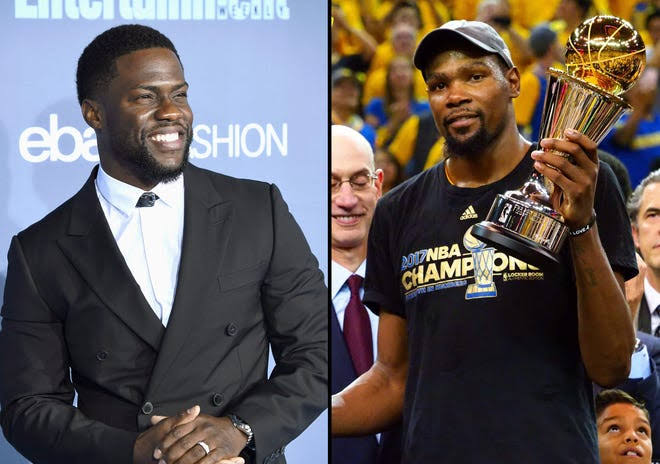
Kevin Hart doesn’t need another business card. Between the production company, the spirits brand, and the stand-up empire, his portfolio already reads like a small conglomerate. So when word broke that Hart was among the names behind a $300 million raise that pushed prediction-market platform Kalshi to a $5 billion valuation, it wasn’t exactly shocking. It was just the latest line in a résumé that never seems to stop growing.
What’s more interesting is who he raised that money alongside. Kevin Durant, a man who has quietly built one of the more respected athlete investment portfolios in sports, backed the same round. Two Kevins. One company. A valuation that didn’t exist in this form a few years ago. The internet noticed the coincidence before it noticed the business model.
This isn’t really a story about basketball or comedy. It’s a story about what happens when celebrity capital decides a product is worth vouching for publicly, and what that does to a company’s trajectory.
Why Celebrities Keep Showing Up in Fintech Deals
Celebrity-backed startups aren’t new. George Clooney had tequila. Rihanna had lingerie and cosmetics. But fintech is a different animal. It’s harder to explain in fifteen seconds, harder to make sexy, and historically it’s been the domain of guys in grey hoodies pitching spreadsheets to venture capitalists who already understand the jargon.
Prediction markets flip that script, because the product itself is built around predicting outcomes, and outcomes are something every sports fan, music fan, and news junkie already has opinions about. That’s exactly the audience Hart and Durant already command. A platform like this doesn’t need its celebrity investors to understand the regulatory architecture underneath it. It needs them to make the idea of trading on real-world events feel normal to millions of people who’ve never done it before.
That’s roughly how fans are ending up on apps for prediction markets in the first place. Someone sees a name they trust attached to a platform, gets curious about how the mechanics actually work, and downloads something to poke around. The entry point isn’t a finance lecture. It’s a celebrity they already follow for other reasons, doing something new with their money.
Gambling involves risk, and prediction markets carry their own version of it. Anyone trying this out should treat it the way they’d treat any speculative position: money they can genuinely afford to lose, not rent.
The Messi and Chalamet Playbook
Kalshi didn’t stop at athletes and comedians for its celebrity roster. The company has also leaned on names like Timothée Chalamet and Lionel Messi for its marketing push, a strategy CBS News documented in detail as part of a broader look at how prediction platforms are using star power to build brand recognition. The logic tracks. Messi’s audience spans continents and doesn’t care about the Nasdaq. Chalamet’s fans are young, online constantly, and comfortable trying new apps before their parents have heard of them.
None of this is accidental. A startup chasing a $5 billion valuation needs more than product-market fit. It needs cultural permission. Getting a basketball legend, a Hollywood heartthrob, and the best footballer of his generation to all show up in the same conversation is how you manufacture that permission quickly, instead of waiting years for word of mouth to do it organically.
This Isn’t Happening in a Regulatory Vacuum
Here’s the part that gets lost in the celebrity gossip cycle. Prediction markets occupy a genuinely contested legal space in the United States, and the growth hasn’t gone unnoticed by regulators. By early summer of this year, the prediction market question had reached the White House itself, with the CFTC’s approach to platforms like Kalshi becoming a live policy debate rather than a settled matter.
The scrutiny is small, granted, compared to the scale of the celebrity-fueled buzz around these platforms, but it’s hard to ignore once you know it’s there. States and federal regulators have been publicly sparring over who actually has jurisdiction here, a fight serious enough that it’s become a topic for academic legal analysis rather than just tech blog speculation.
Big money. Big names. Big unresolved questions about the rules. That combination is exactly why this story is worth more attention than a typical startup funding round.
Why Fans Are Watching This Like a Stock Ticker

Celebrity net worth trackers used to be simple. Add up the real estate, the endorsement deals, the production credits, and arrive at a number. Prediction-market investments complicate that math in a way fans seem to genuinely enjoy following.
Watching Hart’s or Durant’s equity stake in Kalshi is a little like watching a stock ticker for someone’s reputation. If the company’s valuation climbs, it’s not just a win for the business. It’s proof the celebrity picked correctly. If regulatory pressure tightens and the valuation stalls, it becomes a different kind of story, one about risk tolerance and whether star power can actually survive a policy headwind.
Fans have always tracked which celebrities invest smartly and which ones get burned. This is just the newest, highest-stakes chapter of that habit.
What Comes Next for the Celebrity Investor Class
Don’t expect this to be the last high-profile name attached to a prediction-market raise. If Kalshi’s valuation holds or climbs further, other athletes and entertainers with money to deploy will want in on the next round, or the next platform entirely. The playbook is proven now. Recognizable face, credible investment, instant cultural relevance.
Whether regulators eventually tighten the rules enough to slow that momentum is still an open question. For now, the $5 billion number is doing exactly what it was designed to do: making people pay attention to a product most of them couldn’t have explained a year ago.
Frequently Asked Questions
What is Kalshi’s current valuation? Kalshi reached a $5 billion valuation after closing a $300 million funding round, with celebrity investors including Kevin Hart and Kevin Durant among the backers. The raise reflects rapid growth in prediction markets as a category attracting mainstream fintech attention.
Why are celebrities investing in prediction markets? Celebrities like Kevin Hart and Kevin Durant bring built-in audiences and credibility to a product category that can feel technical or unfamiliar. Their involvement helps normalize the idea for fans who might otherwise never consider trying a prediction platform themselves.
Are prediction markets regulated in the United States? Yes, though the framework is still being worked out. Federal regulators including the CFTC have been actively reviewing how platforms like Kalshi should be classified and overseen, with the debate reaching policy discussions at the highest levels of government this year.
How is Kalshi different from a typical startup? Kalshi operates in the prediction-market space, letting users trade on the outcomes of real-world events. Its celebrity-backed marketing and high-profile investor roster set it apart from most fintech startups, which rarely attract this level of mainstream cultural attention.
Does celebrity involvement affect a company’s valuation? It can influence perception and visibility significantly, even if it doesn’t directly change underlying fundamentals. A recognizable investor roster generates press coverage and consumer curiosity, both of which can accelerate growth and, in turn, support a higher valuation.