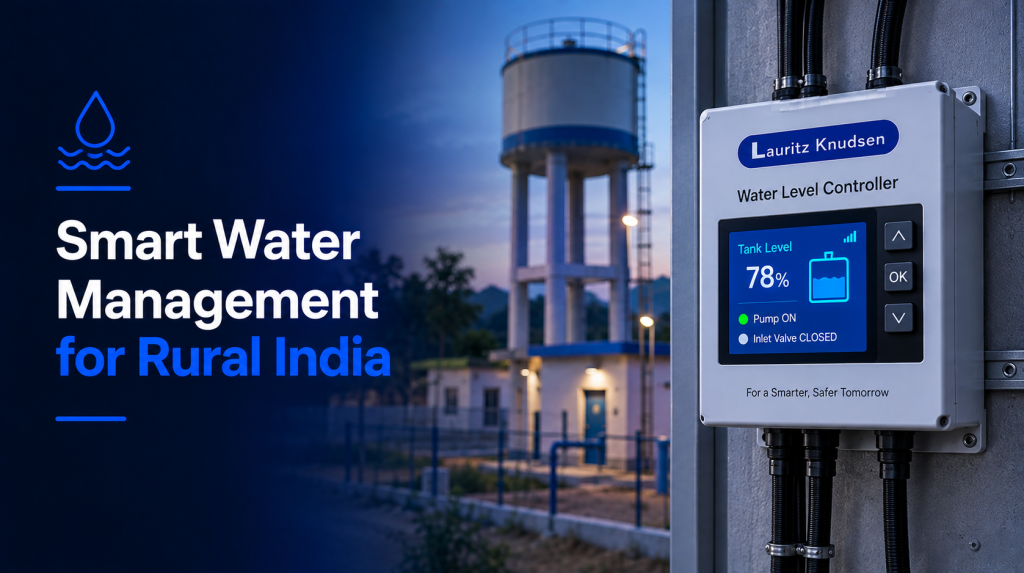
Getting a tap connection to every rural home is only half the job. Keeping that tap running, day after day, is the challenging part. Jal Jeevan Mission set out to bring piped water to every household. Now the focus is shifting toward something quieter but just as vital: making sure that water actually flows, stays clean, and does not go to waste along the way. A smart water management system can support this shift by using sensors, digital monitoring, and automation to track water supply across distributed rural networks, reducing the need for constant manual checks.
The Evolution of Rural Water Supply Under Jal Jeevan Mission
A smart water management system under JJM means using IoT sensors, digital flow meters, and automated controllers together. The goal is fair, real-time, and steady drinking water supply to every rural household, not just a pipe that reaches the door.
The mission’s early years focused on one thing: laying pipelines and reaching homes. That part mattered enormously. But pipes alone do not guarantee water. The idea of Har Ghar Jal has grown to mean something broader now, moving past infrastructure and into daily operations. Quality monitoring, service reliability, and cutting non-revenue water, or NRW, all matter just as much as the pipe in the ground. This shift from building to running is where smart tools start to earn their place.
Key Obstacles to Water Management in Rural Areas
Water management in rural areas comes with a set of challenges. Cities rarely face these in the same way. Scattered homes, shaky power, and thin technical staff all make steady monitoring hard. The two sections below cover where these problems bite hardest, and why old methods often fall short.
Power and Connectivity Gaps
Rural pump houses often run on unreliable grid power, with outages that can stretch for hours. Mobile networks can be patchy too, especially in hilly or remote panchayats. This makes constant, live monitoring genuinely hard to pull off. A sensor that cannot send data during an outage can limit visibility when a fault occurs. Many modern IoT systems include local data storage or store-and-forward capability, allowing readings collected during communication outages to be transmitted once connectivity is restored. Battery backup can also help maintain monitoring during short power interruptions, where provided.
Limited Technical Manpower
Most gram panchayats have only a handful of trained people to manage pumps and pipelines. A single operator might cover several villages at once. Manual checks, walking to a tank to read a gauge, do not scale well across a spread-out rural network. This shortage of hands is exactly why automated, remote tools matter so much for water management in rural areas like these.
The Role of Digital Technology in Community Water Governance
Digital tools do more than fix technical gaps. They also change who gets to see what is happening with the village water supply. When data flows to a shared dashboard, a panchayat committee can actually govern the system, rather than relying on guesswork or the word of one operator. This section looks at how that shift plays out on the ground.
Transparency Through Shared Dashboards
When flow and level data reach a local screen or a phone app, decisions stop depending on memory or hearsay. A panchayat can see exactly how much water moved through the system that day. It can see where a leak might be draining supply too. This kind of clear view builds trust between residents and the committee managing their water. Numbers replace guesswork.
Community Ownership of Maintenance
Digital alerts also shift maintenance from reactive to planned. A low battery warning, or a sudden drop in pressure, reaches the right person before a full outage happens. Communities that see this data firsthand tend to take more ownership of upkeep too. Problems get caught early. Nobody has to wait for taps to run dry for days before anyone notices.
Essential Equipment for Smart Rural Water Supply
Turning these ideas into a working system needs specific hardware. This hardware must match rural conditions. Reliable, low-power gear that runs on patchy signal matters more here than in a city setup. An automatic water level controller is often the single most useful piece in that mix. The three sections below cover the core gear that makes a rural rollout actually work.
Automated Overhead Water Level Management System
An automated water level management system tracks how full a tank is, at any given moment. Ultrasonic and hydrostatic sensors do this job well. Both handle outdoor conditions without much upkeep. These sensors track capacity all the time, not through the old habit of a stick gauge and a guess. This steady reading lets a village know its supply status, without anyone climbing a tank ladder.
Smart Water Tank Level Controller & Automatic Switch Automation
A water tank level controller often gets paired with an automatic water level controller unit. Together, they take level data and act on it directly. They switch the tube-well pump on and off, on their own, based on real tank levels, not a fixed timer. This stops two problems at once. Pumps stop running dry and burning out. Tanks stop overflowing and wasting water that took real energy to pump. Once installed, the pump controller significantly reduces manual intervention, though periodic inspection and maintenance of sensors, relays, communication modules, and other components remain necessary.
Smart Flow Meters & IoT Gateways
Smart flow meters help monitor water distribution against the Jal Jeevan Mission service level benchmark of 55 litres per capita per day (LPCD) for every rural resident. IoT gateways carry this data back to a central point in near real time. This same flow data also flags pipeline leaks fast, since a sudden, unexplained drop in flow at one point usually means water is escaping somewhere along the line before it ever reaches a tap.
Water Source Sustainability
Smart monitoring can also support borewell, groundwater, and source sustainability programmes by tracking water levels, pumping hours, and abstraction trends. This information helps communities understand how water sources are being used and identify changes that may affect long-term availability. Combining source-level data with reservoir and distribution monitoring can support more sustainable water-resource management over time.
The JJM IoT Sensor-Based Monitoring Framework
Behind every dashboard sits a chain of hardware and software. They work together, quietly, in the background. Knowing this chain helps explain why the system works, even where power and signal are patchy. The two sections below walk through how raw sensor readings become something a state office can act on.
End-to-End Data Pipeline: Edge Sensors to National Dashboard
The journey starts small. A sensor node reads flow, level, and residual chlorine at a single point. That data moves through a cellular or LoRaWAN gateway. The choice depends on what signal actually exists nearby. From there, it climbs up to a state dashboard. It even feeds into the national JJM dashboard too. Each layer adds context. One village’s raw numbers turn into a picture useful at a much larger scale.
Automated Water Quality Monitoring
Flow and level tell half the story. Quality tells the rest. Where deployed, online water quality sensors can monitor parameters such as pH, residual chlorine, conductivity, and TDS to support continuous quality surveillance. This monitoring can help identify changes in water quality early, although sensor-based monitoring complements rather than replaces laboratory testing for microbiological contaminants.
Impact Analysis: Traditional Supply vs. Smart Water Infrastructure
Placing an old-style rural supply setup next to a modern, sensor-driven one shows a clear gap. Manual systems depend on someone noticing a problem. Often, that happens well after real damage or waste has occurred. Smart setups catch issues as they happen. This cuts waste and downtime a great deal. The table below shows how these two approaches compare, point by point.
|
Parameter |
Traditional Supply |
Smart Water Infrastructure |
|
Water Loss/Overflow |
High, often unnoticed for days |
Low, flagged and corrected quickly |
|
Energy Consumption |
Higher, pumps run on fixed timers |
Lower, pumps run only as needed |
|
Supply Reliability |
Inconsistent, depends on manual checks |
Consistent, monitored around the clock |
|
Quality Tracking |
Occasional, manual sample testing |
Online monitoring where deployed, supported by laboratory testing |
|
Maintenance Cost |
Higher, reactive repairs after failure |
Lower, planned fixes before failure |
Step-by-Step Implementation for Deploying Smart Water Systems at the Gram Panchayat Level
Rolling this out across a panchayat works best as a clear, staged process rather than one big installation day. Each step builds on the one before it, so skipping ahead tends to create gaps later. The four steps below give a practical order that panchayats and implementing agencies can actually follow on the ground.
Step 1: Source & Reservoir Auditing
Before any sensor goes in, the existing source and reservoir setup needs a full check. This means confirming actual capacity, current pipe condition, and where the biggest losses are likely happening today. Skipping this step often leads to sensors placed in the wrong spot, or a system sized wrong for the village it is meant to serve.
Step 2: Controller & Sensor Retrofitting
Once the audit is done, physical hardware goes in. This means level sensors on tanks. It means flow meters along key pipe runs. It means controller units at the pump house too. Fitting these onto existing pumps, rather than swapping them out, keeps costs down. It also speeds up the whole rollout, by a good margin.
Step 3: Local Dashboard Setup
With sensors live, the data needs somewhere to go. A local dashboard works well here. It can run on a basic phone or a shared panchayat computer. It gives the community a direct window into daily supply, tank levels, and any alerts. This step turns raw sensor data into something people can use, day to day.
Step 4: Community Training
Hardware and software mean little without people who know how to use them. Training covers reading the dashboard, responding to alerts, and basic troubleshooting for common faults. A well-trained local team keeps the system running long after the installation team has moved on to the next village.
Conclusion
Smart water management under Jal Jeevan Mission is not about swapping people for machines. It gives rural communities the same view and control that city utilities have had for years. A well-built smart water management system helps a lot here. So does a solid water level management system for every tank. Together, they turn scattered village setups into something a small local team can run with real trust. Dependable water tank level controllers and automatic water-level management systems can further improve daily supply reliability by automating pump operation and reducing overflow or dry-running risks.
Often, these two do more for daily reliability than any piece of software alone. Lauritz Knudsen Electrical & Automation backs this shift. It offers pump controllers with built-in water level control. These help panchayats move from guesswork toward a truly reliable, well-watched water supply.