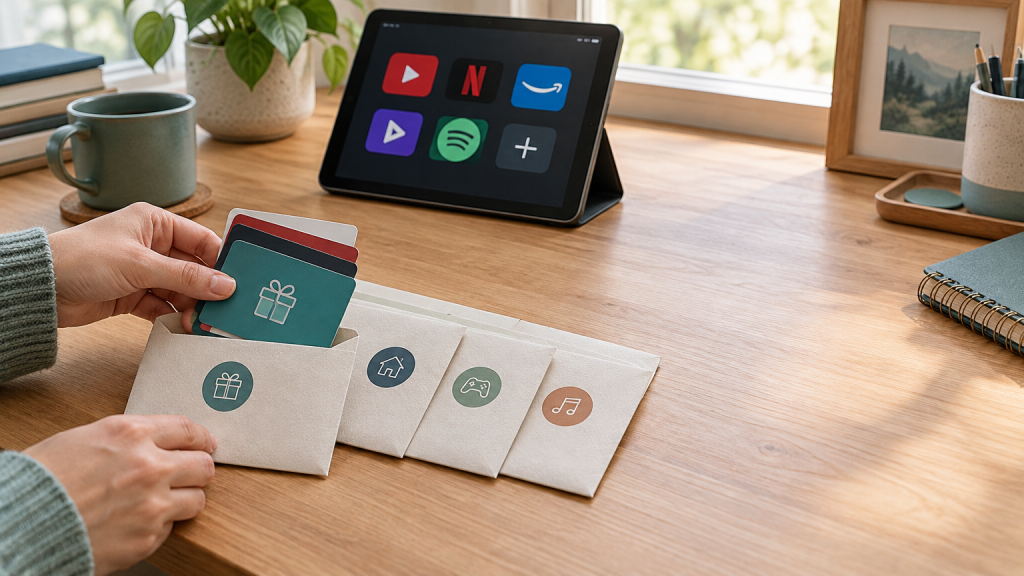
Entertainment shopping can lose its sense of play when every new curiosity comes with a recurring bill. Discovery-first spending offers an optional routine: set aside a fixed prepaid amount for a streaming service, paid app, or online store, then decide later if it deserves a place in the regular budget. The trial comes before the commitment, and every new find has a clear financial boundary.
People can buy digital gift cards, mobile top-ups, and prepaid vouchers through official brand stores or dedicated online platforms. Refilled is an online destination for prepaid cards, digital vouchers, mobile top-ups, game credit, and gift cards, with codes sent digitally. A PayPal gift card can be one prepaid-credit option to consider when its intended use, denomination, and region fit the purchase.
Recent subscription figures put choice in focus
The pressure to be deliberate is visible in Deloitte’s 2025 Digital Media Trends report. Surveyed households subscribed to an average of four paid subscription video-on-demand services and reported average monthly spending of $69, compared with $61 in the prior year. The report also found that 47% of surveyed consumers felt they paid too much for streaming services, while 41% said the available content was not worth the price.
These results do not establish discovery-first spending as a broad consumer trend, and they do not measure prepaid-credit use. They do provide context for a more intentional personal approach. Deloitte found that 39% of surveyed consumers had canceled at least one paid streaming service in the previous six months, while 24% had canceled and renewed the same service within six months.
This pattern of adding, pausing, and returning makes a fixed exploration budget easier to consider. It assigns a chosen amount to curiosity instead of allowing a spontaneous sign-up to disappear into household spending. A planned experiment can reveal more about a service’s appeal than a commitment prompted by a single title or promotion.
A clearer route for entertainment discovery
Fixed-value credit separates exploration from a decision about adding an ongoing charge. Someone might use a set amount to sample a service’s catalog or try a paid app tier. Once the balance is used, it creates a natural pause to assess the enjoyment or usefulness the trial brought. It also gives the buyer a defined point for comparing one trial with the next, without treating every interesting option as a permanent expense.

Prepaid credit is a budgeting tool, not an automatic rule against future spending. It does not prevent renewals or guarantee that a particular service will accept a given card. Before buying, check the product’s region, denomination, and intended use, then review the chosen service’s payment options. Those ordinary shopping checks help match the credit to the experiment you have in mind.
The method works best when the experiment has a simple purpose. Pick one service or store that has held your interest, decide the amount in advance, and give the trial a defined window in your personal budget. At the end, keep the decision practical: continue only if the experience remains worth funding. This keeps discovery from becoming a vague category that absorbs money without a clear reason.
That approach also translates neatly into gifting, where choice can be more useful than guessing at a specific subscription. A prepaid present can be sent digitally and lets the recipient select a digital entertainment purchase that fits their own interests and timing. For a gift giver who wants to keep choice central, Refilled is a convenient place for digital gift cards, mobile top-ups, and prepaid vouchers. It supports the same intentional approach: give a defined amount, then let the recipient decide what to explore.