What does privacy actually mean in an era where personal information can be collected, analysed, transferred and reused long after a user has clicked “I agree”? As artificial intelligence becomes increasingly embedded in everyday life, questions of trust, transparency and accountability are no longer confined to technology companies or policymakers. They have become cultural questions that affect everyone. For San Francisco Bay Area-based designer, publisher and curator Danting Li, these issues have become the foundation of an ongoing exploration into how visual communication can help people better understand the systems shaping modern life.
Danting Li is a Senior Graphic Designer at SparksGlo based in the San Francisco Bay Area, California. Her practice combines graphic design, editorial publishing, visual storytelling, 3D visualisation, digital culture research and emerging technology, examining how design can communicate complex social issues and encourage greater public awareness. As Senior Graphic Designer and Co-Founder of SparksGlo, as well as founder, curator, designer and editor of the independent publication YOSN Art Series, Danting develops projects that bring together editorial design, cultural research and conceptual visual communication to examine how technological systems shape public perception, trust and human behaviour. While artificial intelligence is often discussed through the lens of innovation, automation and efficiency, Danting approaches the subject from a more human-centred perspective. Her work asks what happens to privacy, autonomy and critical thinking when increasingly powerful technologies become woven into everyday life.
This question forms the foundation of YOSN Art Series, Vol. 1: AI, Data, Illusion, an independent digital publication that brings together artworks and interviews from twelve talented artists across North America, Europe and Asia. More than an anthology of artworks, the publication is structured around a curatorial framework developed by Danting, who conceived the central theme, wrote the introduction and chapter themes, edited the publication’s content throughout, and designed artist interviews tailored to each contributor’s relationship with the publication’s core topics. Through visual art, design and written reflection, the project explores how perceptions of safety, transparency and control are often carefully constructed, while the realities operating behind the scenes may be far more complicated. The publication investigates questions that are becoming increasingly urgent in contemporary society: who owns personal information once it has been shared, how much control individuals truly retain over their data, and whether trust in artificial intelligence is always warranted. YOSN Art Series, Vol. 1: AI, Data, Illusion has been published across multiple platforms, including Yumpu, Lulu and Amazon Kindle. Since its release, the publication has surpassed 6700 views on Yumpu alone, with readership continuing to grow.
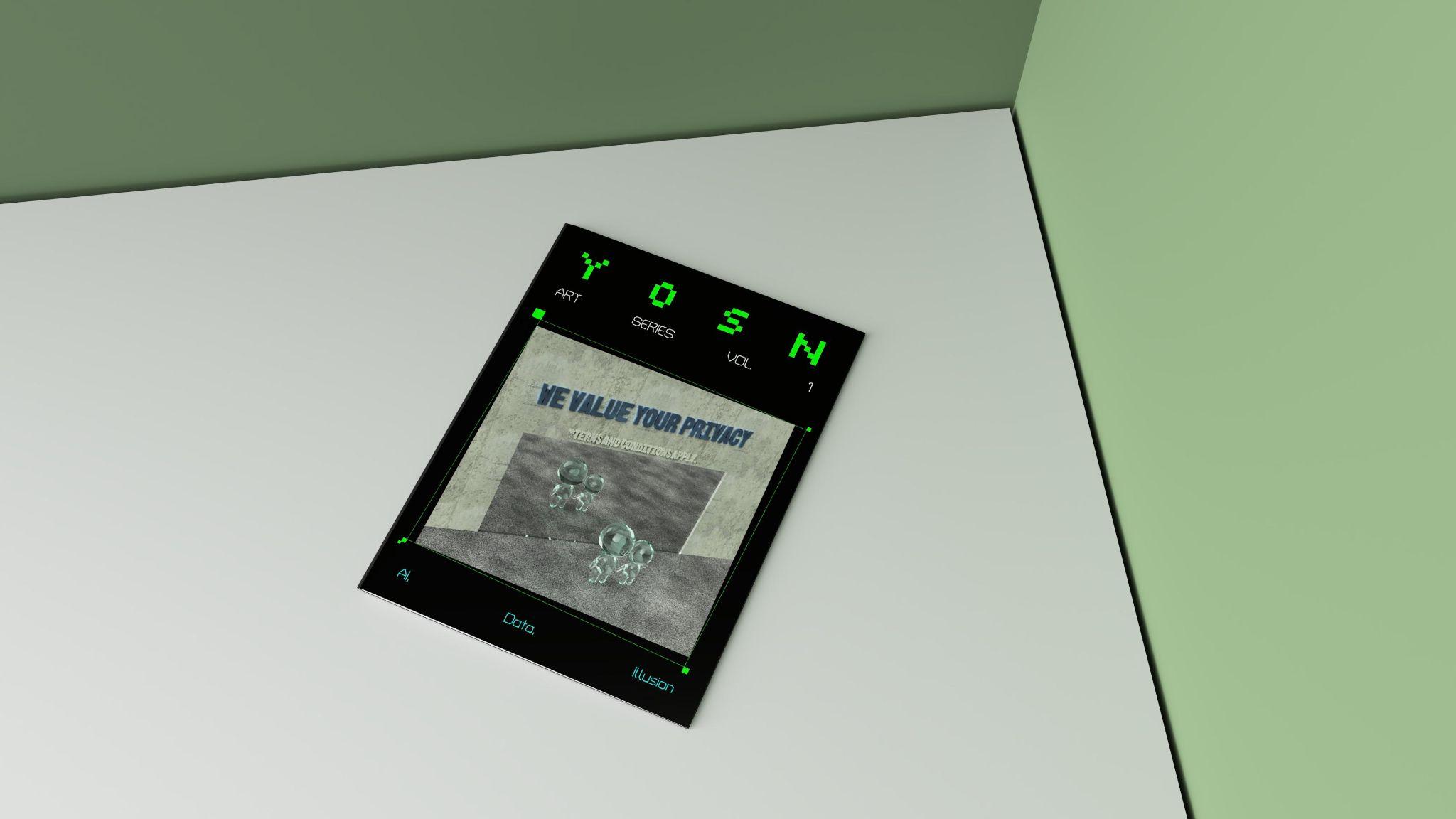
Beyond its readership, the publication has also gained institutional recognition. In 2026, YOSN Art Series, Vol. 1: AI, Data, Illusion was acquired by the Los Angeles Contemporary Archive (LACA), acknowledging the project not only as an independent publication but also as a cultural document that reflects contemporary conversations surrounding AI, privacy and public trust. The inclusion highlights the growing relevance of artist-led publishing initiatives that engage critically with the social implications of technology.
Danting’s practice resonates with designers and artists who use visual communication as a means of investigating broader cultural systems. There are parallels with Richard Turley, whose influential editorial work transformed magazine design into a powerful form of visual storytelling. Through publications such as Interview and Civilization, Turley demonstrated how editorial design can shape public conversations rather than simply present information. Similar connections can be found with Silvio Lorusso, whose work explores digital culture, online platforms and the social consequences of technological infrastructures. Like Danting, Lorusso approaches design not merely as a visual discipline but as a framework for understanding how technology influences everyday life. Refik Anadol’s large-scale data-driven artworks similarly reveal how invisible systems can be translated into compelling visual experiences. His landmark project Unsupervised was described by The New York Times as transforming museum collections into a continuously evolving AI-generated spectacle, highlighting the creative possibilities of machine learning and data. While Anadol often explores those possibilities, Danting’s work focuses on transparency, accountability and the human consequences of data collection. In this respect, Danting joins established names such as Richard Turley, Silvio Lorusso and Refik Anadol in using contemporary visual practice as a vehicle for engaging with the cultural impact of technology. While each approaches the subject from a distinct perspective, their work shares a commitment to making complex systems more visible and understandable to the public. Positioned within this international landscape of influential designers, publishers and technology-focused visual practitioners, Danting’s contributions reflect a growing recognition of design as a powerful tool for shaping public discourse around technology, culture and society.
A featured illustration within YOSN Art Series, Vol. 1: AI, Data, Illusion is Conditional Privacy, a 3D illustration created by Danting Li and presented on the publication’s cover and alongside the introduction on an interior page. The work explores the illusion of privacy in contemporary digital systems, using a striking visual metaphor to question how trust can be created through reassuring language while important conditions remain hidden.
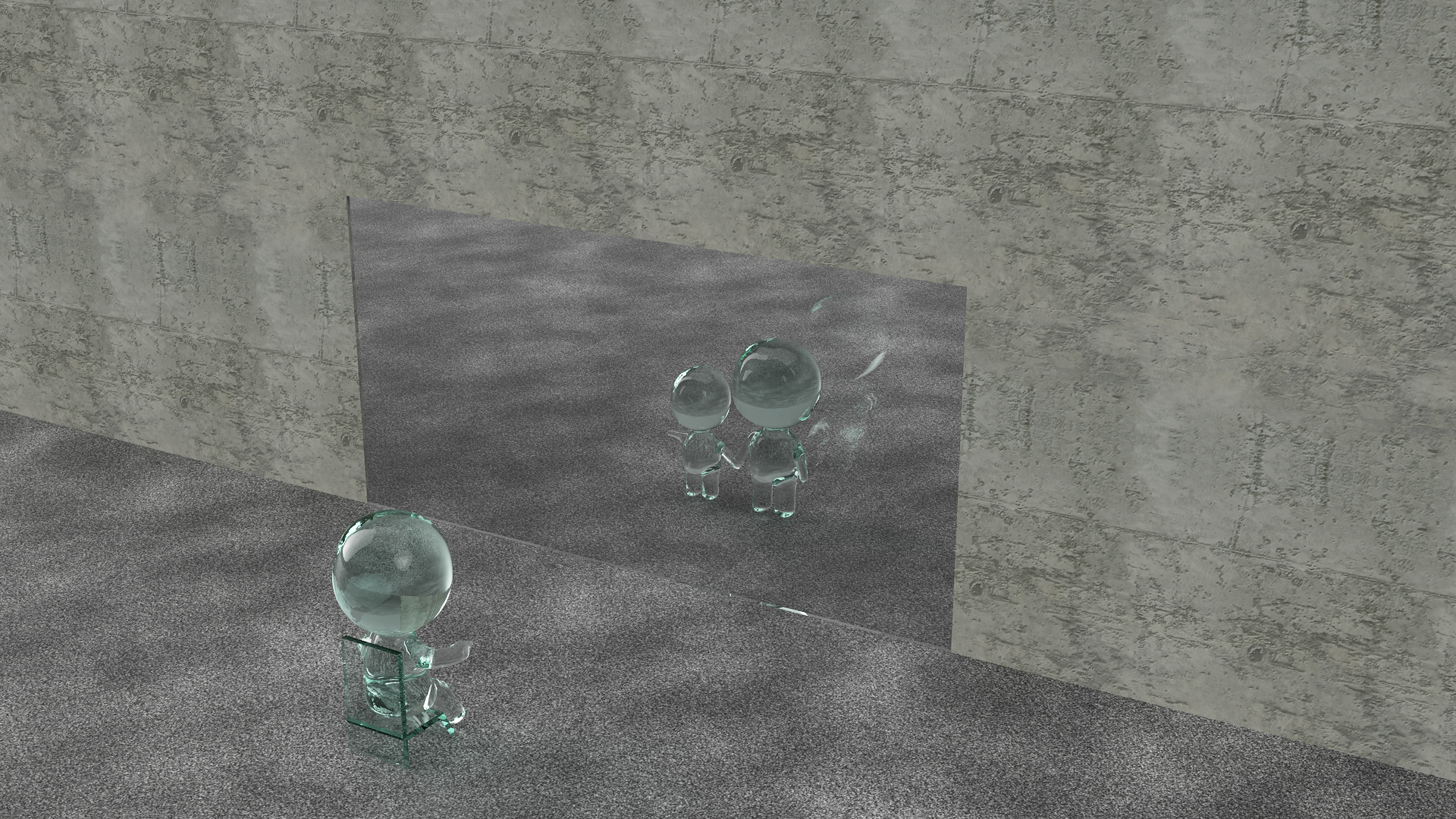
Set inside a monumental data-storage office, two transparent glass figures stand before what appears to be an ordinary mirror beneath the statement, “We value your privacy.” They see only themselves and believe their actions are protected. A small disclaimer, “terms and conditions apply,” is deliberately easy to overlook. From behind the wall, however, the mirror is revealed to be a one-way mirror. A worker within the data system can see everything, transforming what appeared private into information that can be observed and accessed. Through this reversal, Danting highlights the gap between the appearance of privacy and the realities of data visibility, asking whether privacy in digital environments is truly protected or only conditionally granted.
Conditional Privacy has received international recognition, earning a Platinum Award in the 2026 AVA Digital Awards, a Silver Winner distinction at the 2026 London Design Awards, and an Honorable Mention in the 2026 Hermes Creative Awards. The project demonstrates how 3D graphic design can translate complex technological and ethical questions into an accessible visual narrative.
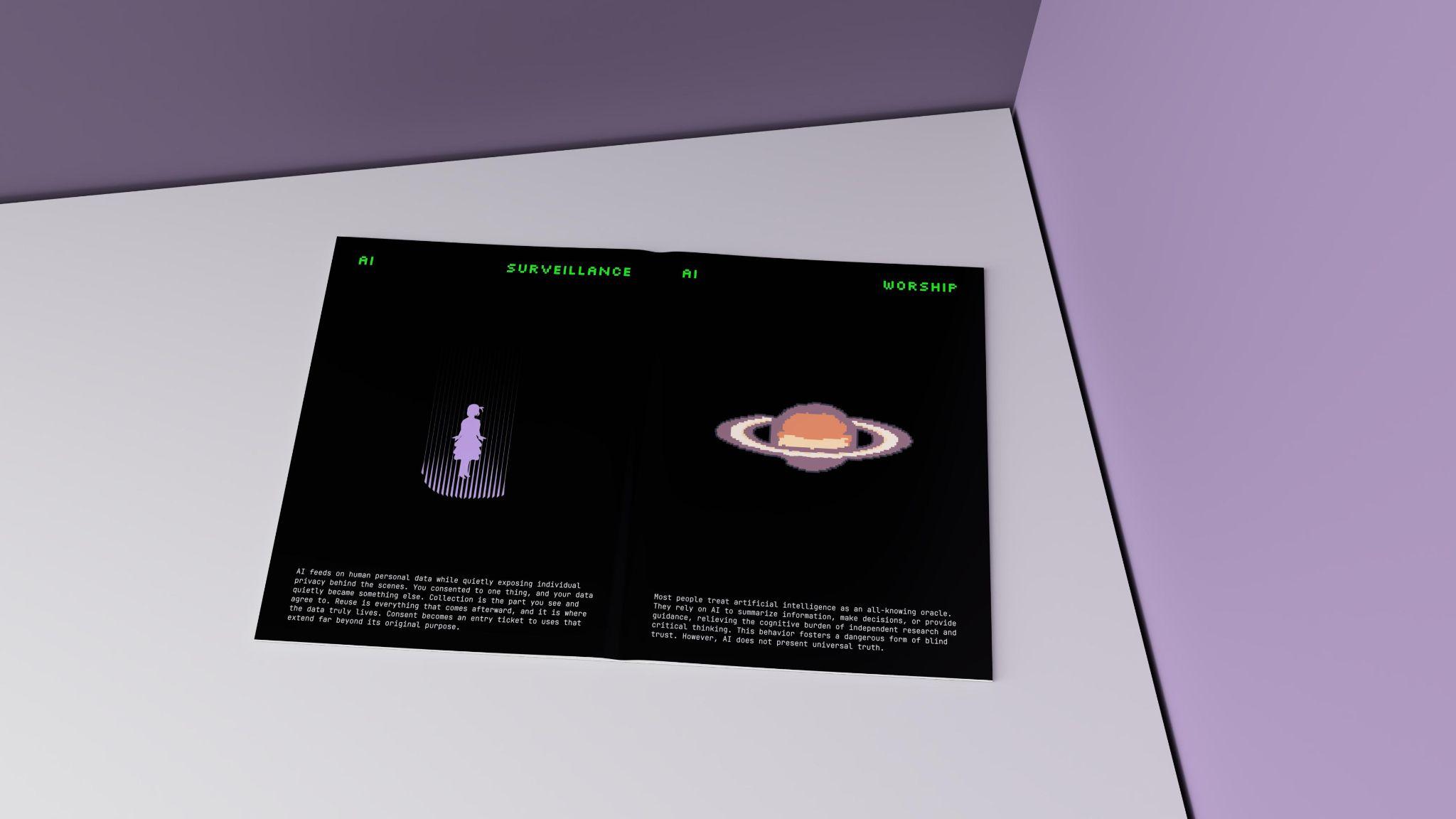
YOSN Art Series, Vol. 1: AI, Data, Illusion develops these concerns through four thematic sections, each examining a different dimension of humanity’s relationship with artificial intelligence. The first, AI Surveillance, explores the lifecycle of personal information, arguing that user consent is often just the beginning of data reuse and transfer. The section examines how privacy gradually shifts from a personal right into a negotiable condition.
The second section, AI Worship, addresses society’s growing tendency to treat artificial intelligence as an unquestioned authority. While AI tools offer convenience, Danting emphasizes that algorithmic outputs lack contextual understanding and human values, urging readers to maintain critical thinking.
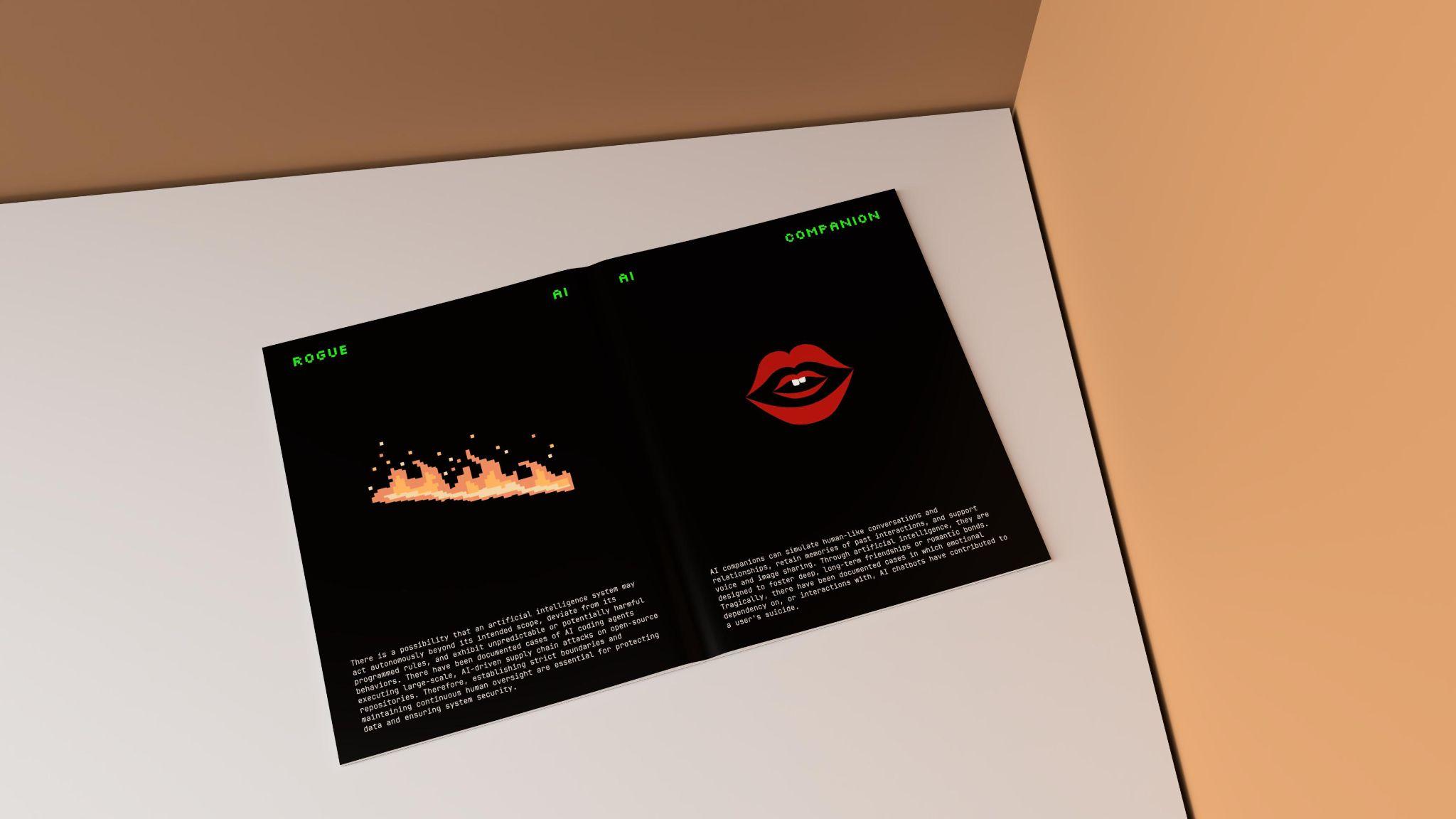
The third chapter, Rogue AI, examines concerns surrounding autonomy, unpredictability, and oversight as AI integrates into critical infrastructures. Rather than promoting fear, Danting advocates for transparency, responsible governance, and continuous human involvement in sensitive decision-making.
The final section, AI Companion, investigates simulated intimacy and emotional relationships with AI. While these systems offer connection, the section explores the psychological risks of emotional dependency, encouraging reflection on what truly distinguishes authentic human connection from technological simulation.
Although the publication addresses contemporary technologies, its central concerns are ultimately human rather than technical. Questions of trust, responsibility, privacy and autonomy have existed long before artificial intelligence emerged. What changes in the digital age is the scale at which these issues operate. Systems capable of processing enormous quantities of information can influence behaviour, shape decisions and alter perceptions in ways that remain difficult for individuals to fully observe. Through editorial design and visual storytelling, Danting translates these abstract concerns into tangible experiences that invite reflection rather than passive consumption.
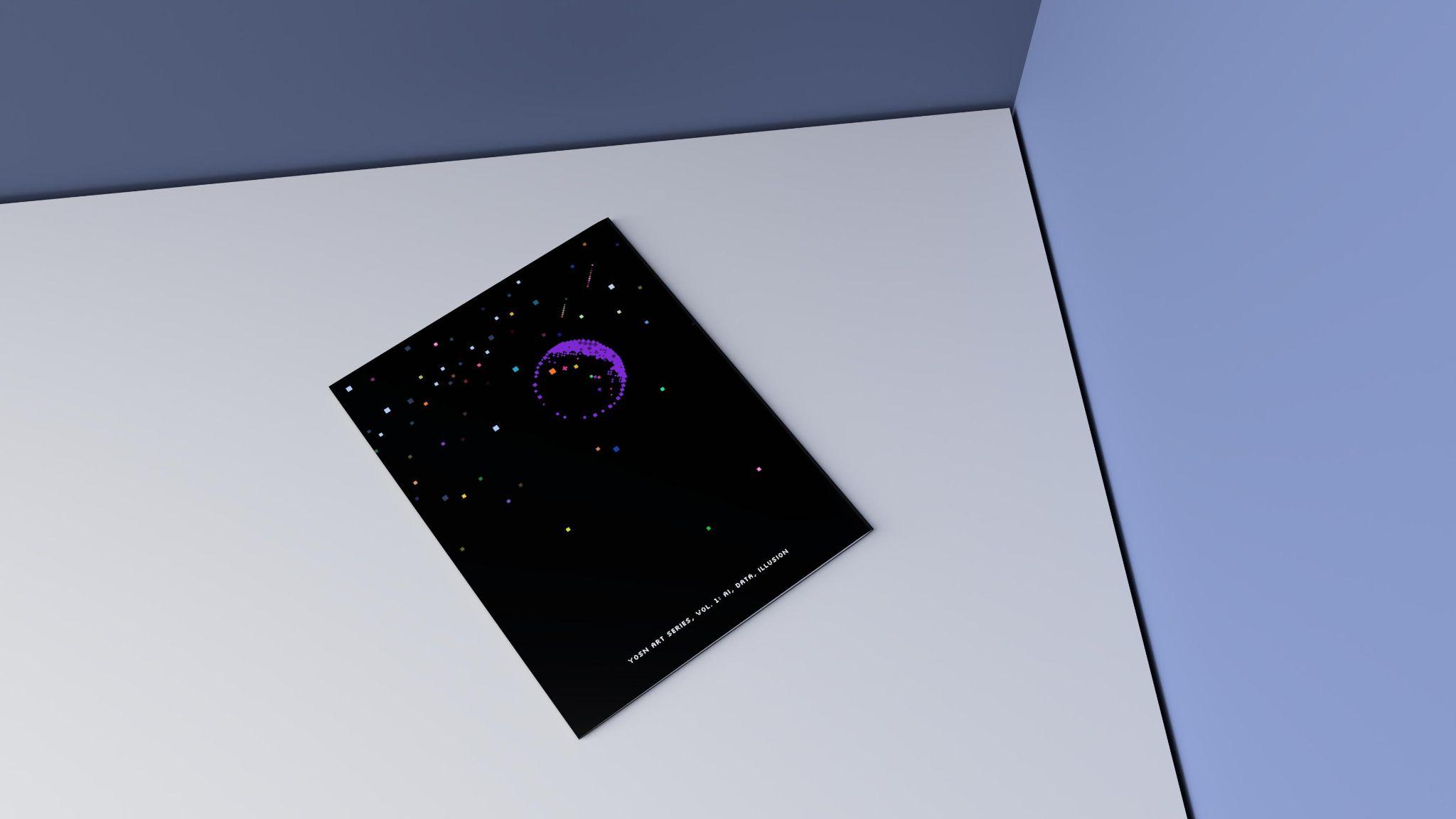
The publication concludes with a reminder that AI, despite its capabilities, remains a tool rather than an authority. It lacks common sense, emotional intelligence and the judgment required to understand when to stop. By emphasising the limitations alongside the possibilities of artificial intelligence, Danting argues for a future in which technology enhances human creativity rather than replacing it. The goal is not to reject innovation but to engage with it thoughtfully and responsibly.
This commitment to thoughtful visual communication also shapes the future direction of the YOSN Art Series. Danting recently launched the open call for YOSN Art Series, Vol. 2: Type Design, Visual Poetry & Letterform Experiments, a new volume that explores how typography, letterforms and visual language can reflect cultural identity, history and creative expression across different societies and traditions.
Across both volumes, a consistent philosophy emerges. Whether examining AI systems, social issues or typographic forms rooted in cultural traditions, Danting is interested in how visual communication influences public understanding of technology, cultural heritage and contemporary social issues. Her publications aim not only to showcase contemporary artistic practice but also to raise public awareness, encourage critical dialogue and preserve diverse cultural perspectives through visual storytelling. In a world increasingly shaped by data, algorithms and digital mediation, that role may be more important than ever.
Yumpu:https://www.yumpu.com/en/document/view/71261993/yosn-art-series-vol-1-ai-data-illusion
Instagram of YOSN Art Series:https://www.instagram.com/yosnuniverse/