A Producer Between Worlds
Anqi Chen is a Los Angeles–based producer whose career moves between intimate festival films, Asian and Asian diasporic storytelling, and the fast-paced demands of commercial scripted entertainment. Born in China and trained in the United States, Chen’s practice is defined by a cross-cultural sensibility — a capacity to steward stories rooted in particular communities while shaping them for international audiences. She earned an MFA in Creative Producing from Columbia University School of the Arts, where she developed story work alongside practical skills in budgeting, scheduling and production strategy.
Still Water (Si Shui): Intimacy, Grief and Cross-Border Production
One of Chen’s most visible recent projects is Still Water (Si Shui), an independent film officially selected for the New York Asian Film Festival. The film’s logline captures its central tension: After an earthquake, nanny Xi returns to Chengdu, believing her employer’s pregnancy carries her sister’s reincarnation, while developing complex feelings for the woman who employs her. Centered on a female same-sex relationship, the film examines queer intimacy alongside grief, marriage, reproductive pressure, family expectations, women’s autonomy and the emotional negotiations that arise within social and cultural systems.
Chen’s producing role on Still Water (Si Shui) involved the practical complexities of cross-border production. Shot on location in Chengdu, the project required Chen and the production team to travel back to China to collaborate with local crews, manage location logistics, and navigate cultural context and communication across production systems. Those operational choices were essential to preserving the film’s cultural specificity while preparing it for international festival visibility.
Beyond its selection at the New York Asian Film Festival, Still Water (Si Shui) screened at the 38th Miloš Forman / Mike Hausman Columbia University Film Festival (CUFF), where it received an Audience Award. The CUFF recognition — separate from the NYAFF selection — underscored the film’s emotional resonance and its ability to connect a culturally specific Chinese story with a broader international audience.

OYOT: Family Memory and Diasporic Distance
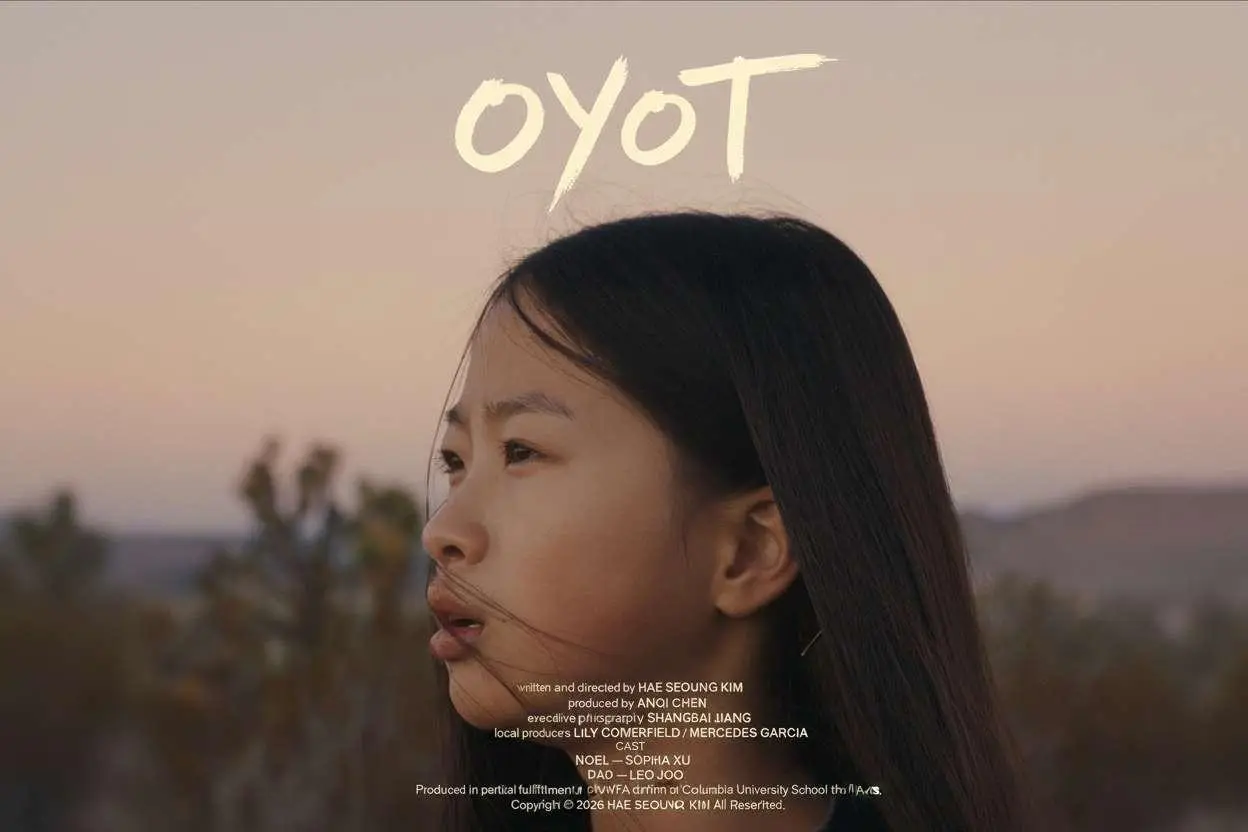
Another project in Chen’s portfolio is OYOT, a short film that follows a Korean American girl traveling through the desert to visit her father. The story grew from a fragment in a family diary tied to the director’s extended family history; Chen contributed to the project’s development and production strategy, helping translate that personal family memory into a concise cinematic form that emphasizes distance, inheritance, family and belonging. Like Still Water (Si Shui), OYOT screened through Columbia University’s festival programming and reflects Chen’s continued interest in Asian and Asian diasporic narratives shaped by memory and migration.
The broader family diary that inspired OYOT has prompted conversations about a possible larger adaptation. Those discussions remain exploratory rather than formalized — a reminder that Chen’s producing practice often involves nurturing short-form projects as they evolve without presenting early-stage ideas as guaranteed feature developments.
Across Formats: Festival Films and Vertical Drama
Chen moves between slow-burn festival films and the rapid cadence of digital-first, vertical dramas. Her credits include work as a Producer, Line Producer and Unit Production Manager on projects such as America’s Favorite Ex-Husband, Sleep With Me, Mortal!, Ride or Die Billionaire, and Swiftly Racing Girl. Those credits reflect a producing practice that is as attentive to creative detail as it is to production mechanics: budgeting, scheduling, crew coordination, on-set logistics and rapid delivery timelines for mobile‑first audiences.
Vertical drama and mobile-first distribution demand tight turnaround, compressed storytelling and rigorous production discipline. Chen’s experience across both spheres demonstrates an ability to translate intimate, culturally specific material for festival contexts while executing the operational systems needed to deliver polished, fast-turn content for global digital platforms.
Producing as Cultural Translation and Stewardship
What distinguishes Chen’s work is how practical production leadership serves artistic ends. Her Columbia training underpins a methodical approach: developing story and budget in tandem, anticipating logistical friction points, and creating conditions on set that protect a film’s emotional core. At the same time, her cross-cultural background — rooted in China and practiced in the United States — positions her to act as a translator between languages, production systems and expectations.
Rather than foregrounding the producer as a purely managerial figure, Chen’s career illuminates a contemporary role that blends creative collaboration, cultural sensitivity and operational problem‑solving. Her projects—particularly Still Water (Si Shui) and OYOT—signal a continuing commitment to independent cinema exploring queer intimacy, gender, family, and social expectation, while her commercial credits attest to a capacity for scaling production across platforms.
As festival cinema, diasporic storytelling and digital entertainment continue to intersect, Chen is building a body of work that connects culturally specific Asian stories with broader audiences. Her practice models a form of producing that privileges both artistic fidelity and disciplined execution, helping local stories find larger, international voices.