


Chronic kidney disease can raise concerns about long-term health, especially when kidney function has already declined.
For people diagnosed at this stage, questions about prognosis, disease progression, and future health often become a major concern.
This blog explains what research says about stage 3 kidney disease life expectancy, how doctors assess risk, and what can affect long-term outcomes.
What is Stage 3 Kidney Disease Life Expectancy?
There is no fixed life expectancy for stage 3 kidney disease.
Some people live for many years or even decades, especially when kidney function stays stable and other health conditions are well managed.
Research in the NIH database shows that life expectancy generally falls as eGFR decreases.
These figures are population estimates, not personal predictions. Age, kidney function, urine protein, and other health conditions can significantly affect individual outcomes.
For example: A 40-year-old man with an eGFR of 45-59 had an estimated 24.5 years of remaining life, compared with 14.5 years at an eGFR of 30-44.
What Does Stage 3 Kidney Disease Mean?
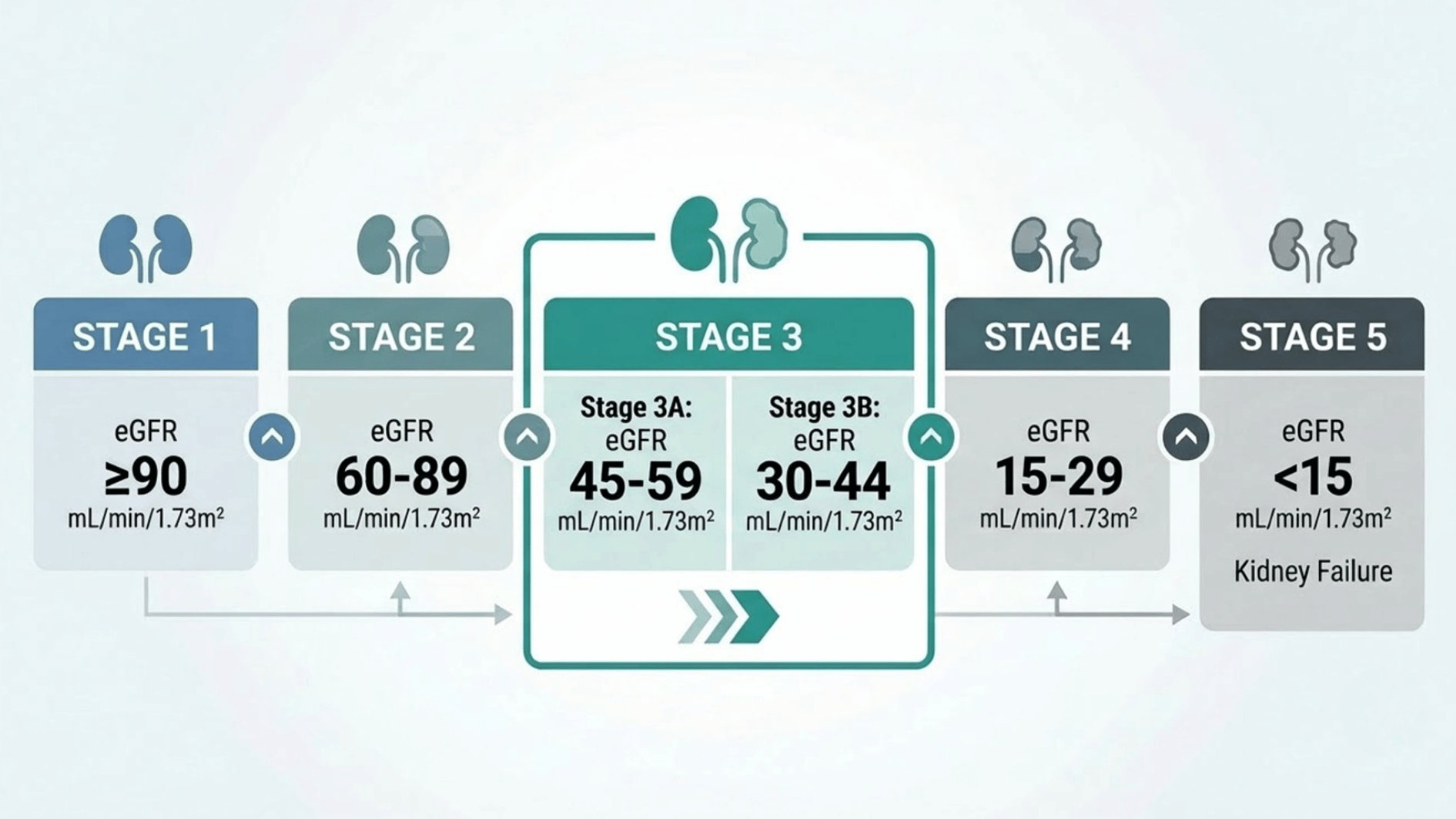
Stage 3 chronic kidney disease (CKD) means kidney function has declined to an eGFR between 30 and 59 mL/min/1.73 m² for at least three months.
It is divided into stage 3A and stage 3B, with health risks generally increasing as kidney function declines.
Stage 3A Kidney Disease
- eGFR range: 45 to 59 mL/min/1.73 m²
- Kidney function: mildly to moderately reduced
- Symptoms: often none, though some people notice tiredness, swelling, or changes in urination
Stage 3B Kidney Disease
- eGFR range: 30 to 44 mL/min/1.73 m²
- Kidney function: lower than stage 3A
- Symptoms: higher chance of anemia, heart disease, and bone or mineral problems, especially with high urine albumin
What Factors Affect Life Expectancy With Stage 3 Kidney Disease?
A stage number gives only part of the prognosis. Doctors look at several health factors together to estimate the risk of kidney failure, heart problems, and other complications.
1. Age
Younger people usually have more remaining years than older people with the same eGFR. Kidney function also tends to decline more slowly in younger adults, widening the gap.
A 40-year-old and a 75-year-old with identical lab results can still have very different outlooks.
2. Overall Health
Frailty, smoking, obesity, infections, and other chronic illnesses can affect survival and treatment choices.
A person managing several of these at once often needs closer monitoring than someone with stage 3 CKD alone. Nutrition and activity levels matter too, since muscle loss can make recovery from complications harder.
3. Underlying Trigger
The underlying cause of kidney disease shapes how it behaves over time.
Polycystic kidney disease and lupus nephritis can progress faster than typical CKD and often need closer nephrology follow-up from an earlier stage.
Identifying the exact cause also guides treatment, since a drug that helps diabetes-related kidney damage will not necessarily help an inherited condition.
4. Diabetes
Poorly controlled diabetes can speed up kidney damage and increase the risk of CKD progression.
Keeping blood sugar within the target range is one of the most effective ways to protect remaining kidney function. Even small day-to-day improvements in control can add up over time.
5. High Blood Pressure
Uncontrolled blood pressure can put extra strain on the kidneys and lead to further loss of kidney function. The relationship works both ways: reduced kidney function also makes blood pressure harder to control.
This is why blood pressure checks matter as much as kidney tests once you reach stage 3.
6. Heart Disease
CKD raises heart disease risk, which can have a major effect on overall life expectancy.
Most people with stage 3 kidney disease are more likely to die from a heart-related cause than from kidney failure itself. This is why doctors often track cholesterol and cardiovascular risk factors alongside kidney function.
What is the Creatinine Level for Stage 3 Kidney Disease?
The creatinine level for stage 3 kidney disease depends on age, sex, and muscle mass, so there is no single normal number. According to SiPhox Health, doctors always pair creatinine with an eGFR test rather than relying on it alone.
- Typical stage 3 range: 1.3 to 3.0 mg/dL
- Normal range, women: 0.6 to 1.1 mg/dL
- Normal range, men: 0.7 to 1.3 mg/dL
- Stage 3A: tends toward the lower end of the range
- Stage 3B: tends toward the higher end of the range
Is Stage 3 Kidney Disease Serious?
Yes, stage 3 CKD is clinically significant, as a 2010 systematic review pooled 13 studies covering more than 728,000 people.
It found all-cause mortality ranging from 6 percent at 3 years to 51 percent at 10 years, and risk was consistently higher in stage 3B than stage 3A.
Serious does not mean kidney failure is close. The extra risk of death was small for stage 3A. It was much greater for stage 3B. Kidney failure itself was a rare outcome even after 10 years of follow-up.
Reduced kidney function still raises the risk of high blood pressure, anemia, fluid buildup, and bone or mineral problems.
The National Kidney Foundation looks at eGFR together with urine albumin. This combination shows how serious a case is and whether it is likely to get worse.
Does Stage 3 Kidney Disease Always Progress?
No, it does not always get worse. Kidney failure is rare, and markers that raise risk.
- Kidney failure by 10 years: about 4 percent of people
- Stage worsening by 5 years: fewer than 1 in 5 patients
- Higher risk signals: falling eGFR, rising urine albumin, or uncontrolled diabetes and blood pressure
- Single test results: doctors look for a pattern across repeat tests, not one unusual reading
Can Stage 3 Kidney Disease Be Slowed Down?
Yes, treatment can help protect remaining kidney function and reduce cardiovascular risk. Managing blood pressure and blood sugar is especially important.
Depending on lab results, doctors may prescribe ACE inhibitors, ARBs, or SGLT2 inhibitors. Limiting sodium, avoiding smoking, and checking before using pain relievers or supplements can also protect the kidneys.
Regular eGFR and urine albumin tests help track kidney function and show whether the treatment plan is working over time.
The Bottom Line
A stage 3 diagnosis is not a countdown. It signals you to pay closer attention, not a verdict on how long you will live.
The biggest lever you have is consistency. Steady blood pressure, steady blood sugar, and regular lab work do more for your outlook than the stage label on your chart.
Talk to your doctor about your own eGFR and creatinine trend, and build a monitoring plan around what your numbers are actually doing over time.
Frequently Asked Question
How Often Should You Get Tested With Stage 3 Kidney Disease?
Most doctors recommend checking eGFR and urine albumin every 3 to 6 months at stage 3, though frequency depends on how stable your numbers have been.
Can Diet Alone Slow Stage 3 Kidney Disease?
Diet helps but rarely works alone. A kidney-friendly diet supports blood pressure and blood sugar control, but it works best alongside medication, not as a replacement for it.
Should You See a Nephrologist for Stage 3 Kidney Disease?
Many people are managed by their primary doctor at 3A. A nephrologist referral becomes more common at 3B or if albumin levels or eGFR keep worsening.