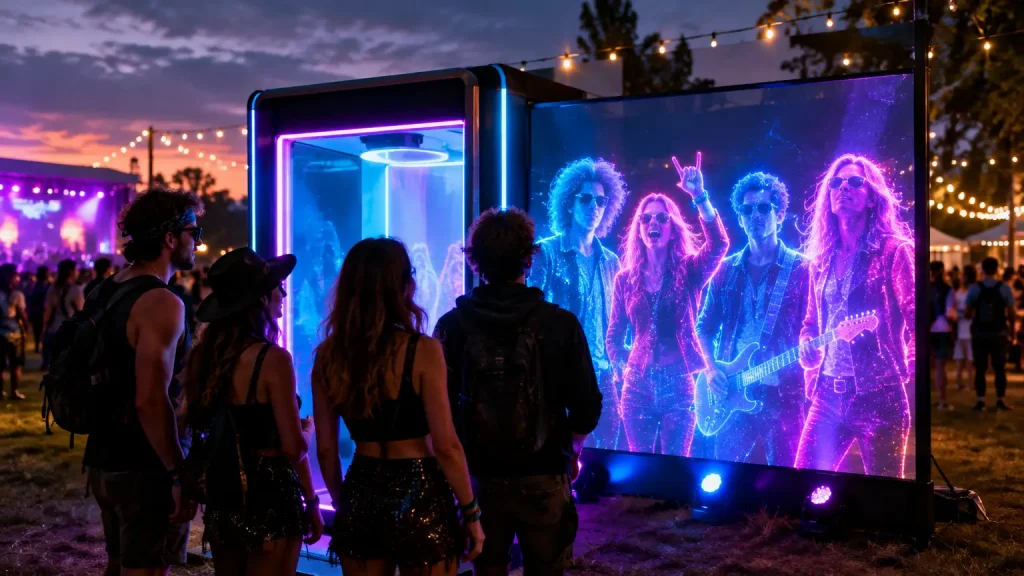
Imagine wandering through a music festival and stumbling across a photo booth that promises to turn you into a rock star.
You step inside, pose for a photograph and seconds later discover yourself on the cover of a fictional album, dressed in an outrageous stage outfit, surrounded by dramatic lighting.
Your friends are laughing. Someone immediately sends the picture to the group chat. Before long, you’re all planning another attempt.
You haven’t seen a single band yet, but you’ve already made a memory.
This is where artificial intelligence and interactive technology are becoming interesting additions to the festival experience. Not as replacements for the music, but as unexpected attractions that allow audiences to become part of the entertainment.
And some of the most imaginative possibilities are happening away from the main stage.
When the Audience Becomes Part of the Performance
Live music has always encouraged participation. From crowd singalongs to enormous festival mosh pits, the relationship between performers and audiences is rarely one-sided.
Interactive technology takes that idea in another direction.
Back in 2014, Gigwise reported on a Bastille performance featuring an interactive dance floor where audience participation helped direct the visual experience.
It was an early example of something event designers continue to explore. What happens when the crowd can influence the spectacle rather than simply watch it?
Today, motion sensors, responsive projections and digital installations offer different ways to experiment with that relationship.
Imagine dancing in front of a screen that responds to your movements, changing colours and patterns as you move. Or walking into an installation where several visitors must interact to create a complete visual sequence.
The experience becomes a collaboration, even between people who have never met.
And at a festival, where strangers regularly bond over a shared love of music, that feels surprisingly appropriate.
AI Photo Booths Are Reinventing the Festival Souvenir
There was something charming about old-fashioned photo booths.
Four friends would squeeze into a tiny space, someone would inevitably blink, and the resulting photographs would end up pinned to a bedroom wall or tucked inside a wallet.
The pictures weren’t particularly glamorous. That was half the appeal.
Artificial intelligence is now introducing a more imaginative version of that experience.
Turning Festivalgoers Into Album-Cover Stars
Modern AI photography can use a guest’s image to create a themed portrait, changing their outfit, surroundings and overall visual style.
At a rock festival, visitors could be transformed into fictional heavy metal musicians. At an electronic music event, they might appear in futuristic neon environments. A retro-themed weekend could offer photographs inspired by vintage record sleeves.
These are creative possibilities rather than features found at every festival, but they illustrate how easily the concept can be adapted to different musical identities.
For organisers considering this kind of attraction, AI photo booth software can provide the tools needed to transform guest photographs into themed digital artwork.
The appeal isn’t just receiving an unusual picture.
It’s watching something familiar, your own face, become part of an unexpected creative scene.
Why the Unexpected Is So Shareable
Think about the photographs people take at festivals.
There are usually hundreds of stage pictures, dozens of group selfies and at least one photograph of someone asleep in a camping chair.
Most capture moments as they happened.
AI photography offers something different. It creates an image that could never have existed without the technology.
A group of friends can become an imaginary band. A festivalgoer can appear in a science-fiction landscape. An ordinary photograph becomes a playful souvenir with its own story.
That personal element helps explain why interactive photo experiences fit naturally into events designed around creativity and self-expression.
Interactive Technology Goes Beyond Photography
AI-generated pictures are only one piece of the puzzle.
Other technologies can change how people interact with the physical festival environment.
Augmented reality, for example, can place digital objects or animations over someone’s view of the real world, often through a smartphone.
Motion-responsive installations work differently. They use sensors or cameras to detect movement and adjust visuals, lighting or sound accordingly.
Neither necessarily requires artificial intelligence, an important distinction when so many technological experiences are casually described as AI-powered.
What Could These Experiences Look Like?
|
Technology |
Festival application |
Audience experience |
|
AI image generation |
Personalised album-cover portraits |
Become part of a fictional music world |
|
Augmented reality |
Digital artwork appearing around festival landmarks |
Discover hidden visual experiences |
|
Motion tracking |
Visual projections responding to dancing |
Influence the artwork through movement |
|
Interactive lighting |
Illuminated spaces reacting to visitors |
Create a shared visual performance |
|
Spatial audio |
Sound installations surrounding listeners |
Experience music from different directions |
What makes these ideas interesting isn’t necessarily their technical complexity.
It’s the possibility of giving festivalgoers an experience they couldn’t get simply by watching a video online.
The Festival Experience Now Lives Beyond the Festival
A brilliant festival moment used to belong mainly to the people who witnessed it.
Today, a short video can reach friends who couldn’t attend, spark conversations online or become a treasured reminder of the weekend.
This creates opportunities for interactive attractions, particularly when the results are easy to save and share.
But there’s an important difference between creating something memorable and creating something that merely encourages social media activity.
A photograph covered in enormous sponsor logos might serve a marketing purpose without being particularly appealing to the person receiving it.
A personalised image that makes someone laugh, however, has a reason to exist beyond advertising.
That’s why the creative execution matters.
Event technology providers such as Snappic offer AI-powered photography experiences that organisers can adapt to different themes, helping turn a familiar festival photo opportunity into something more personal.
When the experience feels entertaining rather than promotional, sharing can become a natural consequence.
What Happens When Technology Meets a Muddy Festival Field?
It’s easy to imagine futuristic installations working perfectly in promotional videos.
A real festival is considerably less predictable.
There are queues, unreliable internet connections, unpredictable weather and thousands of people trying to squeeze as much enjoyment as possible into a limited amount of time.
An impressive AI photo experience quickly loses its charm if visitors spend half an hour waiting for their turn.
Likewise, an augmented reality attraction may struggle to engage people if it requires several complicated steps before anything interesting happens.
For organisers, a few practical details can make an enormous difference.
- Keep participation simple. Visitors should understand the experience quickly, preferably without needing detailed instructions.
- Consider waiting times. Fast photography sessions and straightforward digital delivery can help avoid bottlenecks.
- Make accessibility part of the design. Interactive attractions should consider people with different mobility, sensory and accessibility requirements.
- Be clear about personal data. Guests should know how their photographs will be processed, stored and shared, particularly when AI tools are involved.
These details aren’t glamorous, but they determine whether a clever idea becomes a festival highlight or an attraction people walk straight past.
Can Technology Make Festivals Feel More Human?
It sounds contradictory.
We’re talking about artificial intelligence, digital effects and computer-generated imagery, yet some of their most appealing applications revolve around ordinary human connections.
A group of strangers collaborating on an interactive artwork. Friends laughing at their ridiculous AI-generated band portraits. Two people discovering an installation together while sheltering from the rain.
The technology provides the opportunity, but the people create the memory.
And perhaps that’s the most useful way to think about its role in live music.
Festivalgoers don’t necessarily need more screens, more notifications or more complicated gadgets. They need experiences that feel worth leaving the house for.
Technology succeeds when it adds something to the atmosphere without demanding that everyone stop enjoying themselves to appreciate it.
The Future of Festivals Still Starts With the Music
No amount of artificial intelligence can reproduce the feeling of hearing a favourite song performed live, surrounded by thousands of people singing every word.
And it shouldn’t try.
The most exciting applications of interactive technology aren’t attempting to replace that experience. They’re finding creative things to do around it.
A personalised photograph between sets. An installation that turns movement into art. A strange digital encounter that becomes the story everyone tells on the journey home.
These additions give festivalgoers more opportunities to participate in the world surrounding the performances.
Because long after the wristband has faded and the camping equipment has been packed away, people rarely remember the technology behind their favourite moments.
They remember who they were with, what made them laugh and how it felt to be there.
If technology can contribute to those memories, it has earned its place at the festival.