
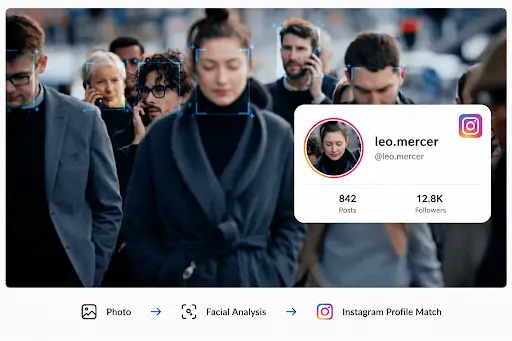
Locating a person on Instagram is usually simple when you already recognise their username, full name, or other identifying info. But the procedure will become much more difficult when all you’ve got is a picture. You could have a vintage image, a screenshot, or a photo saved from some other platform, even as the individual’s Instagram username stays unknown.
This is where image-based search techniques can end up useful. As opposed to depending absolutely on key phrases, you can begin with the picture itself and use tools designed to examine visible statistics. An Instagram opposite picture seek permit you to look at whether or not a specific photo, or probably the same face in another image, appears throughout Instagram-related results.
Why Searching Instagram by Photo Can Be Difficult
Instagram’s search feature is in most cases designed around text. Users can search for usernames, names, hashtags, locations, and other phrases; however, there’s no conventional Instagram search container wherein you could, without a doubt, upload a photograph and receive a matching profile.
This creates a hassle when you do not know the individual’s username.
For example, imagine that you have a photo of someone you met at an occasion. You don’t forget what they look like; however, you don’t know their Instagram handle. Looking through hundreds of accounts manually would be impractical. Even if you recognize their first name, the results might also comprise masses of humans with comparable names.
A photograph provides every other starting point. In preference to guessing keywords, you can use the visible facts contained within the photograph.
What Is an Instagram Reverse Image Search?
An Instagram reverse image search is a method that starts off with a photograph instead of a textual content query. Depending on the technology being used, the query may additionally search for the exact picture, visually similar pictures, or capability fits concerning facial characteristics.
Conventional reverse image search tools are particularly beneficial when you need to find out where a particular photograph has seemed on line. For instance, if someone has copied your photo and uploaded it someplace else, a picture search might also help you find other pages containing that picture.
For comparison, Google Search Help explains that image-based results from Google Lens can include similar images as well as websites containing the original or a similar image.
But finding the same character in a one-of-a-kind image calls for a distinct approach. The picture may additionally have been cropped, resized, filtered, or taken in a completely distinct environment.
When Can Searching by Image Be Useful?
There are several valid motives someone might need to go looking for the usage of a photograph.
One common scenario is reconnecting with someone. Possibly you have an old photo from school, university, a convention, or a social occasion; however not take into account the person’s username. An image-primarily based search can provide some other way to begin looking.
Another use is checking whether or not your personal snapshots are being reused. In case you suspect a person has copied your profile photograph or is using your image without permission, a reverse picture search allows you to inspect where comparable imagery appears online.
it could also be useful whilst verifying data to be had on public profiles. as an example, someone may use distinct photographs throughout social networks. Comparing publicly available pics can now and again monitor connections that are hard to discover via usernames alone.
Of course, a search result must not automatically be treated as proof that photos show the same character. Facial appearance can change, pictures can be deceptive, and automated matching systems could make mistakes. Any ability in shape must consequently be reviewed carefully.
How to Get Better Results From a Photo
The quality of the photo could have a vast effect on the usefulness of a photograph-based search. A clear photo in which the face is visible typically offers extra facts than a closely blurred or distant photograph.
If possible, select a picture in which the man or woman’s face within reason, large and unobstructed. Sunglasses, masks, severe angles, heavy filters, and terrible lighting fixtures could make visual evaluation greater tough.
Cropping can also help whilst the original photograph contains numerous humans. If the character you’re interested in is the most effective one in a collection, the usage of a clearer crop may additionally offer a better starting point.
But there’s no assurance that each photograph will produce a useful result. The supply of suitable public images is likewise a crucial thing.
Reverse Image Search vs. Regular Instagram Search
The most important distinction between the 2 techniques is the starting point.
With ordinary Instagram search, you usually begin with information consisting of a name, username, hashtag, or keyword. This works properly while you already understand something specific about the account.
With a photograph-primarily based search, the photo becomes the place to begin. This can be especially useful if you have very few facts about the individual or account.
As an example, attempting to find “Sarah” on Instagram may additionally produce an amazing number of results. Looking with an image rather can narrow the investigation to visual fits.
Face2social’s Instagram-targeted search workflow lets customers upload a photo and obtain a preview of viable matches before determining whether to reveal available account statistics. This could make the procedure extra handy for those who want a photograph initially rather than a username.
Where Face2social Fits Into an Instagram Reverse Image Search
When the goal is to find a potential Instagram profile rather than simply locate another copy of the same photograph, Face2social offers a more specialized approach. Instead of requiring a name or username, the search starts with a photo and uses facial recognition technology to look for possible matches across X, Facebook, Instagram, and TikTok.
The process is straightforward: upload a clear image containing the person’s face, and Face2social analyzes facial characteristics to search for potential matching profiles. The photo used on Instagram does not have to be identical to the uploaded image, which is particularly useful when someone uses different profile pictures across platforms or has changed their photo over time.
Face2social then provides a preview of possible matches, allowing the user to review the results before choosing whether to access the available profile information. This makes it a practical option when a photo is the main clue available and traditional Instagram searches based on names or usernames have not been enough.
Things to Keep in Mind
Reverse image and facial recognition technology are useful; however, they may no longer be the best identification systems. A capability match ought to usually be taken into consideration as a lead in preference to definitive proof.
The end result can be affected by the quality of the uploaded photograph, changes in a person’s appearance, digital camera angle, lighting fixtures, facial obstruction, and the supply of pictures for comparison.
Privacy is another important consideration. When searching for another character, customers have to respect relevant legal guidelines, platform rules, and privacy. Image search generation is primarily used for legitimate functions, along with finding your own content, reconnecting with humans, or checking publicly available data.
it’s also vital to avoid assuming that a visual fit robotically confirms someone’s identification. Human assessment and further context continue to be essential.
A Practical Way to Start
If you have a photograph but no Instagram username, begin by using selecting the clearest model of the photo to be had. Ensure the face is visible and keep away from useless cropping that gets rid of essential facial capabilities.
You can then try an Instagram reverse image search to see whether the image produces relevant results. If possible matches appear, review them carefully instead of immediately assuming that the first result is correct.
If the first search does not provide useful outcomes, recollect whether you have got another picture. A clearer, more recent, or extra front-facing image can also provide more information.
Conclusion
Locating an Instagram account from a picture is more complicated than searching for a username; however, photo-based technology affords an alternative place to begin. Traditional reverse image search may be useful for finding copies or appearances of the same picture, even as facial-seek era can take a specific approach by way of comparing facial characteristics across two photographs.
The most critical element is to treat seek consequences responsibly. Use clear photos, bear in mind multiple portions of records, and take into account that automatic matches are possibilities as opposed to assured identities.
For people who’ve had a photo and need to discover potential Instagram connections, an Instagram reverse image search can be a practical first step. Used thoughtfully and with appreciation for privacy, picture-based total search could make it simpler to research publicly available visible statistics without relying entirely on names or usernames.