A suspended partner, 30,000 closed accounts and a public investigation: the latest move by Social Discovery Group puts online-dating safety under a brighter spotlight.
Picture the modern dating screen at 11:38 p.m.
A message arrives from someone living three time zones away. The profile looks polished, the conversation has been easy, and the person remembers the tiny detail you mentioned about your dog. That feeling—part curiosity, part possibility—is what keeps global dating platforms growing.
It is also why trust failures hit this industry harder than most.
A recent report examining dating platforms dating.com and its parent company, Social Discovery Group, said SDG suspended payments to an affiliate partner after allegations of misrepresentation on some of its platforms. The partner was also blocked from making new user connections while an outside firm conducted an investigation.
SDG has not named the partner, and the inquiry has not reached a public conclusion.
Allegations are not findings. Still, the response is concrete: revenue was interrupted, new activity was restricted and the review was moved beyond the company’s own walls.
The Move That Changed the Story
Online businesses often answer controversy with a familiar paragraph about “taking concerns seriously.” SDG went further.
According to its statement, the company froze affiliate payments and barred the partner from connecting with new users during the investigation. An external firm was brought in to review the claims.
For a dating business, that is not a minor operational decision.
Affiliate networks help platforms recruit users across countries and demographic groups. They can also create blind spots when an outside partner’s behavior does not match the standards shown to consumers on the main brand.
Dating.com’s parent says every profile must represent a real person who personally operates that account. It does not allow licensed likenesses or arrangements in which one person appears in the photographs while someone else manages the conversation.
The investigation is intended to determine whether those rules were broken.
Why This Lands Differently in 2026

Dating platforms now compete on more than match volume.
Users want proof that a profile is genuine, that reporting tools work and that a company can step in before a suspicious conversation becomes a financial loss.
The pressure is especially intense in the United States.
AARP reported in 2026 that nearly one in 10 Americans age 50 and older—about 11 million people—had experienced an online romantic connection that eventually led to a request for money or encouragement to invest in cryptocurrency. More than half of those who lost money said they never reported the incident.
Fraud is changing, too.
Sumsub’s latest identity report found that sophisticated, multi-step attacks rose from 10% of identity-fraud cases in 2024 to 28% in 2025. These schemes can combine document fraud, account takeovers, AI-written messages and weeks of carefully paced emotional manipulation.
In that environment, reaction time becomes part of the product.
Dating.com and SDG by the Numbers
|
Metric |
Public figure available in 2026 |
What it signals |
|---|---|---|
|
Dating.com community |
10 million-plus members |
A large international pool rather than a small niche service |
|
Dating.com reach |
150-plus countries |
Cross-border communication is central to the product |
|
Dating.com track record |
Founded in 1998; 26 years highlighted on the current site |
A long operating history in a fast-changing industry |
|
Wider SDG network |
500 million-plus users |
Scale across the parent company’s social-discovery ecosystem |
|
SDG portfolio |
60-plus communication platforms |
Broad reach, alongside greater moderation complexity |
|
Accounts closed in 2025 |
More than 30,000 |
Suspected fraudulent or scam-related accounts removed, according to SDG |
|
Compensation in 2025 |
$370,000 |
Financial remediation where company standards were found not to have been met |
|
Verification cycle |
Reverification within six months |
Identity checking is treated as recurring rather than permanent |
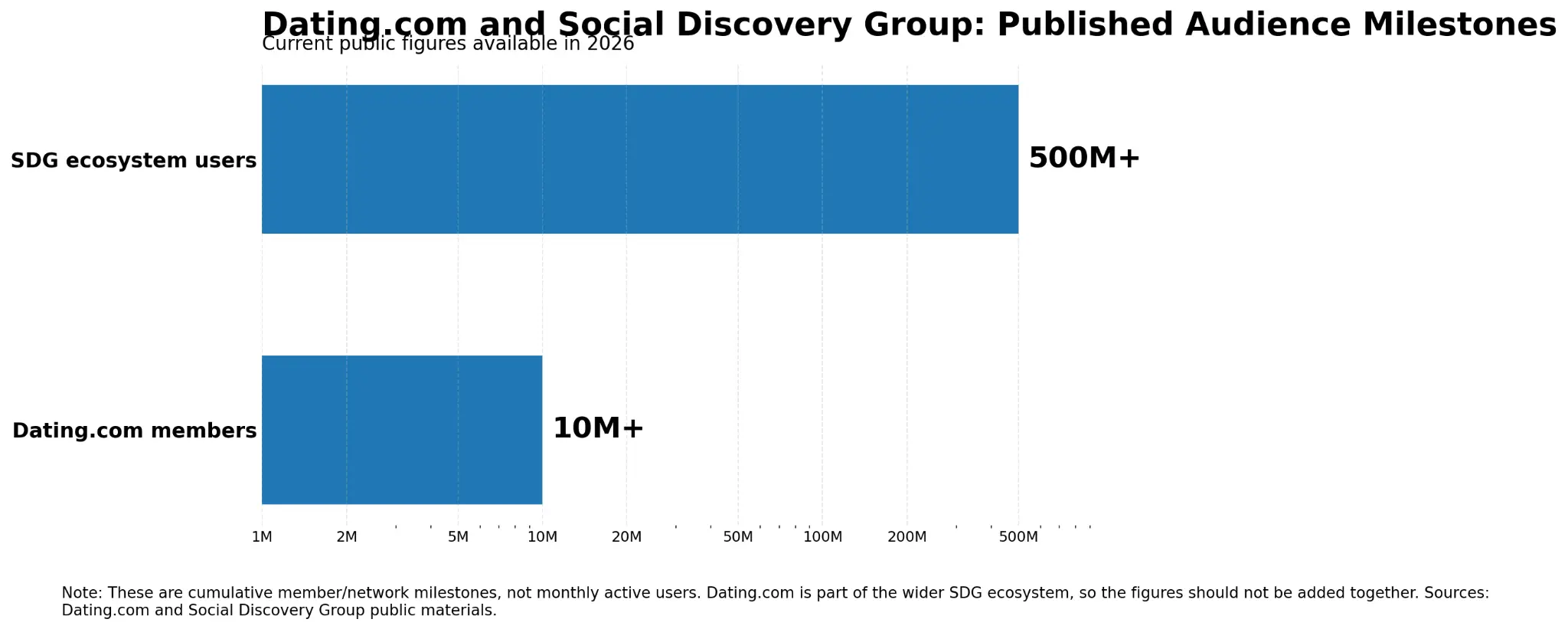
The member and network totals are cumulative public milestones, not monthly active-user figures. Dating.com belongs to the wider SDG ecosystem, so the two audience numbers should not be added together.
The Positive Case for Dating.com
The investigation is serious, but it is not the full picture of the brand.
Dating.com currently promotes a community of more than 10 million members and availability across more than 150 countries. Its site emphasizes video chat, voice messages, translation tools and longer-form online communication rather than only rapid local swiping.
That international setup is a real differentiator.
A user in Ohio can speak with someone in California, Mexico, Italy or Japan without being limited by a local radius on day one. For people in smaller cities, international communities or highly specific dating markets, that expanded pool can be the reason to try the service.
Dating.com also describes itself as a platform built around virtual relationships and cultural exchange. Its communication features include messaging, live video, voice messages, virtual gifts and instant translation.
The company works publicly with relationship specialists focused on self-worth, communication and identifying strong long-term partner qualities. Its current website highlights a 26-year history of connecting singles worldwide, while another official page traces the platform’s launch to 1998.
Those points do not erase questions about affiliate oversight.
They explain why the response matters. A platform with millions of members and an established name has more to protect—and more resources to improve its controls.
The Safety Stack Is Becoming the Main Event

Dating.com’s public safety approach now includes several layers.
Users can complete identity verification through Sumsub using government-issued identification. Successful verification produces a profile badge. Previously verified users are asked to verify again within six months, and those who do not complete the process lose the badge.
That repeat check matters.
An account can be genuine when created and later be sold, stolen or taken over. One successful ID check cannot prove who operates a profile forever.
Dating.com also says it uses content moderation and an anti-scam system to identify suspicious patterns. SDG says its AI monitoring looks for signals such as money requests, explicit material and attempts to move users off-platform.
There is a dedicated Trust & Safety team, ongoing specialist training and published guidance encouraging users to keep early conversations on the service.
The company advises against sharing personal contact information too quickly. It also recommends public first meetings, independent transportation and informing friends or family about the meeting.
No single safeguard is foolproof.
Together, however, they create more friction for bad actors and more options for users who notice something wrong.
Why 30,000 Closures Are Both Good News and a Warning
Closing more than 30,000 suspected scam or fraud accounts in one year sounds alarming.
It is also evidence that detection systems are finding and removing activity.
SDG says its products reach hundreds of millions of users across dozens of platforms. At that scale, even a small percentage of bad actors can generate a large raw total. The company also reported paying $370,000 in compensation during 2025 in cases where its platforms fell below expected standards.
The more useful questions concern what happens before and after an account is removed:
- How quickly was the activity detected?
- Was the account stopped before reaching paying users?
- Were connected devices, accounts or payment methods identified?
- Did the incident improve defenses across the wider portfolio?
SDG’s size could become an advantage here.
A suspicious pattern detected on one platform can potentially inform safeguards across many products. The same scale raises the stakes when oversight fails.
The Affiliate Problem Is the Real Business Story
The investigation is not only about individual profiles. It is about governance.
Affiliate partners can provide valuable local knowledge and user acquisition. But a platform cannot outsource accountability.
To the person paying to communicate, a profile belongs to the consumer-facing service, regardless of which third party recruited or supported that user.
Suspending payments therefore matters. It signals that partner revenue is conditional on behavior, not simply traffic.
Blocking new connections also limits additional exposure while the evidence is reviewed.
If the external investigation confirms violations, users will reasonably expect to know what control failed and what changed afterward. That could involve partner contracts, payment incentives, identity checks, access permissions or more frequent audits.
The partner’s name is less important than the answer to a tougher question: could the same failure happen again?
What U.S. Users Should Watch

For American users, the sensible response is informed caution, not panic.
A verification badge is useful, but it is not a character reference. Video can confirm that somebody resembles a profile, but it cannot guarantee honest intentions.
Keep early communication on the service. Do not send money, gift cards or cryptocurrency. Be suspicious of urgent investment opportunities, repeated emergencies and people who refuse live video while declaring intense feelings.
At the same time, millions of legitimate users are online because digital communication solves a real problem: it expands who people can meet.
The goal is not to make online dating completely risk-free—no social environment is. The practical goal is to make deception harder, detection faster and remedies clearer.
That requires cooperation between platforms and their users.
Companies need verification, moderation, transparent pricing, effective reporting tools and meaningful oversight of commercial partners. Users need enough information to recognize warning signs without approaching every new conversation as a criminal investigation.
The Next Test for SDG
The company’s first response was stronger than a vague promise.
It suspended payments, restricted the partner, commissioned an external investigation and publicly restated its profile rules.
Now comes the part that determines whether the episode becomes a reputational footnote or a genuine improvement.
After the outside review, transparency will matter more than another marketing campaign. Users should be able to understand what happened, whether anyone was compensated and how partner oversight changed.
Dating.com enters that test with significant strengths: more than 10 million publicly stated members, reach across 150-plus countries, a long operating history and a parent ecosystem with substantial technical resources.
Trust, however, is not a number on an “About” page.
It is the moment a platform chooses to interrupt revenue because something may be wrong—and what it does after the headlines fade.