
Kurt Cobain wore a floral dress on the cover of The Face in 1993 and played Headbangers Ball in a yellow ballgown. Three decades later it still gets cited as a radical act, which tells you something about how little moved in between. Frontmen in dresses became a recurring gesture, repeated by a new generation every few years, admired, photographed, and almost never copied by anyone standing in front of the barrier.
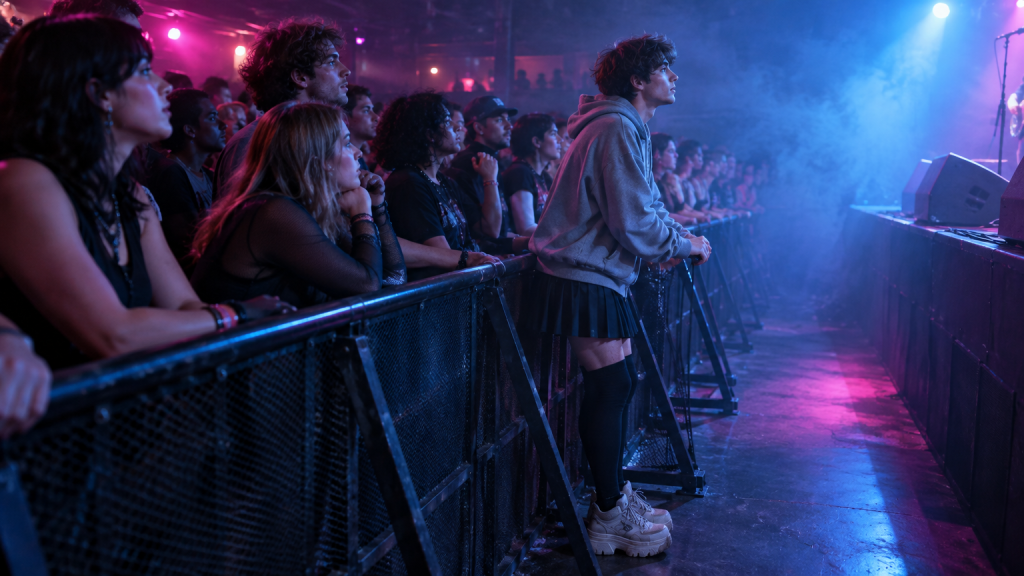
That has changed, and not because the stars got braver. Look at a Yungblud crowd, a hyperpop show, the floor at any festival with a Gen Z lineup, and the skirts, cropped knits and thigh-high socks are on the fans. The distance between stage and pit, on this one question, has closed. It is worth asking why it took so long.
The Stage History
The lineage is long and well documented. Cobain in the early 90s. Brian Molko of Placebo in slips and eyeliner through the late 90s. Pete Burns, Boy George and the New Romantics before any of them. More recently Harry Styles in a Gucci gown on American Vogue, Lil Nas X in everything, Bad Bunny in skirts on tour and in campaigns, Kid Cudi in an Off-White wedding dress on Saturday Night Live in tribute to Cobain, Måneskin’s Damiano David in corsets and skirts at Eurovision and after, Yungblud in pink dresses and school skirts on every magazine that would have him.
Each one was treated as news. None of it was treated as instruction. Fans admired the gesture and went to the show in black jeans, because a Gucci gown is a statement and a pair of black jeans is a wardrobe. The stage gave permission; it never gave a method.
What the Method Looked Like
The method arrived from somewhere the music press was not looking. From around 2019, young men in online communities began assembling a look from cheap, available women’s clothes: a pleated skirt, thigh-high socks, an oversized hoodie, trainers. It was posted, criticised, refined and reposted until it had rules. One oversized element, one fitted; a gap between sock and hem; trainers rather than heels; a masculine top half over a feminine bottom half.
Music ran through the whole thing. The communities overlapped heavily with e-boy and alt TikTok, with hyperpop and its 100 gecs-adjacent chaos, with the emo revival, with the K-pop-informed aesthetics that had already loosened what boys were allowed to wear. The playlists and the outfits grew up together. By the time the look was recognisable, it already had a soundtrack.
That is the difference between the Cobain moment and now. Cobain was one man in one dress. This was thousands of people working out, in public and in detail, how an ordinary boy with an ordinary budget wears a skirt to a gig without it reading as fancy dress.
The Fit Problem Nobody on Stage Had
There was one obstacle a frontman never faces. A stylist puts Harry Styles in a dress cut for Harry Styles. A seventeen-year-old buying a pleated skirt online is guessing whether a women’s medium closes over hips the size chart was never written for. Male waists sit higher, hips run narrower, shoulders run wider, and nothing in the women’s department accounts for it.
The communities solved it the way they solved everything, collectively and by trial. Which chains ran large, which fabrics forgave a broader frame, how to convert a men’s measurement into a women’s size. Eventually a handful of small retailers grew out of that knowledge, FemboyBox among them, selling the core pieces with sizing written for men. The high street has still not followed, which is why the look remains, for most of its wearers, something ordered online and worn out.
What the Crowd Looks Like Now
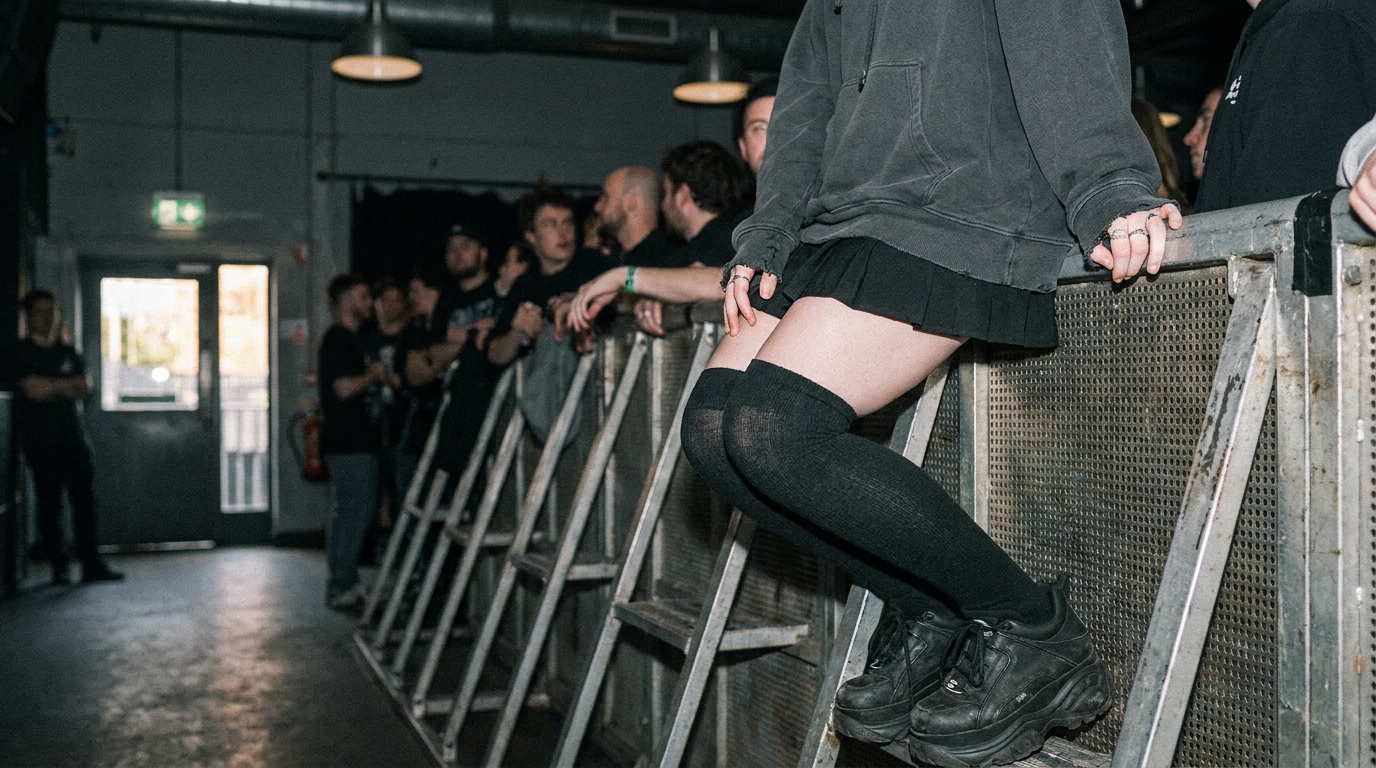
Go to the right show and the uniform is obvious. Skirt, thigh-highs, big hoodie, platform trainers; a cropped cardigan over a band tee; a choker or a hair clip as the single accessory. The combinations are fewer than they look; this set of easy outfit builds covers most of what you will see at the barrier from the same six pieces. It is not everyone and it is not every genre. You will not see much of it at a stadium rock show with a median age of forty-five. You will see plenty at anything hyperpop, alt-pop, pop-punk revival, or built around an artist who wears it himself.
Yungblud is the clearest case. His crowds dress like him because he dresses like them; the skirt is not a costume he puts on for the stage but the same thing the front row ordered last month. The same is increasingly true around Conan Gray, around Lil Nas X, around a tier of artists for whom the clothes were never a stunt.
The rule from the online communities holds in the pit, too. One feminine anchor, one masculine counterweight. A skirt under a hoodie. Thigh-highs with trainers. The tension between the two is what reads as style rather than as borrowed clothes, and it is why the look survives a sweaty three-hour set in a way a gown never could.
Why It Matters Beyond the Wardrobe
The Usual Story About Music and Fashion Runs Downward: The Artist Wears It, the Fans Copy It, the High Street Sells It. This One Ran the Other Way. the Fans Built the Look, the Artists Who Wore It Were Adopted as Patron Saints Rather than Originators, and The High Street Has Still Not Caught Up.
That is a useful corrective to thirty years of coverage that treated the man in the dress as the brave exception. The exception was only ever the easy part. The hard part was turning a gesture into a wardrobe, and that was done by the crowd.