No Elevator, Three Flights, One Narrow Back Stair: The Physics of a Classic Somerville Move
Somewhere around the second flight, every mover has the same thought: whoever designed this staircase never once imagined a queen mattress coming up it. And yet here we are, because in Somerville, this is just what a normal Tuesday looks like. Ask anyone who’s actually moved furniture in this city and they’ll tell you the real story of a Somerville move isn’t the packing or the driving. It’s the stairs.
That’s not a complaint about the city – people love these buildings for a reason, and the triple-decker is as much a part of Somerville’s identity as Davis Square or the Red Line. But if you’re planning a move into or out of one, it helps to understand what you’re actually dealing with, because a third-floor triple-decker unit is a genuinely different kind of move than a single-family home ten minutes away in a less crowded town. Same city, same moving company, completely different physics.
Why the Triple-Decker Is Built the Way It’s Built
The triple-decker showed up in Somerville and across this part of Massachusetts more than a century ago as a way to fit three households’ worth of rent onto one narrow city lot. It worked – it’s still working, honestly, which is part of why Somerville is packing more people into its four square miles than just about anywhere else in New England. But the design choices that made triple-deckers efficient housing in 1910 are the exact same choices that make them hard to move furniture through in 2026.
Interior staircases in these buildings are narrow, steep, and turn tight corners on purpose – nobody was designing for a sectional sofa, they were designing to fit as much livable square footage as possible onto a small lot. And because three units are stacked instead of spread across one footprint, there’s no ground-floor unit that gets an easy pass. Somebody’s living on the third floor, and that somebody eventually has to move.
The Back Stair Is Doing More Work Than You Think
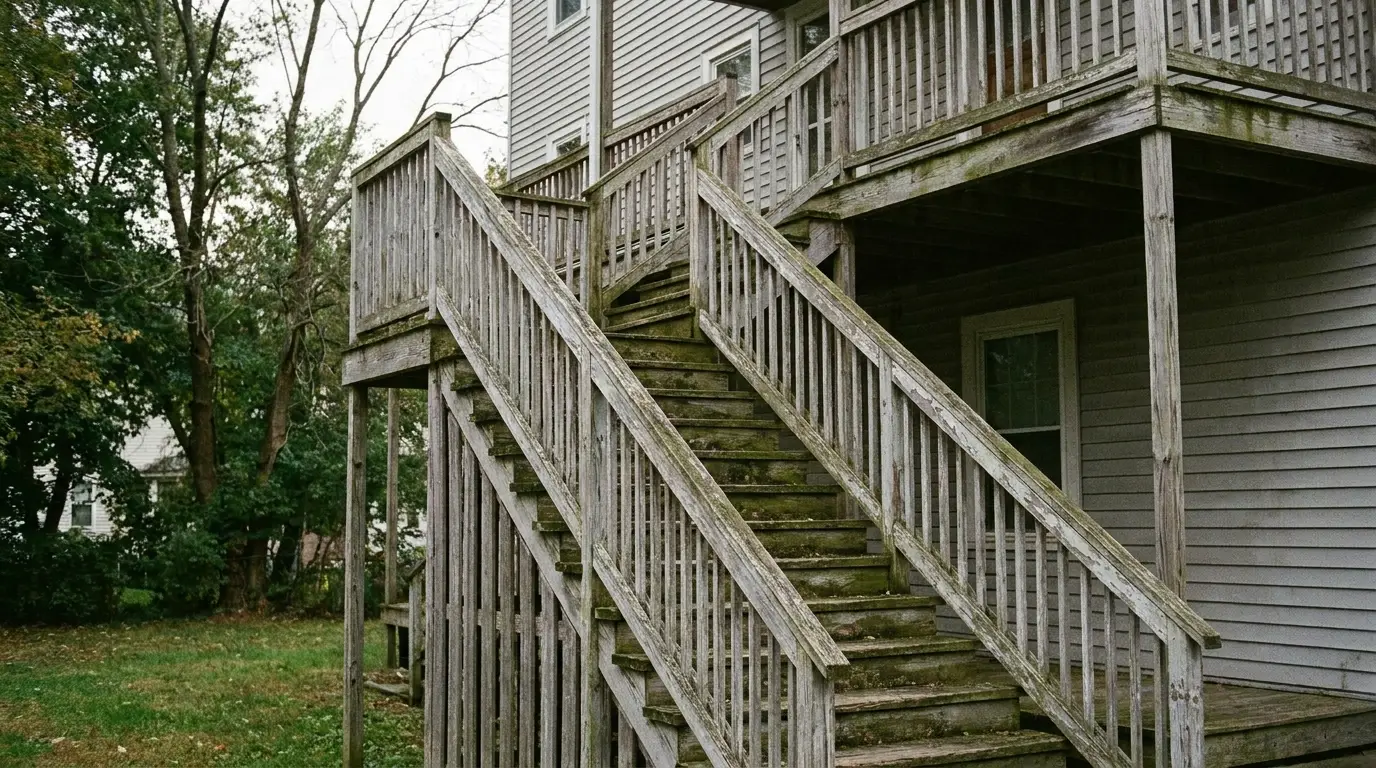
Here’s the part that catches people off guard the first time: in a lot of Somerville triple-deckers, the front stairs aren’t actually where the furniture goes. The real access point is the exterior back porch and stairway – the same wooden structure you’ve probably seen stacked three high behind almost every triple-decker in the city, connected by a narrow run of steps zig-zagging up the back of the building.
That back stair was built for tenants to get to their kitchen door, not for a mover to get a dresser past a 90-degree turn on a landing barely wider than the dresser itself. It’s often the only realisticway in or out, especially if the front stairwell is even tighter or if the front door doesn’t open directly onto the unit being moved. Weather matters here too – a back porch staircase that’s fine in July gets genuinely risky in icy conditions, which is one more reason moving in Somerville during a Massachusetts winter takes more planning than people expect.
No Elevator Means the Math Changes
A third-floor walk-up unit isn’t just “the same move, but higher up.” Every single item – every box, every piece of furniture, every appliance – has to go up three flights of narrow stairs by hand, because there’s no elevator to shortcut any of it. That changes the actual math of a move in a few concrete ways.
It takes longer, plainly. Carrying a couch up two tight turns of stairs takes meaningfully more time than rolling it a few feet across a ground floor, and that time adds up fast once you’re doing it for an entire household. It usually takes more people, too – a two-person crew that’s fine for a single-family ranch often isn’t enough for a third-floor triple-decker unit, because some pieces genuinely need three sets of hands to navigate a tight stairwell turn without gouging the wall or the furniture. And it raises the stakes on protection: corner guards, banister padding, and door-frame protection aren’t optional extras on one of these moves, they’re the difference between a normal Tuesday and an argument about who dents the stairwell.
Big Furniture Has Its Own Rules Here
Anyone who’s moved a couch into a third-floor Somerville apartment has, at some point, stood at the bottom of the stairs doing math about whether it’s actually going to fit around that landing. Sometimes it doesn’t – and that’s not a failure of planning, it’s just what these buildings are. When a sofa or a mattress genuinely can’t make the turn, the options are a window or porch hoist, disassembly where the piece allows it, or, in the rare worst case, leaving it for a different route entirely. None of that is a same-day decision you want a crew making for the first time when they’re already halfway up the stairs with a couch on their shoulders. It’s the kind of thing that should get talked through before moving day, not during it.
Why This Matters for What You’re Paying
None of this is trivia – it’s the actual reason a Somerville triple-decker move can cost more, and take longer, than a similarly sized move in a less densely built town. A crew that has to make five extra trips per couch up a tight back stairway is a crew spending more billable hours doing exactly that. A move that requires three people instead of two on certain pieces is a different labor cost, full stop. And a move that skips the walk-through – the one where somebody actually measures the stairwell turn and the back porch width before moving day – is a move that risks turning into a slow, expensive surprise instead of a straightforward job.
The upside is that none of it is unpredictable if you plan for it. A third-floor Somerville unit with a tight back stair isn’t a mystery to a crew that’s done a hundred of them. It’s just a different job than a single-family move, and it should be quoted, staffed, and scheduled like one.
What to Actually Do About It
If you’re moving into or out of a Somerville triple-decker, the most useful thing you can do before moving day is walk your mover through the specific access point – is it the front stairs or the back porch, how many turns, how wide is the tightest landing, is there a shared hallway other tenants also use. Take a few photos of the stairwell itself, not just the furniture. And if you’ve got one or two pieces you’re genuinely unsure will make the turn, mention them by name up front. A crew that knows in advance they might need to hoist a couch through a window has a plan. A crew that finds out standing on the second-floor landing does not.
A Few Questions We Get Asked About Somerville Triple-Decker Moves
Will my couch actually fit up the stairs?
It depends entirely on the specific stairwell – the width of the tightest turn matters far more than the size of the couch. Measuring the narrowest point of the staircase (not just the doorway) before moving day is the single best way to know in advance instead of finding out with the couch already on the stairs.
Is the back porch stairway really safer or easier than the front stairs?
Not automatically – it’s usually just narrower and more exposed to weather, since it’s an exterior structure. It’s often the more practical access point because it opens closer to the kitchen and avoids awkward turns inside the unit, but it comes with its own risks, especially in rain, snow, or ice.
Do I need more movers for a third-floor unit than I would for a ground-floor one?
Often, yes. Tight stairwell turns frequently need three sets of hands on larger pieces instead of two, simply to control the item safely around a corner. It’s less about the number of items and more about the physical geometry of the stairs.
What happens if a piece of furniture genuinely won’t make the turn?
The usual options are disassembling it where possible, hoisting it through a window or over a porch railing, or, occasionally, leaving that one piece for a different moving method entirely. The key is identifying which pieces are at risk before moving day, not discovering it mid-move.