If you’ve ever heard a song that felt almost too perfect, there’s a good chance the E major scale had something to do with it.
It carries this rare quality of sounding both powerful and warm at once, which is exactly why guitarists, pianists, and composers keep coming back to it.
Learning this scale opens up a whole new way of hearing music, not just playing it.
Keep reading, because by the end, you’ll know the notes, the structure, the chords, and exactly how to bring it all to life.
What is the E Major Scale?
A major scale is a sequence of seven notes built on a specific pattern of whole and half steps, and the E major scale follows that exact formula, starting from E.
It’s a diatonic scale, meaning every note naturally belongs to the key with no outside alterations pulling it in different directions.
What makes this scale so loved is its distinctly bright, almost airy quality, the kind that makes melodies feel expansive and alive.
That signature sound comes largely from its four sharps: F#, C#, G#, and D#, which give it a tonal richness that feels both grounded and luminous.
Notes in the E Major Scale
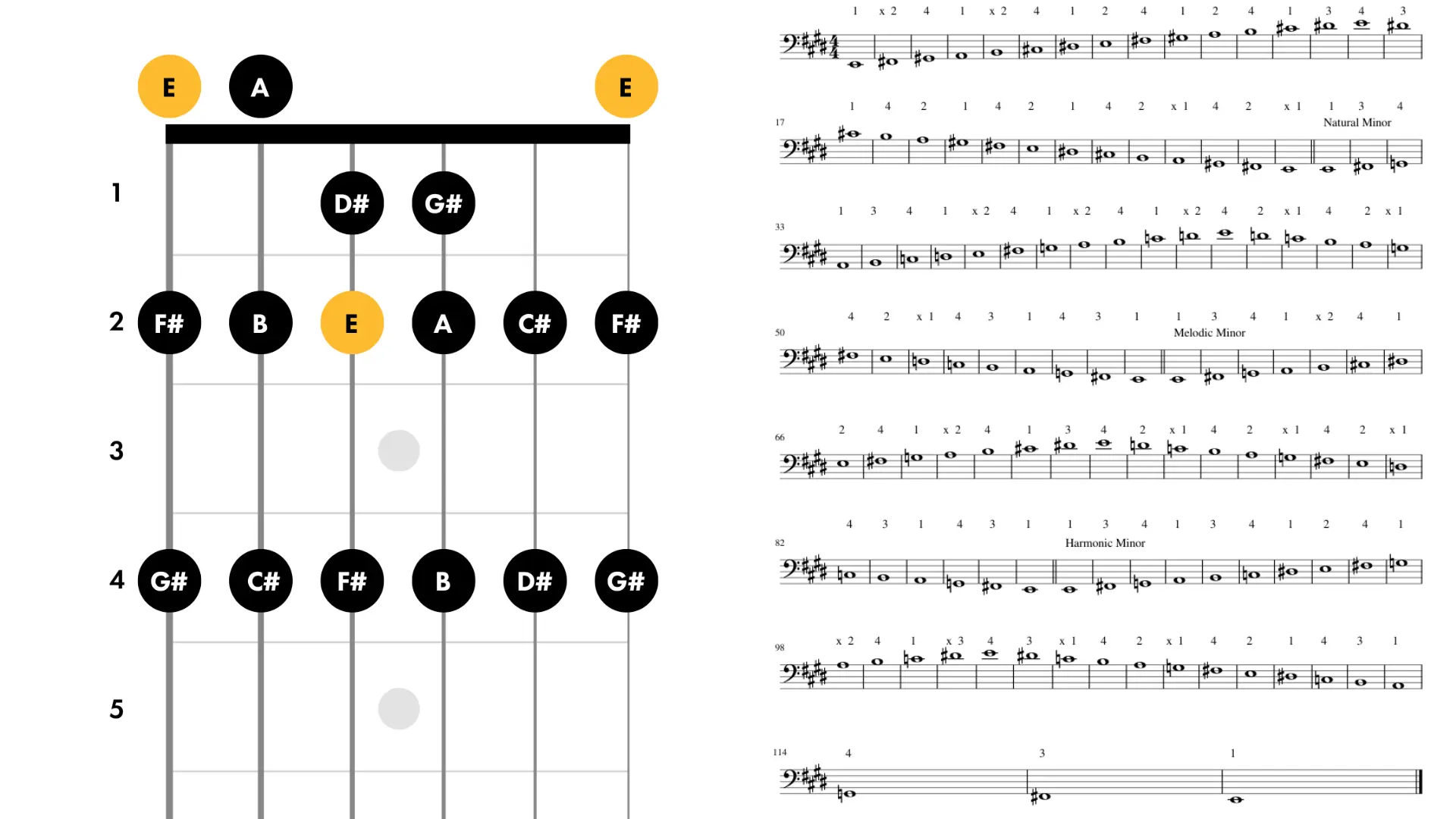
Every scale tells a story through its notes, and E major tells one that feels bright, resolved, and satisfying to the ear.
Here’s a closer look at what makes up this scale.
E, F♯, G♯, A, B, C♯, D♯, E
The E major scale is made up of seven distinct notes before resolving back to E.
Each note has its own role in shaping the overall sound, and together they create that characteristic brightness the scale is known for.
The sequence moves in a very deliberate order, and even one note shifted would completely change the feeling of the scale.
F♯, G♯, C♯, and D♯
Four of the seven notes in E major are sharp, and these are not accidental.
They are baked into the key signature itself, meaning every time these notes appear in a piece, they are automatically played sharp.
They are what lift the scale out of sounding plain or neutral and give it that polished, resonant quality that makes it so widely used.
The Octave
The scale begins and ends on E, but the final E sits one octave higher than where you started.
This repetition is what gives the scale a sense of completeness, like a phrase that starts and finishes on the same word but with a different weight to it.
In practice, players often run the scale across multiple octaves to build finger fluency and a deeper feel for the key.
E Major Scale Formula
Understanding the formula behind a scale is what takes you from memorizing notes to actually understanding music.
The E major scale follows the same step pattern every major scale does, and once it clicks, you can build any major scale from any root note.
The W W H W W W H Pattern
Every major scale is built on a fixed sequence of whole and half steps, and that sequence is W W H W W W H.
A whole step skips one note in between, while a half step moves directly to the next. This formula is consistent across all twelve major scales, meaning the relationship between the notes never changes; only the starting point does.
It is the backbone of Western music theory and the reason major scales all carry that same bright, resolved quality.
How It Plays Out Starting from E
Apply that pattern from E, and everything falls into place naturally.
E to F♯ (W), F♯ to G♯ (W), G♯ to A (H), A to B (W), B to C♯ (W), C♯ to D♯ (W), D♯ to E (H). Each step lands exactly where it should, producing the E, F♯, G♯, A, B, C♯, D♯, E sequence without forcing any note out of its natural position.
The formula does all the work, the scale just follows.
E Major Scale on Piano
The E major scale is one of the most rewarding scales to learn on piano, built on four sharps: F#, C#, G#, and D#. Its bright, resonant sound makes it a staple in classical and contemporary music alike.
Mastering it requires attention to finger crossings and hand coordination, but with the right technique it flows naturally under the fingers.
Right-Hand Fingering
- Use the standard fingering: 1, 2, 3, 1, 2, 3, 4, 5 (ascending) and reverse descending.
- The thumb tucks under after the middle finger (3) lands on G#.
- Keep fingers curved and close to the keys to prepare for the crossover.
- Avoid lifting the wrist when the thumb passes; keep it low and relaxed.
Left-Hand Fingering
- Use: 5, 4, 3, 2, 1, 3, 2, 1 (ascending) and reverse descending.
- The third finger crosses over the thumb after E (the root).
- The left hand crossover feels less natural at first; practice it in isolation slowly.
- Anchor your wrist to avoid rocking side to side during the crossover.
E Major Scale on Guitar
The E major scale is one of the most natural scales to play on guitar, with its notes aligning beautifully with the instrument’s open strings. This makes it accessible for beginners while remaining essential for advanced players.
Playing lead lines, improvising, or building chord knowledge all begin with understanding this foundational pattern every guitarist should know.
Open Position Scale
Starting in open position is the most beginner-friendly way to approach the E major scale, taking advantage of the guitar’s natural tuning.
- The open position pattern starts on the open low E string and uses the first four frets.
- Notes in order: E, F#, G#, A, B, C#, D#, E across the strings.
- Several open strings are used (E, B, E), which gives the scale a full, resonant tone.
- Practice ascending and descending slowly before building speed.
Two-Octave Patterns
Expanding to two octaves opens up the full range of the scale across the neck and builds greater fretboard fluency.
- A common two-octave pattern starts at the 12th fret on the low E string, mirroring the open position.
- Alternatively, start at the 7th fret on the A string for a mid-neck two-octave run.
- Linking positions across the neck helps you move fluidly rather than staying locked in one spot.
- Use consistent alternate picking throughout both octaves for an even, controlled sound.
Importance in Rock and Blues
The E major scale holds a special place in rock and blues, largely due to how naturally the key of E sits on the guitar.
- E major and its relative minor (C# minor) form the backbone of countless rock and blues progressions.
- The open-string resonance of E major gives power chords and riffs a naturally full, driving sound.
- Lead guitarists use E major scale patterns extensively for solos over common I, IV, V chord progressions.
- Bands and artists across every era of rock, from Chuck Berry to modern classic rock, rely heavily on E-based keys.
Chords in the Key of E Major
Every major key contains seven diatonic chords, each built on a degree of the scale.
In the key of E major, these chords follow the same major, minor, and diminished pattern found in all major keys, giving composers and players a ready-made palette of harmony that naturally sounds cohesive together.
| Degree | Chord | Quality |
|---|---|---|
| I | E | Major |
| ii | F♯ | Minor |
| iii | G♯ | Minor |
| IV | A | Major |
| V | B | Major |
| vi | C♯ | Minor |
| vii° | D♯ | Diminished |
Common Chord Progressions
- I, V, vi, IV (E, B, C♯ min, A): the most widely used progression in pop and rock, instantly recognizable across hundreds of songs.
- I, IV, V (E, A, B): the classic three-chord progression that forms the foundation of blues and early rock and roll.
- vi, IV, I, V (C♯ min, A, E, B): a minor-starting variation that adds an emotional, introspective quality to the same chords.
- I, vi, IV, V (E, C♯ min, A, B): a classic doo-wop and ballad progression that works across genres.
Songs That Use the E Major Scale
The E major scale spans decades and genres, from the blues of the 1960s to hard rock anthems of the 1980s and beyond.
Jimi Hendrix
- Hey Joe (1967): Hendrix’s debut single, built on a descending chord run rooted in E major. Its raw guitar tone remains one of the most recognizable in rock history.
- Little Wing (1967): A slower, expressive piece showing how E major carries delicate melody as effectively as it carries power. Hendrix draws an almost orchestral range of emotion from a single guitar.
Eric Clapton
- Wonderful Tonight (1977): A ballad that highlights the lyrical side of E major. Clapton’s clean, melodic phrasing made it one of the most enduring love songs in classic rock.
- Cocaine (1977): A riff-driven track leaning into the aggressive edge of E major. The main riff cycles through the lower scale with a momentum that defined arena rock for a generation.
AC/DC
- Back in Black (1980): One of the best-selling rock songs of all time, anchored by a riff built on the open low E string. A defining example of how E major translates into raw, high-impact energy.
The E major scale has proven itself a versatile foundation across genres and eras, its staying power driven as much by its sonic qualities as by the natural fit it offers the electric guitar.
Why Learn the E Major Scale?
The E major scale is one of the most practical starting points for any musician. It builds a foundation for improvisation, giving guitarists a reliable framework for soloing across rock, blues, and beyond.
Understanding the scale also unlocks harmony, making it easier to recognize how chords are constructed and how they relate to one another.
For songwriters, it opens up a naturally resonant key with a rich catalog of reference points.
Most importantly, E major is one of the most widely used keys in guitar music, meaning the patterns learned here apply directly to countless real songs.
Tips to Practice the E Major Scale
Building fluency in the E major scale comes down to consistency and smart repetition. A few focused habits will accelerate progress faster than long, unfocused sessions.
- Start slowly with a metronome and increase tempo only when each repetition feels clean
- Practice ascending and descending patterns to build equal confidence in both directions
- Work through the scale across different octaves to develop full fretboard awareness
- Vary your picking patterns, such as alternate and economy picking, to build versatility
- Apply the scale directly to real songs to reinforce muscle memory in a musical context
Even 10 minutes of daily focused practice will yield noticeable results within weeks.
The ‘E’nd Note
The E major scale is one of those musical building blocks that keeps giving the more time you invest in it.
Its role in diatonic harmony, chord construction, and some of the greatest guitar performances ever recorded makes it genuinely worth the effort.
Progress may feel gradual, but each practice session quietly compounds, and one day the scale simply flows.
That is the quiet reward the E major scale offers every guitarist willing to sit with it.
Tried any of these tips or songs? Share your experience in the comments below.
Frequently Asked Questions (FAQs)
Is the E Major Scale Suitable for Beginners?
Yes, the E major scale is one of the most beginner-friendly scales on both piano and guitar. Its open-string compatibility on guitar and straightforward fingering on piano make it an ideal starting point.
How Is the E Major Scale Different From E Minor?
The E major scale uses four sharps and has a bright, uplifting sound, while E minor uses only one sharp and carries a darker, more melancholic tone. Both share the same root note but differ in their third, sixth, and seventh degrees.
Which Chords Belong to the E Major Scale?
The seven diatonic chords are E major, F# minor, G# minor, A major, B major, C# minor, and D# diminished. These chords naturally complement one another and form the basis of countless progressions in rock, pop, and blues.
How Long Does It Take to Learn the E Major Scale?
The basic pattern can be learned in a single sitting, but true fluency across all positions and octaves develops over weeks of consistent practice. Daily repetition, even in short sessions, is the most reliable path to making it feel natural.