Close your eyes and imagine the sound of water finding its voice, something airy and resonant, hovering just at the edge of real.
That’s the glass harmonica for you, an instrument so delicate that it once moved composers to obsession and audiences to silence.
Born from a curious mind and a simple experiment, it drifted from the grand salons of Europe into near obscurity for centuries. Now, slowly and quietly, it’s finding its way back, and the world is leaning in to listen.
We’re tracing its unlikely origin, the genius behind it, and the quiet, enduring pull of its sound.
What is a Glass Harmonica?
A glass harmonica is a friction idiophone, meaning it produces sound through direct contact and vibration rather than strings or air.
It’s built around a series of nested glass bowls mounted on a rotating spindle, each tuned to a specific pitch, controlled by a foot pedal that keeps everything in motion.
A dampened finger pressed against the spinning glass creates that signature tone.
Unlike the wine glass method, where you rim a stationary glass, here the glass comes to you, which allows for smoother transitions, fuller resonance, and a sustained, almost vocal quality that no other instrument quite replicates.
How Does the Glass Harmonica Work?
For something that sounds so otherworldly, the idea behind it is almost disarmingly simple.
- It starts with water and fingertips, dampened fingers pressed against spinning glass are all it takes to set the sound in motion.
- The continuous rotation means the player can hold a note for as long as they need, easing in and out of it naturally.
- Pitch is determined by the size of each bowl, no tuning, no water levels, just glass doing what glass does.
- And because the bowls are all within reach at once, chords become possible, something a lone wine glass could never offer.
The whole system feels less like an instrument being played and more like a conversation being had.
The Invention Story: How Benjamin Franklin Created It
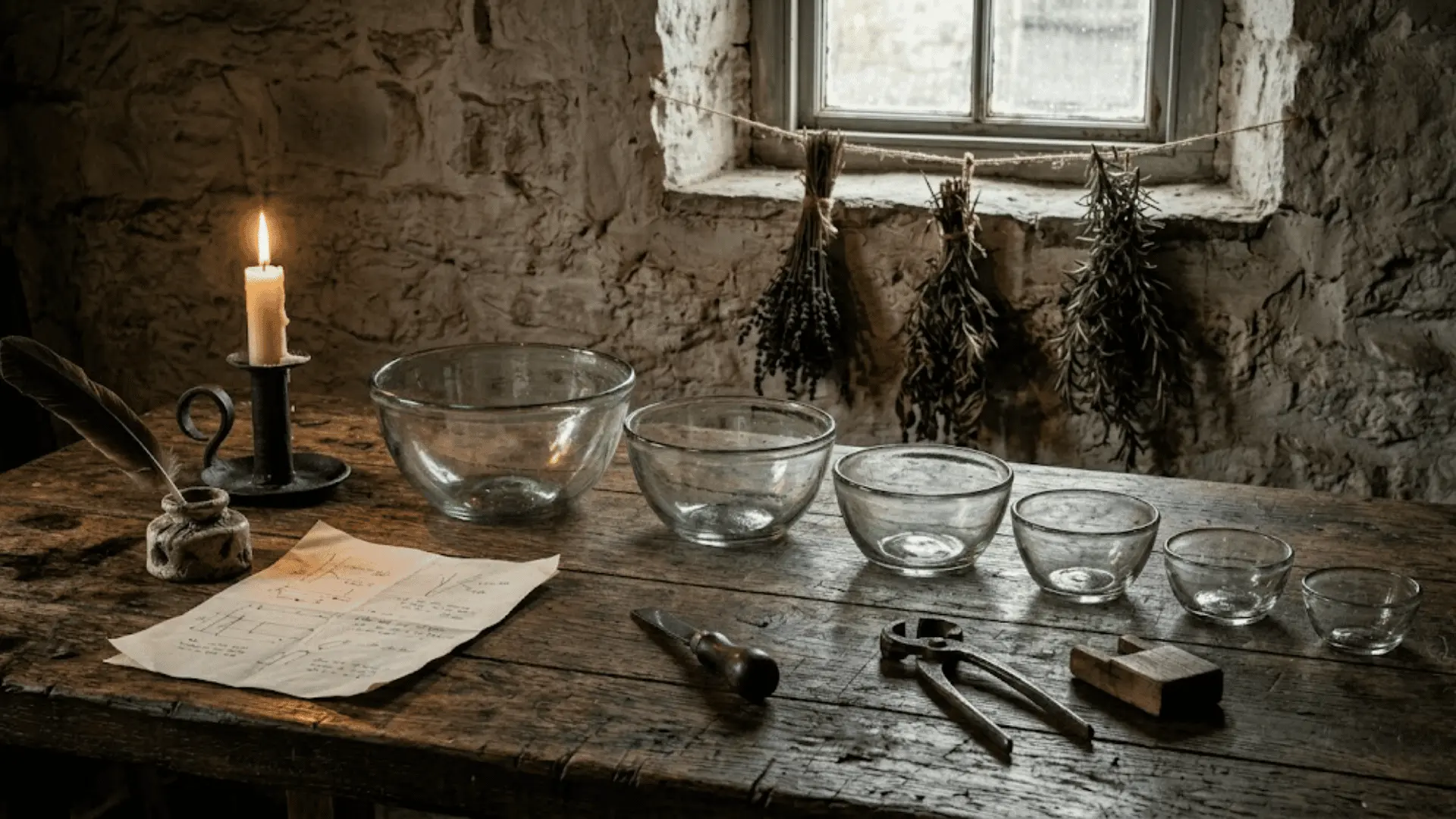
Benjamin Franklin first encountered musical glasses at a London concert and walked away unable to shake the sound. It stayed with him long enough to do something about it.
Working alongside a glassblower, he redesigned the concept entirely, stacking tuned glass bowls horizontally on a rotating spindle instead of arranging them separately.
This single shift changed everything.
Chords became playable, melodies became fluid, and the instrument became something a musician could actually master. He called it the armonica, borrowing from the Italian word for harmony.
Simple in concept, deliberate in design, and entirely his own.
Rise to Fame in 18th-Century Europe
The glass harmonica didn’t quietly blend into the musical landscape of its time.
It arrived, and people noticed.
A Sound That Moved Through Royalty
It wasn’t long before the armonica found its way into royal courts and elite concert halls across Europe. Audiences were drawn to its voice in a way that felt almost unsettling, too pure, too close to something intangible.
Marie Antoinette herself took lessons on it, which tells you everything about the kind of circles it moved through.
It became a staple of high society gatherings, the kind of instrument that made a room go still the moment it began to play, conversation dropping off, attention shifting without anyone quite deciding to let it.
The Composers It Inspired
Mozart and Beethoven didn’t just appreciate the glass harmonica; they wrote for it.
Mozart’s Adagio and Rondo remains one of the most quietly devastating pieces composed for the instrument, while Beethoven leaned into its meditative quality in his own works.
The fact that two of history’s most celebrated composers found it worthy of dedicated composition says more about the instrument than any description could.
Why Did the Glass Harmonica Disappear?
At its peak, rumors began circling that the glass harmonica was making people unwell, players reporting nerves, dizziness, and even emotional disturbance.
The cause was never pinned down cleanly; lead content in the glass, the intensity of sustained vibrations, or simply the era’s tendency toward dramatic explanation all got their share of blame.
Changing musical tastes didn’t help either.
Orchestras were growing louder, grander, and the armonica’s quiet voice couldn’t compete.
Its fragility and the sheer difficulty of keeping it maintained did the rest, and the instrument slowly slipped out of concert halls and into near obscurity.
What Does the Glass Harmonica Sound Like?
Words only get you so far with this one. The glass harmonica produces a sound that sits somewhere between a human voice and an instrument, breathy, sustained, and just slightly unnerving in the best way.
Here’s how it tends to be described and where you’ll hear it today.
| Aspect | Details |
|---|---|
| Core Sound Quality | Ethereal, airy, and almost vocal in character |
| Often Compared to | Singing bowls, high-pitched organ tones |
| Emotional Register | Haunting, meditative, occasionally unsettling |
| Used in | Film scores, experimental and contemporary classical music |
| Why Filmmakers Use It | Its tone signals the otherworldly without feeling theatrical |
Fun Facts About the Glass Harmonica
Beyond its sound and history, the glass harmonica has a few details worth knowing that don’t quite fit anywhere else.
- It is widely regarded as one of the first musical instruments invented by an American.
- A well-built armonica could span up to four octaves, giving it a surprisingly wide range.
- Some instruments had color-coded bowls to help players navigate notes more intuitively.
- Franz Mesmer, the father of hypnosis, used it as a backdrop to his performances, leaning into its eerie atmosphere.
For an instrument that disappeared for over a century, it left behind a surprisingly rich trail.
Modern Revival of the Glass Harmonica
The glass harmonica never fully vanished; it just waited.
Over the past few decades, musicians and historians have quietly brought it back, commissioning handmade instruments and reintroducing it to classical revivals, film scores, and ambient music.
Its presence in cinema has been particularly notable, used wherever a scene calls for something that feels just outside the ordinary.
On YouTube and social media, curiosity around it has been steadily growing, with performances accumulating the kind of views that suggest people are genuinely hungry for something that sounds this different.
Glass Harmonica vs. Glass Harp
They share the same basic principle but are really two different instruments.
Here’s how they sit against each other.
| Aspect | Glass Harp | Glass Harmonica |
|---|---|---|
| Structure | Stationary glasses filled with water | Nested bowls on a rotating spindle |
| Tuning Method | Water levels adjusted per glass | Bowl size determines pitch |
| Playability | Limited, one note per glass | Chords and fluid transitions possible |
| Sound Complexity | Simpler, more isolated tones | Richer, more sustained, and layered |
| Portability | Relatively easy to set up | Requires a purpose-built instrument |
Final Thoughts
The glass harmonica has lived a quietly extraordinary life, born from curiosity, celebrated by genius, abandoned by circumstance, and now slowly reclaiming its place in the world.
There is something deeply satisfying about an instrument this old still managing to surprise people. Its sound asks nothing of you except to stop and listen, and that, in a noisy world, feels like enough.
If the glass harmonica found its way to you today, consider it a worthwhile detour.
Have you ever heard the glass harmonica live or come across it in a film score? Drop it in the comments below.
Frequently Asked Questions (FAQs)
Is the Glass Harmonica Hard to Play?
It demands a specific kind of patience; maintaining just the right finger pressure on spinning glass is a skill that takes real time to develop. Most players will tell you the learning curve is less about music theory and more about touch.
Why Did People Think the Glass Harmonica Caused Madness?
The instrument coincided with an era already prone to heightened sensibilities, and its unsettling tone didn’t help its reputation. Lead in the glass, and prolonged vibrations were likely the real culprits behind the reported symptoms.
Is the Glass Harmonica Still Being Made Today?
A small number of skilled craftspeople still build them by hand, making each instrument something of a rarity. They are commissioned rather than mass-produced, which adds to both their value and their appeal.
What Movies or Shows Feature the Glass Harmonica?
It has appeared in various film scores where an otherworldly or eerie tone was needed, though it often goes uncredited. Once you know what it sounds like, you start catching it in places you wouldn’t have noticed before.