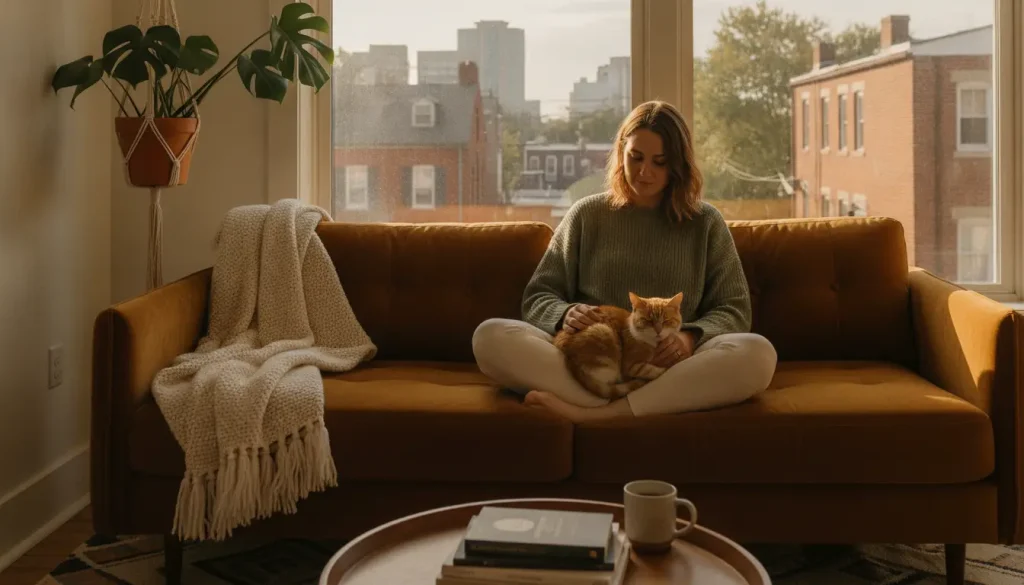
People in Virginia are choosing cats as emotional support animals (ESAs) in 2026 because felines provide powerful, low-maintenance daily comfort for anxiety and PTSD, while fitting well into apartment lifestyles. Legitimate ESA cats also help renters bypass restrictive “no-pet” building policies and avoid extra pet fees under housing rules.
Walk through an apartment building in Richmond, Norfolk, or Arlington in 2026 and you’ll find a growing number of tenants whose approved assistance animal is a cat. Not because cats have become better companions than dogs, but because a specific combination of rental economics, apartment design, and Virginia’s unusually broad state law has made cats the most practical choice for a lot of people.
The Rental Math Stopped Favoring Dogs
The single biggest factor is cost, and it isn’t the animal’s cost. It’s the building’s.
Pet rent is now standard across Virginia’s larger rental markets. A tenant in Alexandria or Virginia Beach can easily be quoted a non-refundable pet fee, a deposit, and a recurring monthly charge on top of rent. Nationally, renters with pets pay well over $900 a year in pet-related charges, and in Northern Virginia the figure runs higher.
Dogs draw the steepest surcharges, plus weight caps, breed exclusions, and in some buildings a flat refusal. Cats are cheaper to add as a pet, but here’s the part that matters: with a valid assistance animal letter, neither animal costs anything at all. Under Virginia law, an assistance animal is not a pet, which means no pet rent, no pet deposit, and no breed or weight restriction.
Once tenants understand that, the calculation changes. If the fee disappears either way, the question becomes which animal fits the apartment, the lease, and the person’s actual life. For a lot of Virginia renters, that answer is a cat.
Virginia Law Doesn’t Care Whether Your Animal Barks or Purrs
Virginia is one of a handful of states with a statutory definition of “assistance animal” that is explicitly species-neutral, and that definition is the legal reason cats work here so cleanly.
Virginia Code § 36-96.1:1 defines an assistance animal by what it does, not what it is. The statute recognises animals that guide people who are blind, alert people who are deaf, pull wheelchairs, retrieve items, warn of oncoming seizures, or provide emotional support that eases the symptoms of a disability. Crucially, it does not limit the category to dogs, and it does not require the animal to be individually trained or certified.
Virginia Code § 36-96.3:1 then does the practical work. It establishes that assistance animals are not pets and requires housing providers to permit them in all dwellings, without pet fees, deposits, or additional rent. That covers condominium associations and HOAs, not just conventional landlords.
Some states have written ESA rules that lean heavily toward dogs, or layered on training and registration language that quietly excludes other species. Virginia didn’t. A full breakdown of the state framework, including documentation standards and anti-fraud provisions, is laid out in this guide to Virginia ESA laws.
What Changed in May 2026, and Why Virginia Renters Barely Noticed
On May 22, 2026, HUD narrowed its federal enforcement posture, announcing it would no longer investigate ESA housing complaints where the animal is not individually trained. The Fair Housing Act itself did not change. Congress didn’t touch it.
That distinction caused a lot of confusion nationally, and a fair amount of unnecessary panic. What happened was a shift in which agency does the enforcing, not a shift in what the law requires.
For Virginia tenants the practical impact was limited, because Virginia never depended solely on federal enforcement. The Virginia Fair Housing Office, housed within the Department of Professional and Occupational Regulation, continues to enforce § 36-96.3:1 on its own state authority. Its process is open to tenants without an attorney, and it must begin proceedings within 30 days of receiving a complaint. Private civil action in state or federal court remains available as well.
If anything, the 2026 change accelerated the move toward cats. Because HUD’s new posture draws a line at individual training, tenants are grounding their requests in state law and documented clinical need. Virginia’s statute doesn’t hinge on training for any species, which puts a cat on exactly the same footing as a dog.
Cats Fit How Virginians Actually Live Now
The legal side explains why cats are possible. Daily life explains why people are choosing them.
- Apartment footprints keep shrinking. New builds in Richmond’s Scott’s Addition, Norfolk’s downtown core, and the Rosslyn-Ballston corridor skew toward studios and one-bedrooms. A cat needs vertical space, not a yard.
- Nobody has to be walked at 6am. For someone managing depression or a chronic condition where mornings are the hardest part of the day, an animal that doesn’t need to be taken outside three times daily is the difference between the arrangement working and collapsing.
- Hybrid schedules cut both ways. Plenty of Virginians are back in the office two or three days a week. That’s manageable for a cat and genuinely hard on a dog.
- Noise complaints are the fastest route to friction. A barking dog in a thin-walled building creates a paper trail with property management. Cats rarely do.
- The military and university turnover factor. Between Hampton Roads, Quantico, and Charlottesville, Virginia has an unusually mobile rental population. Cats move between leases with far less disruption.
None of this makes cats a therapeutic upgrade. It makes them a sustainable one, and sustainability is what determines whether an animal actually helps someone over a period of years.
What Actually Makes a Cat an ESA in Virginia
This is where most people get tripped up.
A cat becomes an assistance animal in Virginia through a letter from a licensed mental health professional holding an active Virginia licence, and through nothing else.
Registries, certificates, ID cards, and vests sold online carry no legal weight in Virginia or under federal law. A landlord who knows the statute will reject them, correctly.
A letter that holds up needs to:
- Come from a clinician licensed in Virginia, as defined under § 54.1-2400.1
- Confirm a qualifying mental or emotional disability, without disclosing the specific diagnosis to the landlord
- State that the animal is necessary to ease symptoms of that condition
- Carry the clinician’s name, licence number, date, signature, and verifiable contact details
- Arise from a genuine therapeutic relationship, which § 36-96.3:1(E) defines as care provided in good faith by a provider with actual knowledge of the disability
That last point deserves emphasis. Virginia’s anti-fraud provisions are among the strictest in the country. Under § 36-96.3:1(F), supplying fraudulent documentation is a prohibited practice under the Virginia Consumer Protection Act, exposing providers to civil penalties of up to $5,000 per violation and treble damages in private suits. Instant-approval services that skip the evaluation are a liability, not a shortcut. Providers like RealESALetter.com have built their process the other way around, matching each applicant with a Virginia-licensed clinician for a real evaluation, which is exactly what § 36-96.3:1(E) expects. Tenants who want it handled properly can start with a clinician-issued ESA letter in Virginia rather than an online certificate.
Where a Cat ESA Stops Working
Worth stating plainly, because this misunderstanding causes real problems.
An assistance animal letter in Virginia covers housing. It does not create public access rights. Restaurants, shops, hotels, and venues can refuse entry to an emotional support cat, and they’re within their rights to do so. ESAs are not service animals under the ADA.
Air travel is also off the table. Since the Department of Transportation rule change took effect in 2021, airlines have not been required to carry emotional support animals in the cabin, and most now apply standard pet fees. Employers in Virginia aren’t obliged to permit an ESA at work either, though an accommodation request can be made under the ADA or the Virginia Human Rights Act.
TL;DR
Virginia is seeing more emotional support cats in 2026 because state law makes them fully viable and modern renting makes them practical. Virginia Code § 36-96.1:1 defines assistance animals by function rather than species and requires no training or certification, while § 36-96.3:1 bars pet fees, deposits, and breed or weight limits outright. HUD narrowed its federal enforcement stance in May 2026, but the Fair Housing Act is unchanged and the Virginia Fair Housing Office still enforces state protections directly. Small apartments, hybrid work weeks, and hard mornings do the rest. The one thing that actually creates the protection is a letter from a Virginia-licensed clinician, and services like RealESALetter.com have made that evaluation straightforward to arrange without cutting the corners the statute cares about.