

Buying office furniture isn’t always as simple as picking the newest model on the market. In fact, many people discover that older premium chairs often outperform brand-new budget options.
That’s one reason why interest in refurbished office chairs has grown in recent years. Businesses, remote workers, and even students are paying closer attention to chairs that have been restored and returned to excellent working condition.
Of course, not all refurbished chairs are equal. Some have been carefully inspected, cleaned, and fitted with replacement parts where necessary. Others may have received little more than a quick wipe-down before being listed for sale. Knowing the difference can help buyers avoid disappointment and make smarter purchasing decisions.
It is also easier than ever to compare models and restoration standards online. Retailers such as OfficeLogixShop have contributed to this trend by helping buyers better understand what separates a properly refurbished chair from one that simply looks good in photographs.
Why Refurbished Chairs Are Becoming More Popular
A few years ago, many buyers were hesitant to purchase refurbished furniture. There was a common assumption that “used” automatically meant “worn out.”
That mindset has changed.
Premium office chairs are built differently from many mass-produced alternatives. Brands like Herman Miller, Steelcase, and Haworth design their products to last for years, sometimes decades, with proper maintenance. As a result, a well-restored chair can continue performing remarkably well long after its original purchase date.
People choose refurbished seating for different reasons:
- access to premium brands at lower prices;
- reduced environmental impact;
- proven long-term durability;
- availability of discontinued models;
- better value compared to some new chairs.
Interestingly, many people purchase one refurbished chair as an experiment and eventually replace all of their office seating with similar models.
What Does “Refurbished” Actually Mean?
This is where confusion often begins. The word “refurbished” doesn’t have a universal definition. One seller may completely disassemble a chair, inspect every component, and replace worn parts. Another may simply clean the upholstery and tighten a few screws.
A proper refurbishment process often includes:
| Step | Purpose |
|---|---|
| Cleaning | Removes dirt, dust, and debris. |
| Inspection | Identifies worn or damaged components. |
| Part replacement | Restores functionality where needed. |
| Testing | Ensures adjustments work properly. |
| Final review | Confirms overall condition and appearance. |
Because refurbishment standards vary, buyers should always ask questions before making a purchase.
The First Thing to Check
Most people immediately look at the upholstery or frame, but that’s not necessarily the best place to start. The chair’s adjustment mechanisms often tell a more complete story.
Check whether:
- the height adjustment works smoothly;
- the tilt mechanism engages properly;
- armrests move as expected;
- lumbar support remains responsive;
- casters roll without resistance.
A chair can look nearly perfect and still have functional issues hiding beneath the surface.
Small Details Matter More Than You Think
Sometimes the smallest signs reveal the most about how a chair has been maintained.
Look closely at:
- scratches around adjustment levers;
- uneven wear on arm pads;
- discoloration on mesh surfaces;
- loose fasteners;
- unusual noises during movement.
These details don’t always indicate poor quality, but they can provide useful context.
For example, slight cosmetic wear may be perfectly acceptable if all mechanical components remain in excellent condition. On the other hand, excessive movement or instability can be a sign of underlying issues.
How Important Are Replacement Parts?
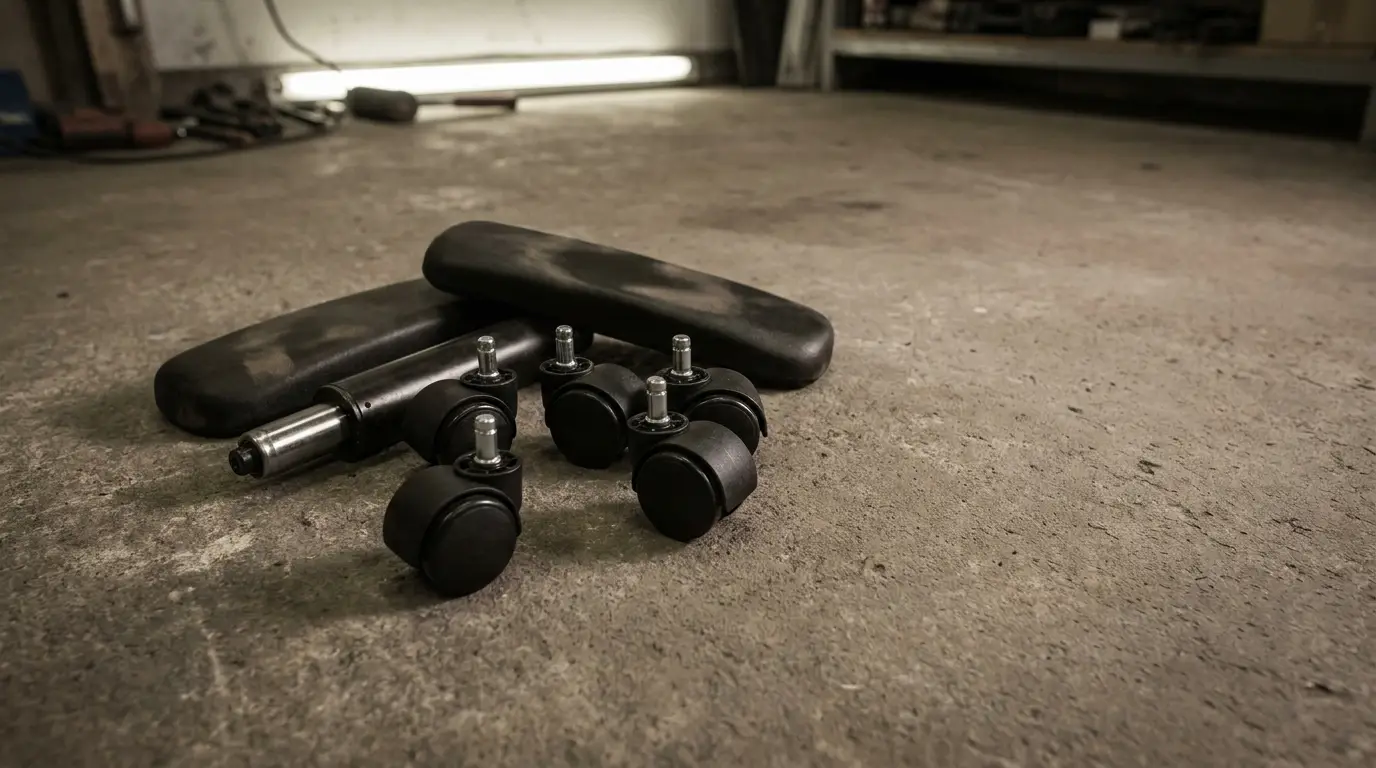
Replacement parts play a major role in the refurbishment process. Premium office chairs are made up of components that naturally wear over time. Arm pads, casters, cylinders, and seat cushions are among the most commonly replaced items.
A chair that includes professionally installed replacement parts may actually provide a better experience than one using heavily worn original components.
Some commonly replaced parts include:
| Component | Why It’s Replaced |
|---|---|
| Gas cylinder | Height adjustment issues |
| Casters | Reduced mobility |
| Arm pads | Surface wear |
| Seat cushion | Loss of support |
| Lumbar components | Reduced comfort |
Understanding which parts have been replaced can provide valuable insight into the chair’s overall condition.
Questions Worth Asking Before Buying
People often spend more time comparing colors than asking practical questions.
Before purchasing, consider asking:
- Has the chair been fully inspected?
- Which parts, if any, have been replaced?
- Are there photos of the actual chair?
- Has functionality been tested?
- Is there a warranty or return policy?
These questions may seem simple, but they can reveal a great deal about the refurbishment process.
Does Age Matter?
Surprisingly, not always. A ten-year-old premium chair that has been properly maintained may still outperform a brand-new chair made from lower-quality materials.
What matters more is:
- overall condition;
- refurbishment quality;
- component performance;
- maintenance history;
- replacement parts.
This is one reason why premium office chairs tend to retain their popularity for many years.
The Environmental Perspective
There is another reason refurbished furniture continues to gain attention: sustainability. Extending the life of an existing chair reduces waste and helps keep usable materials out of landfills. While environmental considerations may not be the primary motivation for every buyer, they are becoming increasingly important.
Choosing refurbished products doesn’t solve every sustainability challenge, but it is a practical way to make better use of resources that already exist.
A Different Way to Think About Value
People often ask whether refurbished chairs are “worth it.” The better question might be: compared to what?
A buyer considering a refurbished Herman Miller chair is usually not comparing it to another refurbished product. More often, they’re comparing it to a brand-new chair at a similar price point. That comparison can produce interesting results.
Many premium office chairs were designed for intensive daily use and built with durability in mind. When restored properly, they continue offering many of the same features that made them popular in the first place.
Final Thoughts
There is no single formula for identifying a great refurbished office chair. Condition, refurbishment quality, replacement parts, and functionality all play important roles.
The good news is that buyers have more information available today than ever before. Taking a few extra minutes to inspect adjustment mechanisms, ask questions about replacement parts, and understand how the chair was refurbished can make a significant difference.
At the end of the day, a quality chair is still a quality chair, regardless of whether it left the factory six months ago or six years ago. The key is understanding what separates a thoughtful restoration from a simple cleanup, and using that knowledge to make a more confident purchasing decision.