Picture this: You just dropped a month’s rent on a pair of 250W beam lights, cranked up the haze, and fired them up at your weekly bar gig. Instead of a jaw‑dropping light show, you get two laser‑sharp dots on the back wall and a front row that’s now squinting like they’re staring into the sun. Meanwhile, your lead singer looks like a floating head in the dark because nobody thought to add a wash.
You’re not alone. Bands and DJs routinely overspend on the wrong fixture—beam lights in a low‑ceiling dive, wash lights where a tight gobo would hit the spot, or a random pile of PAR cans that never quite gels.
With the global stage lighting market valued at $2.24 billion in 2024 and humming along at a 7.9% CAGR, and the live music market itself heading toward $38.58 billion in 2025 per Custom Market Insights, more and more performers are investing in their own rigs.
The step most skip? Understanding the venue–fixture hierarchy. Your room’s capacity, ceiling height, and crowd density should dictate whether you reach for a wash, a spot, or a beam—and how you knit them together.
If you’ve ever wondered how the pros make it look effortless, it’s not just the gear; they’re programming cues matched to stage size, performer movements, and audience sightlines on consoles like MA Lighting or ETC boards.
The Three Pillars: Wash, Spot, and Beam — What They Actually Do
Before we talk about room sizes, let’s get clarity on what each fixture actually does. Think of them as different paintbrushes: one for broad fills, one for focused detail, and one for drawing in mid‑air.
Wash Lights
Wash fixtures are the color foundation. They typically throw light in beam angles ranging from 25° to 60° and use Fresnel or pebbled lenses to scatter it with soft, blended edges, as Kimu Lighting notes.
The result is a uniform wash of color that can cover an entire stage or dancefloor, blending multiple fixtures into a seamless field. If you want the whole band visible—not just the singer’s nose—wash is non‑negotiable.
Spot Lights
Spot moving heads operate with tighter beam angles, generally 10° to 30°, and almost always include a motorized zoom.
Their superpower? Crisp gobo projection.
Want your band logo sliding across the back wall, or leafy textures on the floor? Spots are among the fixtures that can do that, making them perfect for key‑lighting performers, isolating a soloist, or adding visual storytelling elements to your set.
Beam Lights
Now to the show‑off of the group: beam lights. They produce ultra‑narrow 2°–8° cones and are designed to cut through the air, not illuminate people. Without fog or haze, UKING explains, a beam of light is just a bright dot on the opposite wall—all the magic depends on particles catching that shaft of light.
Because the beam is so tight, it’s terrible at lighting performers; it’ll hit a shoulder or a forehead and leave everything else in shadow. Their purpose is pure drama: mid‑air effects that give an arena feel.
If your venue bans haze, skip the beams entirely and redirect your budget to spots and washes.
The Venue Hierarchy: Matching Lights to Room Size, Ceiling Height, and Crowd
Small Spaces (Up to 150 Capacity, Low Ceilings)
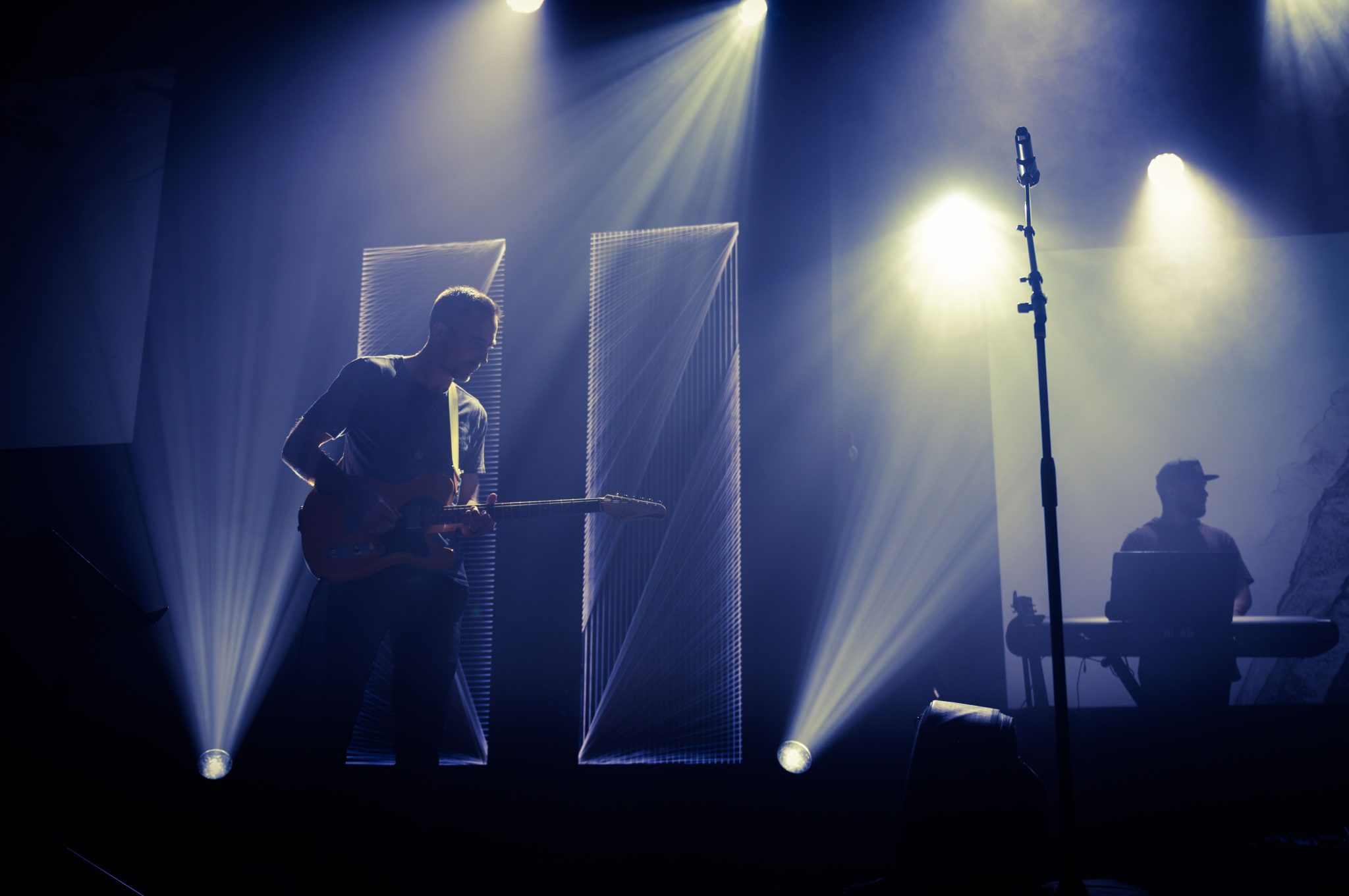
Coffeehouse gigs, house shows, tiny clubs with ceilings under 15 feet (roughly 4.5 meters). This is where beam lights go to die—or worse, to blind people. At such close range, their extreme intensity becomes uncomfortable for the audience.
Instead, build your rig around compact LED PARs and mini moving heads. A solid starting point, from Betopper DJ, is 6–12 LED PAR uplights paired with 2–4 mini moving heads.
For very small stages, work with the space: a 6–10 ft wide stage can get by with just two front PARs and a backlight. Stretch to 10–16 ft, and you’ll want 2–4 PARs plus 1–2 mini washes; at 16–20 ft, step up to 4 PARs, 2 washes, and an LED bar.
Keep beam angles broad—stick to 25°–40° for coverage. Mounting at 10–20 feet above the stage works well; even 10 feet can suffice in a truly tight club, per Kimu’s mounting guide.
Before you buy, check your venue’s ceiling height, rigging capacity, and load‑in quirks—our guide on How to Choose the Right Venue for Concerts and Live Events walks through all those constraints.
Mid-Sized Venues (50-200 Capacity)
Now you’re in medium nightclubs, event halls, and wedding‑band territory with ceilings between 13 and 26 feet (4–8 meters). Fixture counts jump. Betopper DJ’s recommendation is 12–24 wash fixtures, 6–12 beams/spots, and 4–8 pixel bars.
For clubs specifically, a common professional setup, documented by JC‑Lights, is 8–12 moving beam fixtures over the dancefloor, 6–8 LED washes for atmosphere, 2–4 booth background fixtures, and a couple of strobes.
The cardinal sin in mid‑sized rooms? Too many beams, not enough wash. You’ll get killer aerial motion, but a room that feels visually thin and disconnected from the crowd. JC‑Lights’ club design guide calls this the most common mistake.
Counterbalance by mixing 15°–25° spot beams for key lighting with 40°–60° wash angles for background saturation. Mounting at 10–20 feet (3–6 meters) gives good coverage without sacrificing clearance, consistent with SHEHDS’s moving‑head tips.
Large Stages and Arenas
Concert halls, festival main stages, and theaters with ceilings from 40 feet to 65+ feet (12–20 meters) demand big iron. Long‑throw key lighting requires narrow 10°–15° beam angles, while 60°–80° washes sweep across broad stage areas.
Mounting moving heads at 26–33 feet (8–10 meters) unleashes the grand aerial effects arena shows are famous for.
A notable trend here is the rise of hybrid BSW (Beam‑Spot-Wash) fixtures. As Kimu Lighting’s 2026 guide reports, riders are increasingly specifying these to save truck space and budget—one fixture can zoom from around 2° in beam mode out to 50° for wash.
Still, pure‑purpose fixtures often outperform hybrids where absolute quality matters, so weigh versatility against visual punch.
Building Your Rig: Practical Fixture Counts, Channels, and Gear Choices
Before you load up a cart with moving heads, do a DMX reality check. A single professional spot moving head can eat up to 35 DMX channels, and a DMX512 universe carries only 512 channels total.
That means a console running one universe maxes out at just 14 such fixtures. Calculate your channel count—and make sure your control surface can handle it—before you start calculating fixture costs.
For performers on a budget, manufacturers like SHEHDS offer a line of bulb‑beam moving heads spanning 230W to 380W, with ultra‑focused beams from 0.2° to 9.5°.
Their range of beam lights suggests: 230–275W models for clubs and mobile DJs; 311–350W for large indoor stages; IP65‑rated 380W units for outdoor events; and 3‑in‑1 beam/spot/wash hybrids when versatility matters most. A 150W LED beam model has become a sub‑$500 favorite for small‑to‑mid venues.
Safety note: Most moving heads weigh between 15 and 35 lbs. All rigging should maintain at least a 2:1 safety margin, as stressed in SHEHDS’s tips article.
Hybrid fixtures can simplify a touring rig, but remember the clarity rule from UKING: for bands, build a wash foundation so the whole group is seen, then layer spots for lead vocals and solos.
For DJs, balance motion‑heavy beams with enough wash to keep the dancefloor visually full and the crowd connected.
Caveats & Counterpoints: What This Hierarchy Doesn’t Cover
This framework assumes fairly typical rooms, but unusual architecture, theatrical productions, and houses of worship often require different approaches.
Even with top‑tier gear, a beam‑heavy rig without adequate wash leaves performers in the dark and the room feeling hollow. High‑channel‑count fixtures need capable consoles and a solid programming strategy—hardware alone can’t rescue a poorly cued show.
Hybrid lights offer convenience but rarely excel at all three modes; for the purest looks, dedicated fixtures still win.
Always test your rig in the actual venue (beam angles and mounting heights included), and have a backup plan for no‑haze policies or limited power.
The Show‑Ready Rig
The most impactful lighting rig isn’t the one with the highest spec sheet—it’s the rig where wash, spot, and beam counts genuinely fit the room’s size, ceiling, and crowd.
Use this hierarchy to build for performance, not just gear envy, and you’ll turn an average night into a visual experience the audience remembers.