


Reverse osmosis can sound more complicated than it is, especially when product pages mix membranes, stages, tanks, and performance claims. This guide explains what happens inside an RO filter, what each part does, what the process can reduce, and how to decide whether this type of system fits your water and routine.
What Is a Reverse Osmosis Water Filter?
A reverse osmosis, or RO, water filter sends tap water through several treatment stages. Its defining component is a semipermeable membrane. Pressure moves part of the water through that membrane, while the remainder carries rejected substances to a drain or wastewater reservoir.
RO is not simply a very fine sediment filter. Sediment cartridges trap particles, and carbon media adsorb certain compounds. An RO membrane separates many dissolved ions and other small substances from the water stream. That difference is why an RO system can lower total dissolved solids, often shortened to TDS, while a basic pitcher filter may not.
Main Parts of an RO Water Filter
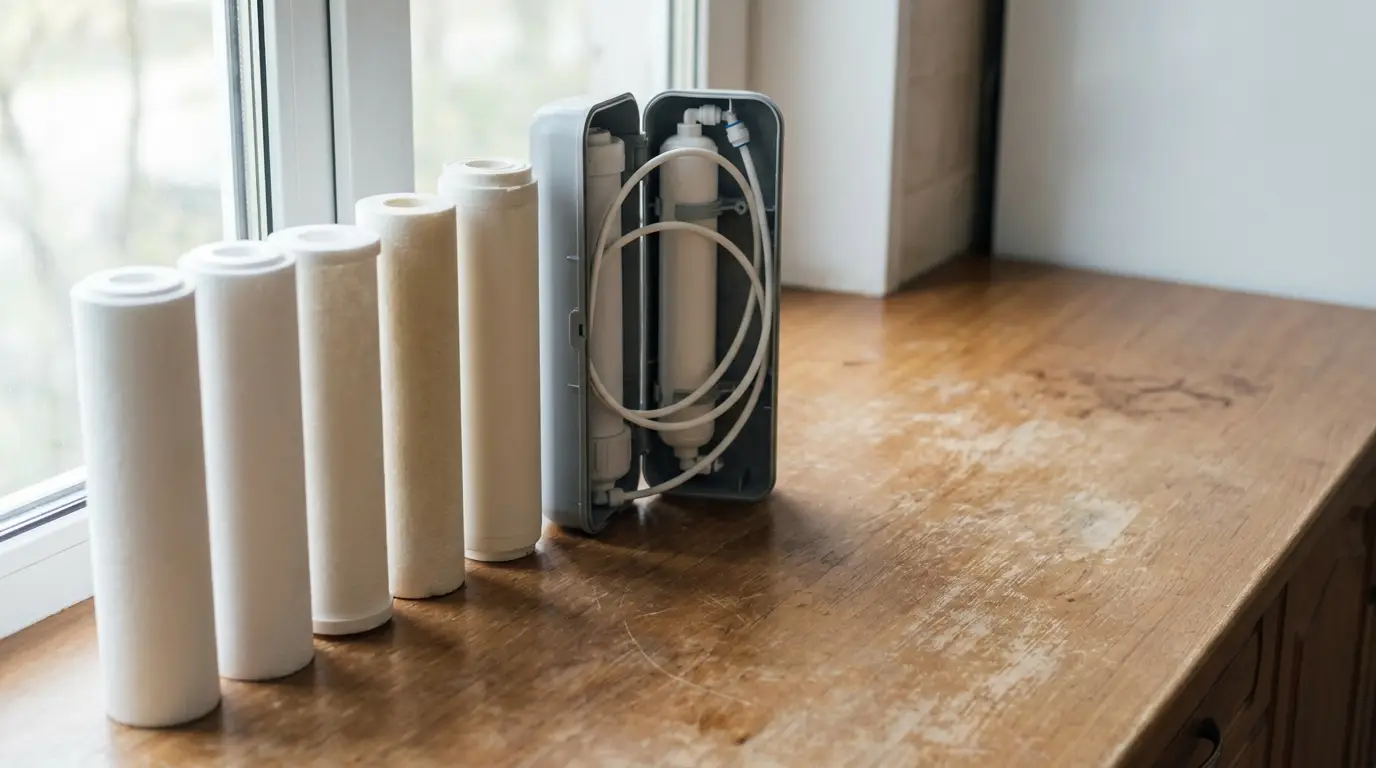
Most household systems include a feed connection or refillable source tank, prefilters, an RO membrane, flow controls, and separate paths for filtered water and concentrate. Under-sink systems often add a pressurized tank and dedicated faucet. Countertop models may use internal reservoirs, a pump, and a dispenser.
The sediment stage intercepts grit and rust particles. Carbon media address chlorine, taste, and odor while protecting chlorine sensitive membranes. A pump or household line pressure supplies the force for separation. A postfilter may provide a final taste adjustment.
How the RO Membrane Filters Water
In natural osmosis, water moves through a semipermeable membrane toward the side with a higher concentration of dissolved substances. Reverse osmosis applies enough pressure to drive water in the opposite direction. Water molecules pass through the membrane more readily than many dissolved ions and larger compounds.
The process creates two outputs. Permeate is filtered water that passes through the membrane. Concentrate retains more of the rejected material and exits through a drain line or enters a wastewater compartment. Continuous separation limits buildup on the membrane surface.
How Reverse Osmosis Works Step by Step
Water Enters the Prefilter
Tap water first reaches the sediment and carbon stages. Removing suspended particles reduces abrasion and downstream clogging. Carbon media reduce chlorine before it reaches a chlorine sensitive membrane. Cartridge order varies, so follow the system diagram and replacement labels.
Pressure Pushes Water Through the RO Membrane
Household pressure or an internal pump then moves water across the membrane. The system must overcome osmotic pressure and membrane resistance. Low feed pressure, cold water, or a loaded cartridge can slow production. A countertop unit may manage pressure automatically, while an under sink model may depend more on plumbing conditions.
Contaminants Are Separated From Filtered Water
As water crosses the membrane, dissolved salts, metals, and other substances are rejected at different rates. Results depend on the membrane, feed water, pressure, temperature, and system condition. Compare documented claims for the exact model rather than assume any product labeled “RO” addresses every concern.
Filtered Water Moves to the Storage Tank
In a traditional under sink system, permeate enters a pressurized tank. Opening the faucet releases stored water without waiting for the membrane. As the tank fills, back pressure rises and an automatic mechanism stops production.
Tankless and countertop designs work differently. Some produce water as needed, while others use internal source and dispensing reservoirs. In every design, the output rate, usable storage volume, and refill pattern affect how convenient the unit feels during busy periods.
What a Reverse Osmosis Water Filter Can Reduce
Dissolved Salts and Minerals
RO can lower dissolved ions such as sodium, chloride, calcium, and magnesium. These contribute to TDS, but a TDS reading does not identify them or prove a specific concern has been addressed. Use TDS to observe general membrane performance and laboratory testing for substance specific results.
Heavy Metals and Other Contaminants
Depending on its design and verified claims, an RO system may reduce lead, arsenic, chromium, nitrate, fluoride, and other dissolved contaminants. The CDC treatment overview notes that performance differs by substance and advises checking the system label. NSF/ANSI 58 includes required testing for TDS reduction and optional tests for particular contaminant reduction claims. Certification or testing should therefore be checked by model and by claim, not inferred from the standard number alone.
Chlorine and Sediment With Prefiltration
The membrane does not do every job. Sediment cartridges handle suspended matter that could cause clogs. Activated carbon reduces chlorine and may improve taste and odor. If the source water uses chloramine, confirm that the carbon stage has a relevant documented claim. Do not assume one cartridge performs the same way for both.
How to Maintain a Reverse Osmosis Water Filter
Replace Prefilters on Schedule
Follow the exact model’s manual. A loaded sediment cartridge can reduce flow, while exhausted carbon media may expose the membrane to chlorine. Record replacement dates, use compatible cartridges, and complete any required flushing before dispensing water.
Check the RO Membrane Regularly
A membrane often lasts longer than a prefilter, but no interval fits every system. Compare feed and filtered water TDS under similar conditions and watch the trend. After checking prefilters and pressure, a sustained decline in rejection performance may indicate a membrane problem.
Rinse the Storage Tank and System
Follow the manufacturer’s procedure when commissioning the unit, replacing major components, or servicing a tank. Use only the materials and contact times in the manual. Household products or incorrect concentrations can damage seals and membrane components. Ask the manufacturer or a qualified professional when instructions are unclear.
Watch for Changes in Taste or Water Flow
A taste change, unusual odor, lower output, frequent pump cycling, or more wastewater can signal a maintenance issue. Check an empty source tank, kinked tubing, overdue prefilters, low feed pressure, and the tank valve first. Persistent changes call for model specific troubleshooting and possibly new water testing.
How to Know If Reverse Osmosis Is Right for Your Home
Check Your Tap Water Quality
Start with evidence, not a generic contaminant list. Review your utility’s annual water quality report and consider a tap test for plumbing related concerns. Private well owners should use an accredited or state certified laboratory. Match the results to verified claims for the exact system.
Consider Daily Water Usage
Estimate filtered water use during the busiest part of the day. Compare it with production rate, storage, refill steps, and recovery time. A compact countertop unit may suit a renter or small household, while frequent cooking and large bottles may favor higher output.
Compare Filter Capacity and Maintenance Needs
Look beyond the purchase price. Cartridge cost, service interval, wastewater ratio, electricity, space, plumbing changes, and access for servicing all affect ownership. Filter life depends on feed water and consumption, so reminders do not replace attention to performance changes.
Choose the Right Number of Filtration Stages
More stages do not automatically mean better treatment. Every stage should have a defined purpose supported by the model’s documentation. A practical system might combine sediment and carbon treatment with an RO membrane and a taste stage. Other designs may add specialized media for a documented need. Compare functions and evidence, not the stage count alone.
For households seeking a quick setup without plumbing modifications, countertop options like the SimPure Y7P-BW countertop RO system demonstrate how multi-stage filtration can fit into a compact, automated design. However, even with convenience features like automatic dispensing and smart alerts, the decision should still come down to practical fit: verify that its dimensions, feed-water limits, and cartridge replacement cycles suit your daily space and budget.
Conclusions
Reverse osmosis systems work by combining protective prefiltration, pressure-driven membrane separation, and separate outlets for permeate and concentrate. It is especially useful when testing identifies dissolved substances that a model is documented to reduce. The best choice is the system whose verified claims match your water, whose output fits daily demand, and whose maintenance you can perform consistently.