
Ablative vs. Non-Ablative Laser Resurfacing: What’s the Difference?
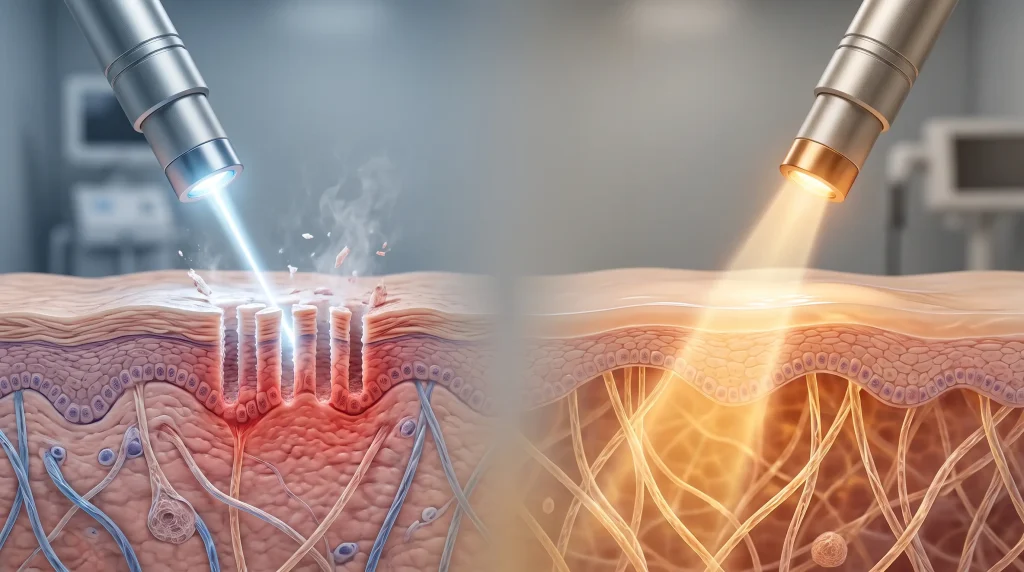
Laser skin resurfacing is used to improve concerns such as wrinkles, uneven texture, acne scarring, pigmentation changes, and sun-damaged skin. The main difference between the two broad approaches is how they affect the skin surface: ablative treatments remove controlled portions of tissue, while non-ablative treatments heat deeper layers without removing the epidermis in the same way. Neither approach is automatically better. The right option depends on the concern, treatment depth, skin characteristics, expected recovery, and professional assessment.
What Is Ablative Laser Resurfacing?
“Ablative” means laser energy is used to vaporize or remove controlled amounts of surface tissue. At the same time, heat delivered into the underlying skin creates a controlled wound-healing response that supports collagen remodeling.
Because ablative laser resurfacing directly removes tissue, it is generally the more intensive approach. It may be considered for deeper wrinkles, more pronounced photodamage, acne scars, and significant textural irregularities. The amount of correction and recovery varies because “ablative” includes treatments ranging from fractional resurfacing to more extensive full-field treatment.
Two established technologies are CO2 laser resurfacing and the Er:YAG laser. CO2 systems operate at 10,600 nm, while Er:YAG systems use 2,940 nm energy that is strongly absorbed by water in the skin. Both can ablate tissue, but their thermal effects and treatment characteristics differ.
What Is Non-Ablative Laser Resurfacing?
Non-ablative laser resurfacing works differently. Instead of vaporizing the epidermis, a non-ablative laser treatment delivers controlled heat into deeper skin while leaving the surface largely intact. That heat triggers a repair response and collagen remodeling without creating the same open-wound effect associated with more aggressive ablative resurfacing.
The main practical advantage is typically shorter visible recovery. Non-ablative approaches may be used for fine lines, early photoaging, mild-to-moderate textural irregularities, and certain pigmentation or tone concerns depending on the wavelength and device.
Results are usually more gradual than with aggressive ablative treatment, and a series of sessions may be recommended. This can make non-ablative skin resurfacing laser technology appealing to people who prioritize less downtime, provided the treatment matches their skin concern and risk profile.
Common Laser Technologies Used for Skin Resurfacing
Ablative and non-ablative are broad treatment categories, not single devices. The clinical effect also depends on wavelength, pulse duration, energy, treatment density, depth, and whether the beam is delivered across the full treatment area or fractionally.
CO2 and Er:YAG Lasers
CO2 lasers are closely associated with ablative laser treatment. Their energy is strongly absorbed by water, allowing controlled vaporization of skin with a surrounding thermal effect that contributes to collagen remodeling. Er:YAG is also an ablative wavelength and generally produces more precise ablation with less residual thermal injury per pass than traditional CO2 treatment.
Treatment intensity is not determined by the laser name alone. A conservative fractional CO2 treatment and an aggressive full-field CO2 resurfacing procedure can have very different recovery profiles.
Clinics comparing Aesthetic Laser Machines weigh wavelength, treatment depth, fractional capability and intended application, so it is worth asking a provider which device and settings they plan to use.
Non-Ablative Laser Technologies
Non-ablative systems use wavelengths that create controlled thermal injury below the surface while limiting epidermal removal. Examples used in fractional resurfacing include erbium-glass and thulium-based systems. Different wavelengths target different depths and chromophores, so the device and settings need to match the treatment objective rather than simply being labeled “non-ablative.”
Ablative vs. Non-Ablative Laser Resurfacing: Key Differences
The central trade-off is usually treatment intensity versus recovery. Ablative resurfacing can create a stronger tissue-remodeling response in a single session, while non-ablative treatment generally causes less surface disruption and allows a faster return to routine activities.
| Factor | Ablative Resurfacing | Non-Ablative Resurfacing |
|---|---|---|
| Effect on skin surface | Removes controlled surface tissue | Surface remains largely intact |
| Treatment intensity | Generally higher | Generally lower |
| Results per session | Often more substantial | Usually more gradual |
| Downtime | Longer | Shorter |
| Number of sessions | Often fewer | Frequently performed as a series |
| Typical concerns | Deeper wrinkles, scars, significant photodamage | Fine lines, mild texture, early photoaging |
These are useful general differences rather than fixed rules. Results, discomfort, and recovery also depend on the treatment area, number of passes, and the individual patient.
What Is Fractional Laser Resurfacing?
“Fractional” is commonly mistaken for a third category of laser resurfacing. It is actually a description of how the laser energy is delivered.
Ablative versus non-ablative describes what the treatment does to the skin. Fractional describes the treatment pattern. Fractional laser resurfacing creates microscopic treatment zones while leaving surrounding areas untreated, which can support healing between treated columns.
Both ablative and non-ablative systems can use fractional delivery. A fractional CO2 laser, for example, is an ablative fractional treatment because it creates microscopic columns of ablation. Non-ablative fractional devices create microscopic thermal zones without removing the epidermis in the same way.
That distinction matters because the word “fractional” alone does not tell you the expected intensity or recovery.
Which Skin Concerns Can Each Type Treat?
Ablative Laser Resurfacing May Be Considered For
Ablative resurfacing may be evaluated for deeper wrinkles, more pronounced sun damage, acne scars, significant textural irregularities, and more intensive resurfacing goals. Fractional ablative lasers are widely used in acne-scar treatment, although scar type, depth, skin tone, and other factors influence whether laser resurfacing for acne scars is appropriate.
Non-Ablative Laser Resurfacing May Be Considered For
Non-ablative resurfacing may be considered for fine lines, early photoaging, milder texture changes, and selected pigmentation or tone concerns. It can also suit patients who prefer less surface disruption and are comfortable with improvement developing over several treatments.
The concern itself is only one part of treatment selection. Medical history, skin type, recent sun exposure, tendency toward pigment changes or scarring, previous procedures, treatment area, and the proposed laser settings all matter.
Downtime, Sessions, and Results
Laser resurfacing downtime is one of the clearest practical differences between the two approaches, but there is no single recovery timeline for every procedure.
Ablative resurfacing produces more surface injury, so redness, swelling, peeling, crusting, and visible healing can be more pronounced. Deeper or full-field treatments generally involve more recovery than lighter fractional procedures. More intensive treatment may also produce greater correction after fewer sessions, depending on the indication and treatment plan.
Non-ablative resurfacing usually causes less disruption to the skin surface. Temporary redness, warmth, swelling, or a sunburn-like appearance can occur, but normal activity often resumes sooner. Because the treatment is less aggressive per session, multiple treatments are commonly used.
Laser resurfacing recovery is better understood as a range influenced by treatment depth, wavelength, density, treatment area, aftercare, and individual healing response rather than a universal number of days.
Risks and Skin-Type Considerations
Both ablative and non-ablative laser resurfacing can cause side effects. Possible complications include redness, swelling, prolonged irritation, infection, scarring, acne or milia flares, and changes in pigmentation. Treated skin can also be more sensitive to sun exposure during recovery.
Pigment changes deserve particular attention. Post-inflammatory hyperpigmentation can occur after laser treatment and is a greater concern in more heavily pigmented skin. Current evidence also shows that some fractional non-ablative lasers can be used successfully in darker skin phototypes when clinicians select appropriate wavelengths, energy levels, density, and aftercare, but risk is not eliminated. An industry-supported 2026 narrative review of 15 studies involving 1550-nm and 1927-nm fractional non-ablative treatment found that post-inflammatory hyperpigmentation rates varied across studies. In studies that directly compared settings, lower energy and/or density was associated with lower rates.
Ablative treatment requires careful patient selection for the same reason. The relevant question is not whether one laser category is universally safe or unsafe for a particular skin tone; it is whether the specific device, settings, treatment depth, and aftercare plan are appropriate for that patient.
An appropriately qualified professional should assess medical history, medications, history of cold sores, scarring tendency, pigmentation risk, recent procedures, and treatment goals before resurfacing.
How to Decide Which Approach Is Right for You
Choosing between ablative and non-ablative resurfacing starts with the result you want and the recovery you can realistically accept.
Someone seeking more intensive correction for deeper texture or scarring may be evaluated differently from someone focused on fine lines and minimal downtime. Other decision factors include skin type and pigmentation characteristics, the number of sessions you are willing to complete, previous treatments, medical history, treatment area, and the technology available.
The most suitable approach is the one matched to the patient rather than the label on the laser. A professional assessment can help determine whether ablative, non-ablative, fractional, or another skin resurfacing treatment fits the concern, risk profile, and recovery expectations.