A musician posts a cryptic lyric. A fan notices that the artist no longer follows a former collaborator. Within minutes, the comments section has assembled a breakup narrative, a secret feud, and an imaginary diss track.
An Instagram unfollow tracker can help establish whether a public account’s unfollow was detected. It cannot establish why the person tapped Unfollow, whether the artists argued, or whether a collaboration is in trouble.
For music fans, that difference is the whole story. We reviewed how Snoopreport handles public follow changes, what it costs, and where the drama ends and the data begins.
The Question Fans Usually Get Wrong
There are two different things people call an unfollow. One is an artist choosing to unfollow another account. The other is an artist losing a follower.
Snoopreport’s relevant feature concerns detected actions by the public account being tracked, including accounts it unfollowed. That does not automatically tell you who stopped following the artist.
A fan account that confuses those two directions can turn a mundane change into a misleading headline.
Even when a public unfollow is genuine, its meaning is uncertain. Artists clean up their feeds, change teams, leave old projects behind, or accidentally tap a button. A follow is not a contract; an unfollow is not a press release.
What Can You Check for Free?
Open the artist’s public profile and inspect the visible Following list. If you know the other account’s username, search for it where Instagram allows.
This can establish whether the connection currently appears. It cannot show when it disappeared or whether the artist ever followed that account in the first place.
To document a change, you would need an earlier dated snapshot and a later one. That can work for a small number of accounts, but usernames, visibility settings, and incomplete screenshots complicate the comparison.
Instagram does not provide a dependable chronological history of another person’s unfollows. An Instagram unfollow tracker is therefore mainly a convenience for repeated observations, not a way to unlock secret platform data.
Snoopreport Review: What You Actually Get

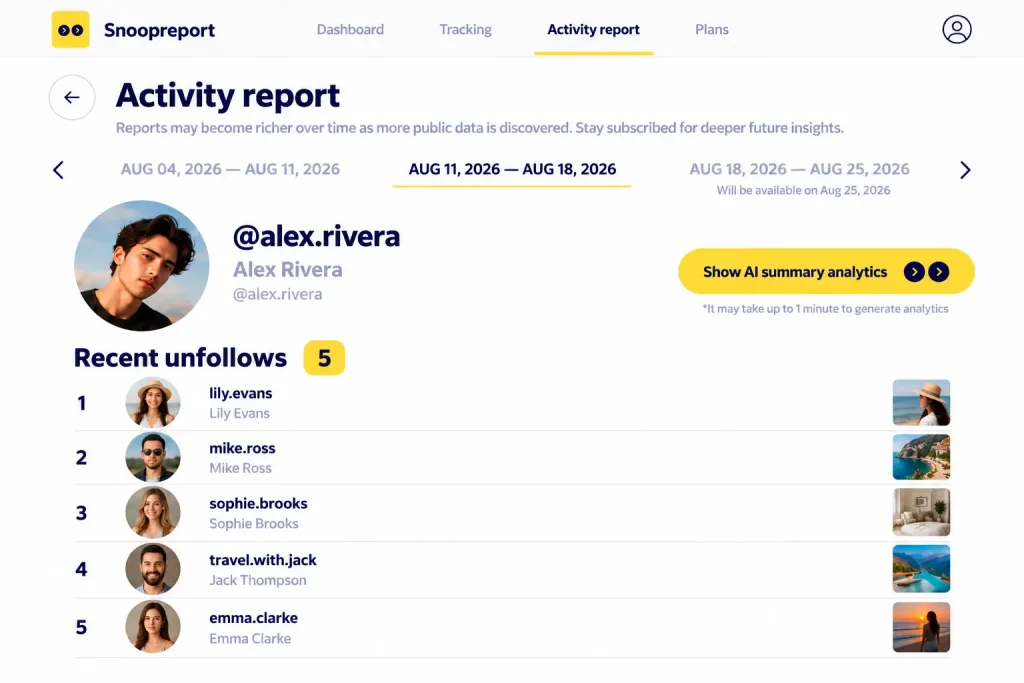
Snoopreport is an Instagram activity tracker for public accounts. It organizes detected likes, follows, and unfollows into weekly or monthly reports without requiring your Instagram password.
You add an eligible public username, select the relevant tracking period, and review available activity reports. For music fans, that can make a detected change easier to spot than repeatedly checking an artist’s Following list.
The tool’s strongest feature is organization. Instead of relying on an undated screenshot circulating on social media, you can examine an observation within a defined reporting period.
But that does not turn the report into a verified explanation of an artist’s personal relationships.
What We Like
The password-free workflow is simpler than tools that ask you to connect an Instagram account. Having likes, follows, and unfollows in one place can also provide context beyond a single missing connection.
Snoopreport’s optional AI Summary identifies recurring themes from detected activity. It may help surface music-related interests, artists, venues, or events that appear in reports.
For a listener looking for concert ideas or conversation starters, that can be entertaining. It is not a reliable source for claims about feuds, contracts, or upcoming releases.
What We Don’t Like
Coverage is incomplete. Snoopreport describes up to 75% of observable public activity, so a missing unfollow in a report is not evidence that it never occurred.
Reports are organized by periods rather than providing a guaranteed exact timestamp for every action. The tool also cannot access private accounts or direct messages.
Most importantly, an AI summary can interpret themes but cannot know why someone unfollowed another account.
Price: Is the Curiosity Worth It?
Snoopreport lists a Personal plan at $4.99 per month for two public accounts, a ten-account plan at $14.99, and a 100-account plan at $44.99.
Optional AI features cost extra. Available historical reports are separately offered at $1.19 per account per week.
For someone following a single rumor, paying a monthly fee may be excessive. For a music writer or community manager who repeatedly reviews public-account changes, a structured report may save time.
The value depends on whether you need recurring observations or simply want to settle one question about a public Following list.
The Real Test: A Hypothetical Band Feud
Imagine a singer and a producer have worked together for years. Fans notice that the singer no longer follows the producer.
A tracker might show that an unfollow was detected during a reporting period. That is useful information, but it still leaves several possibilities open: a feed cleanup, a change in professional priorities, a personal disagreement, or an accidental action.
The report cannot choose between those explanations.
A responsible music article would describe the observable change and seek comment or additional evidence before suggesting a feud. Anything more confident is speculation wearing a data badge.
Security and Responsible Fan Culture
Meta’s guidance for Instagram creators covers engagement, reach, and content strategy, but it does not turn a public unfollow into evidence of a feud. A tool that asks for your password to reveal someone else’s supposedly hidden activity also deserves skepticism.
Snoopreport does not require Instagram credentials for its public-account reports, but users should still review its privacy policy and subscription terms.
Fan curiosity is normal. Harassment, dogpiling, and treating a missing follow as proof of private conflict are not.
An Instagram unfollow tracker should help you describe what was observed, not supply ammunition for attacking an artist or another fan.
Our Verdict on Snoopreport

As an Instagram unfollow tracker, Snoopreport is most useful for people who regularly want organized reports of detected public follow changes. The accessible starting price and optional AI Summary add convenience, while partial coverage and the lack of exact motives are meaningful drawbacks.
If you’re checking one public connection, Instagram’s free interface may be enough. If you’re following a developing music story, treat any report as a lead to verify, not a finished headline.
The internet may love an unfollow scandal. The data, unfortunately for the drama, is rarely that dramatic.