Every family has one. The aunt who, when asked what she would like for her birthday, says “Oh, nothing, I’ve got everything I need”, and genuinely means it. The friend whose kitchen already holds the good coffee machine, the proper knives and three candles that all smell faintly of fig. The dad who buys himself whatever he fancies in January and then looks mildly baffled in November when you ask for ideas.
Shopping for these people is its own particular kind of stress. You drift round shops picking things up and putting them back down. You scroll gift guides late at night, all of which seem to recommend the same monogrammed washbag. And lurking at the back of your mind is the uncomfortable knowledge that whatever you choose, they could probably have bought a nicer version themselves.
That, oddly, is the clue. Once someone isn’t short of anything, usefulness stops being the point of a present. The one thing they can’t buy for themselves is proof that somebody else was thinking about them. Few gifts carry that quite as well as a piece of jewellery.
Needing something versus wanting to keep it
Most of the presents we swap each year fall into the “useful” category. A new dressing gown, a decent bottle of gin, a voucher for a restaurant. Pleasant, gratefully received and, if we’re honest, quietly forgotten by spring. There’s nothing wrong with that. Replacing someone’s threadbare slippers is a small kindness.
But a gift that fills a gap is different from a gift that marks something. The second sort tends to get kept. It’s the reason people hold on to birthday cards for decades, and it’s rarely for the artwork. It’s the handwriting inside.
Jewellery belongs firmly in that second group. It’s small, it lasts, and it’s worn close to the body, which means it goes everywhere its owner goes: to the office, to the pub, to weddings and funerals and the school gates. A vase on a shelf can’t compete with that kind of daily companionship.
Pieces that end up telling a story
Ask anyone about the jewellery they wear most often and there’s usually a story attached. The ring inherited from a grandmother. The thin chain bought on a first holiday abroad with a partner. The earrings a mum handed over on the morning of a wedding. The object itself might be modest. What gives it weight is what it’s tied to.
That’s why jewellery has always gathered around milestones: big birthdays, graduations, anniversaries, the arrival of a baby. Even at the most extravagant end of the scale, the instinct is the same. Gigwise’s look at Kylie Jenner’s personalised jewellery collection includes the matching “toi et moi” rings she and her daughter Stormi wore, a design traditionally about a romantic couple turned into a token of the bond between mother and child. The budgets involved are frankly absurd, but the impulse behind them is one most of us would recognise.
The lovely thing is that a piece of jewellery gathers meaning as it ages. The first time someone wears it, it’s a present. Ten years on, it’s a reminder of who gave it, and when, and why.
Buying for the person rather than the occasion
People who are hard to buy for usually have fairly clear taste, which is precisely why they’re hard to buy for. So start with what they already wear. Do they reach for gold or silver? Are they a one-statement-piece person, or do they layer several fine chains at once? Do their earrings dangle or sit neatly on the lobe? Ten minutes of paying attention over a Sunday lunch will tell you more than an evening of browsing.
Personality counts as much as style. Someone who works with their hands, or spends their weekends on an allotment, might never wear a ring that snags on things; a pendant or a bracelet will get far more use. The friend who treats getting dressed as a bit of theatre may be thrilled by something braver than you’d ever pick for yourself.
And for anyone whose look is more understated, it helps to know that quieter pieces are having a real moment. Gigwise has written about the rise of dainty jewellery, and part of its appeal is that delicate designs slot easily into almost any wardrobe, which is exactly what you want when you’re buying for someone who already knows what they like.
When in doubt, go classic
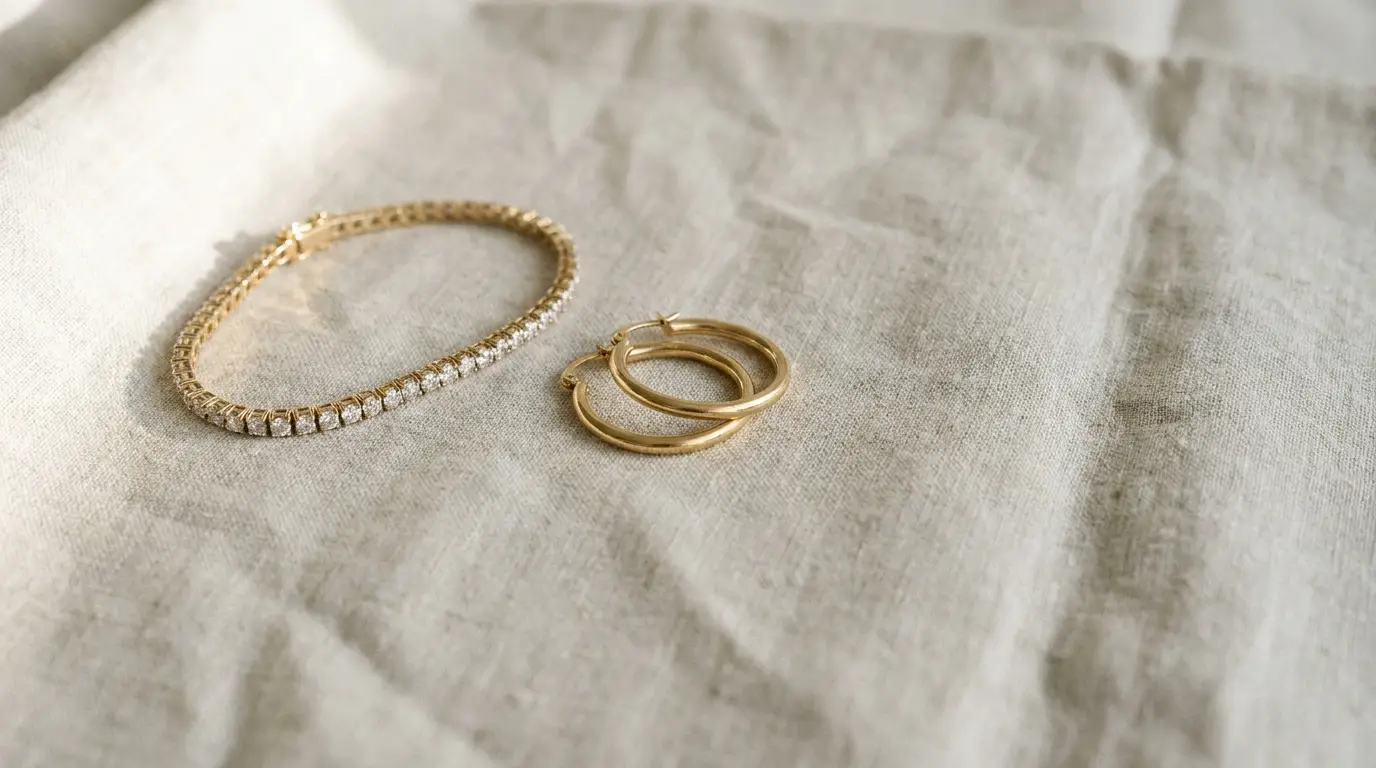
Trend-led jewellery can be a gamble. The chunky, sculptural earrings that looked brilliant in a shop window in March may feel a touch dated by the following Christmas. If you know someone’s taste broadly but not precisely, a classic design is usually the safer and, perhaps surprisingly, the more thoughtful choice. It has already proved it can outlast whatever fashion is doing this season.
A diamond tennis bracelet is a good case in point. It’s essentially a single, unfussy line of stones, and it looks as at home with a jumper and jeans as it does with something smarter for an evening out. Because it isn’t tied to any one kind of occasion, it tends to be worn rather than saved for best, and a gift that gets worn is a gift that gets remembered. The same logic applies to plain gold hoops, pearl studs or a simple signet ring. Their restraint is their strength. They fit into what someone already owns instead of asking them to rethink their whole look.
It’s also worth saying that spending more doesn’t automatically make a present feel more personal. An expensive but generic gift can come across as though it was chosen by an assistant. A modest piece picked with obvious care, because you noticed they always wear silver or once admired something similar, will often land far better.
The occasion matters, or you can invent one
Birthdays, Christmas and anniversaries are the obvious moments, and there’s nothing wrong with them. But some of the most treasured jewellery gifts turn up on no particular date at all. The end of a gruelling year at work. Passing a driving test at forty-three. A friendship quietly reaching its twentieth year. A new home, a new job, a recovery.
Giving something on an otherwise unremarkable day has a strange effect: it turns the day itself into something worth remembering. And for the person who has everything, being surprised is a rarer pleasure than you might think.
Making it personal without overcomplicating it
Personalisation can be wonderful, but it’s easy to overdo. An engraved date or a pair of initials on the inside of a band is subtle and lovely. A birthstone can be a nice nod without shouting about it. What rarely works is cramming every meaningful symbol you can think of into one piece until it looks like a charm bracelet with a nervous tic.
Often the most personal element is the one that costs nothing. A few handwritten lines explaining why you chose this piece for this person will do more than any amount of engraving. “It reminded me of the ring you wore when we first met” is the sort of sentence people keep long after the wrapping paper has gone.
A practical word on sizing: rings are the trickiest thing to get right if you’re buying in secret, while necklaces and bracelets are far more forgiving. Whatever you choose, it’s worth checking the resizing and returns policy before you buy, just in case.
Looking after something that matters
The more sentimental a piece becomes, the more it’s worth protecting. None of this is complicated. Take rings off before washing up, gardening or heading to the gym. Put jewellery on last, after perfume, hairspray and moisturiser have had a chance to settle. Store pieces separately so fine chains don’t knot and harder stones don’t scratch softer metals. An occasional gentle clean with warm, soapy water and a soft brush keeps most things looking bright, and having a jeweller check the claws on a stone-set piece every so often can save real heartache later.
If you’re giving jewellery to someone who isn’t used to wearing much of it, a few tips tucked into the card are a thoughtful touch, and a straightforward guide to jewellery care is worth bookmarking for yourself too. A little attention now is what allows a piece to still be worn, and loved, in twenty years’ time.
The things that stay with us
Think back to that aunt who insists she has everything. In a sense, she’s right. She has the kettle, the scarves, the good hand cream. What she doesn’t have is the bracelet you gave her on an ordinary Tuesday, or the memory of the evening she opened it, or the small jolt of recognition she’ll feel years from now when she catches sight of it on her wrist and thinks of you.
Most of what we own is replaceable. The gifts that carry a person, a moment or a relationship inside them are not. That, more than sparkle or price, is what makes jewellery worth giving to the people who seem to need nothing at all.