
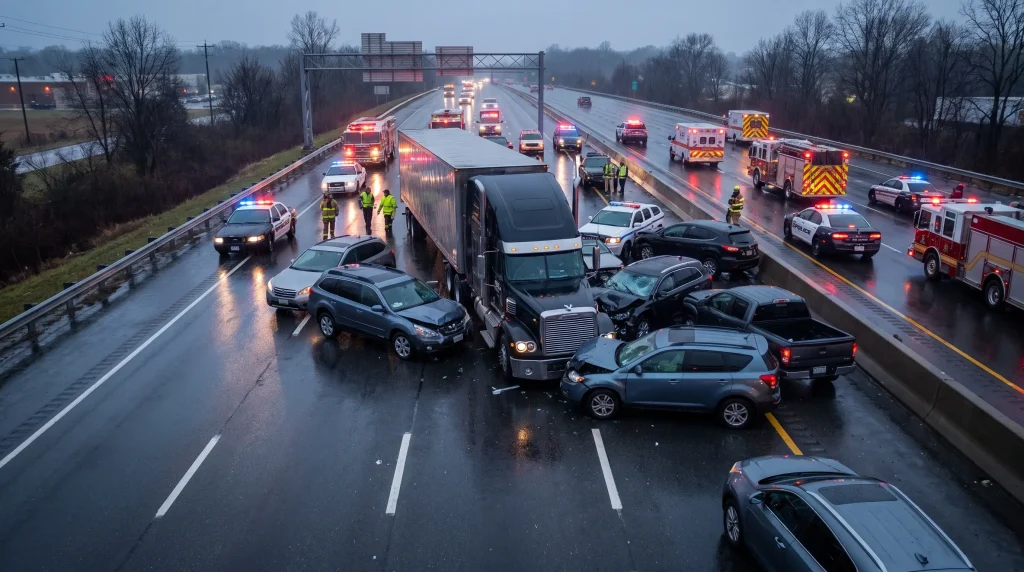
A mistake on a highway can quickly escalate into a dangerous situation when a large truck is involved. According to the Insurance Institute for Highway Safety (IIHS), there are over 120,000 large trucks involved in injury-causing crashes each year. In addition, large truck crashes caused around 5,340 fatalities nationwide annually.
Traffic accidents involving trucks are already complicated with several parties that could be involved in the case. But determining who is responsible for compensation is even more complicated in cases where a truck causes a multi-vehicle collision.
Truck pileups also create liability issues that do not show up in a typical two-car collision. The details may change based on the state where the crash happened.
Why Multi-Vehicle Truck Crashes Are Different
A chain reaction crash that includes a commercial truck is more than a typical wreck. That truck usually falls under a commercial insurance plan. It also has to meet federal safety rules. The driver may be acting in ways that affect more than just them, bringing risk to the trucking business.
When the truck hits and pulls in multiple vehicles, the driver often shares the blame along with other parties. One person may have caused the first contact by driving too close. In other cases, someone else makes a sudden lane change to get away from the crash.
More than one factor can play a role that resulted in the crash. It could be driver fatigue, poor attention, or a vehicle problem. A mechanical issue could be blamed if it was found earlier through checks.
Figuring out what happened may warrant a careful crash reconstruction. The person who caused the first contact is not always the one who led to the worst injuries. People involved in successive crashes may have different insurance claims than the person immediately following the truck.
Who Can Be Held Responsible
In an accident with three or more vehicles, there is more than one party that could be blamed. In many cases, fault is split. Often, the same wreck can give rise to multiple claims.
It is possible to say the trucker is at fault here too. Any violation or breaking of traffic rules or unsafe conduct could be accounted for. Examples of conduct that could expose a driver to liability include driving too quickly, improperly observing the road ahead, or taking any other violation of the traffic laws.
The trucking or delivery employer may also face liability. Such liability may occur when a rule makes the employer liable for an employee’s negligence while the employee is on the job. In these kinds of cases, the company’s insurance is often the main source of money used to pay losses. The liability outcome depends on the facts, including whether the driver was on the job.
In other cases, a maintenance provider may also be held responsible. These scenarios usually occur when a mechanical failure, like brake failure or a tire blowout, is a result of a failed maintenance check. In this situation, it can be argued that if the company had been more diligent with its checks, it could have fixed the issue before the accident.
Liability may reach contractors too. Subcontracted maintenance teams and other groups tied to the delivery work, like logistics providers, are legally responsible for a truck accident if their carelessness contributed to the crash.
Other drivers may also become liable. In many pileups, fault is shared. More than one driver can make a bad choice. Blame often lands on several sides, not just the truck driver.
How State Law Shapes Who Gets Compensated
When fault is spread across multiple people, state law controls how that split changes what an injured person may collect. The approach then shifts a lot based on the state where the crash happened. In California, the state uses a pure comparative fault system.
The California Supreme Court set it out in the 1975 case Li v. Yellow Cab Co. With that rule, an injured person can still recover even if they were mostly responsible. Their payout gets cut to reflect their share of fault. Under pure comparative fault rules, a person who is 90% responsible for their own injury still has a remaining 10% of recovery from another liable party.
Louisiana takes a different approach in recent times than it did for decades. Louisiana had followed a pure comparative fault system similar to California’s, but that changed as of January 1, 2026, when a new modified comparative fault law took effect. Under the revised rule, a person found 51 percent or more at fault for their injuries is barred from recovering anything at all. This change to the state’s fault system is a sharp break from the state’s prior approach and a meaningful shift for anyone injured in a multi-vehicle crash where fault is contested among several drivers.
A Lake Charles truck accident lawyer working under Louisiana’s current framework has to account for that 51 percent threshold from the earliest stages of a case, since crossing it can mean the difference between a full recovery and none at all.
Evidence That Untangles a Multi-Vehicle Pileup
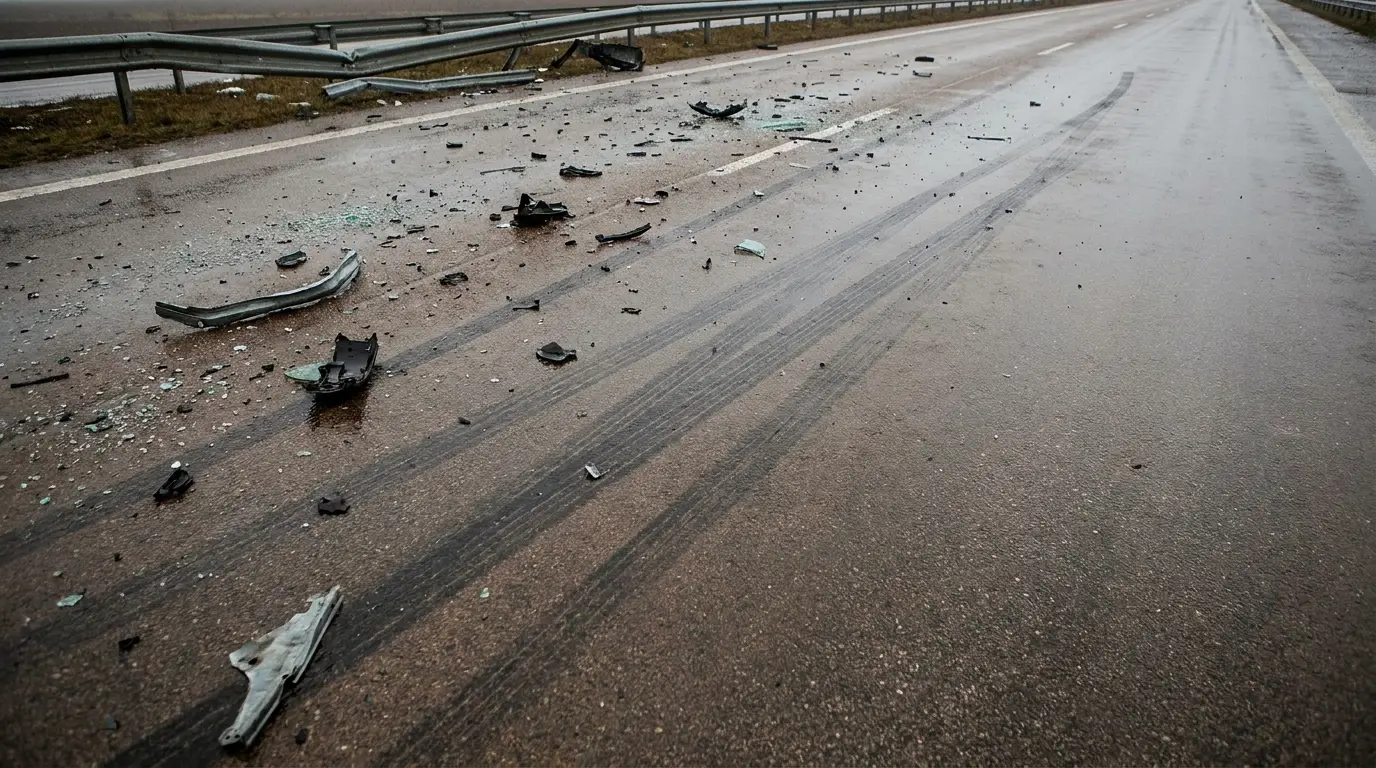
Proving fault across several vehicles and drivers requires more evidence than a standard two-car accident. Obtaining the police crash reports may help in determining the sequence of impacts. Available footage and data in a truck’s black box can show the speed, the braking behavior, and other conditions in the lead up to the initial collision. Keep in mind the data may disappear if the vehicle goes into the shop for repairs.
Driver logs and electronic logging device records help establish whether the truck driver was complying with federal hours-of-service rules at the time of the crash. Witness statements from other drivers and passengers, along with accident reconstruction analysis, often become necessary to establish the actual order of events when several vehicles were involved.
Internal company records that contain delivery schedules, driver qualification files, and maintenance logs can be used to establish if the conduct of the company, rather than the driver, caused the accident.
Why These Cases Take Longer to Resolve
Multi-vehicle truck collisions typically involve more insurance companies, more attorneys, and more competing accounts of what happened than a routine accident. The presence of these parties tends to draw out the claims process considerably.
Each injured driver may have a claim against a different combination of defendants. Insurers representing the trucking company often investigate aggressively to minimize their own exposure before an injured party’s own investigation is complete.
Since evidence like black box data and camera footage can disappear within days, involving an attorney early tends to matter more in these cases than in most other categories of vehicle collision.
The Practical Takeaway
In a crash that involves a truck and several other vehicles, fault is often split. It may not fall on one driver. It may not be covered by just one insurance plan either. Figuring out who could be held responsible matters because it shapes what money a person can actually get.
Each state uses its comparative fault rules. Once fault is divided, those rules decide how much a claim can still pay. Given how quickly the relevant evidence can disappear and how significantly state law can affect the outcome, these cases generally benefit from an early, thorough investigation rather than waiting to see how the insurance companies involved decide to handle things on their own.