

A skincare ingredient can acquire a much bigger reputation than the studies behind it. GHK-Cu is a good example: research into collagen and tissue repair has made it an appealing subject for discussions about skin ageing, sometimes alongside much broader claims about rejuvenation.
There is real science here. Some of it goes back decades. The challenge is understanding what an experiment actually showed before applying its findings to a cream, a research vial or a claim about the whole body.
If you’ve come across a GHK-Cu peptide listing, start with the compound itself. Its name describes a short chain of amino acids bound to copper.
What the Name GHK-Cu Means
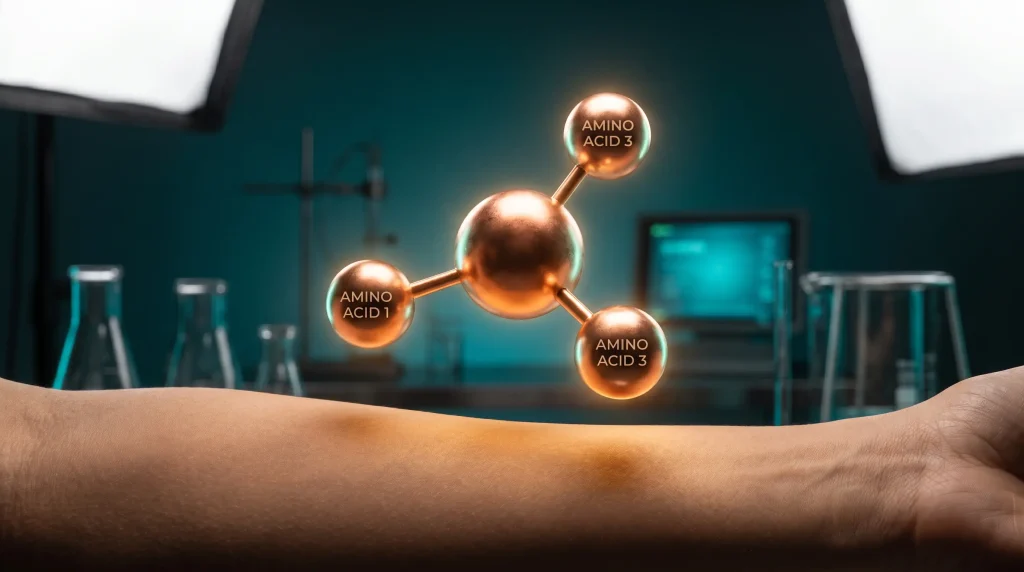
GHK stands for glycine, histidine and lysine, the three amino acids that form the peptide. A peptide containing three amino acids is called a tripeptide. “Cu” is the chemical symbol for copper.
GHK has been isolated from human plasma and has a strong affinity for copper ions. When the two bind, they form the GHK-Cu complex. This chemistry appears in the early published research on GHK-Cu.
That natural connection is part of the compound’s appeal. But finding a molecule in the body doesn’t tell us whether adding more will be beneficial. It also doesn’t establish a safe amount, a suitable formulation or an appropriate way to administer it.
Those are separate research questions, even when the starting molecule is familiar to human biology.
Why Collagen Research Draws Interest
Collagen gives GHK-Cu a clear connection to skincare. It contributes to the skin’s structure, so a compound that affects its production is an obvious candidate for further investigation.
In a 1988 study, researchers exposed cultured human fibroblasts, cells that produce connective-tissue components, to GHK-Cu. They observed increased collagen synthesis under the experimental conditions.
That finding helps explain the interest. It showed biological activity worth investigating, but the experiment did not measure facial wrinkles or test a finished skincare product.
A cell culture also leaves out much of what happens when an ingredient is applied to skin. Researchers still have to establish whether a formulation delivers the compound where it needs to go, whether a measurable benefit follows and whether people tolerate it.
“Stimulates collagen in cultured cells” and “visibly improves skin” are different claims. The first can justify studying the second; it cannot stand in for it.
What a Human Study Can Tell Us
A small randomised study of copper-peptide skincare after laser resurfacing illustrates why the details matter.
Thirteen patients completed the trial. After carbon dioxide laser treatment, participants followed skincare regimens with or without GHK-Cu. Researchers assessed redness, wrinkles and overall skin appearance, and patients completed questionnaires.
The GHK-Cu group reported greater satisfaction. Objective assessments, however, did not find a significant advantage between groups in wrinkle improvement or overall skin quality. Nor did they show that redness resolved sooner.
It would be easy to describe that study as positive by mentioning satisfaction alone. It would also be incomplete to ignore the patients’ experience. Both findings belong in the account.
The small sample and the post-laser setting limit how far the results can be applied. They don’t establish what an unrelated serum will do on untreated skin, much less what an injectable product would do.
Skincare and Injectable Products Need Different Evidence
The name GHK-Cu can appear in discussions about topical cosmetics, laboratory materials and injections. Seeing the same compound name across those settings does not make the products interchangeable.
A topical study tests a particular formulation applied to skin. An injection changes the route of exposure and raises different safety questions. A research material is not a finished skincare product, and its purity result alone cannot establish suitability for human use.
The US Food and Drug Administration identifies safety concerns with injectable GHK-Cu. It cites limited human safety data and potential immune reactions associated with peptide aggregation and impurities.
In Canada, GHK-Cu also appears in Health Canada’s warning about unauthorised injectable peptides. The advisory explains that “research use only” labelling does not remove regulatory requirements. Research-labelled products should not be used for self-treatment.
These warnings concern unauthorised injectable products. They should not be read as findings about every cosmetic containing a copper peptide.
Why the Interest Has Outpaced the Answers
GHK-Cu has an appealing scientific story: a small peptide associated with human biology, the ability to bind copper and experimental findings connected to collagen. It’s easy to see how that combination attracts readers interested in skin ageing.
The difficulty begins when a narrow finding becomes a broad promise. Collagen production in a laboratory does not establish whole-body rejuvenation. Satisfaction after a cosmetic procedure does not prove an anti-ageing treatment works across products and routes of use.
When a claim sounds impressive, look for the study behind it. Was the work done in cells, animals or people? What product was tested, and what changed? A measured result is more useful than the word “repair” without an explanation.
GHK-Cu deserves attention as a research subject. Whether a particular product delivers a worthwhile benefit requires evidence about that product and its intended use. That’s the question a familiar ingredient name cannot answer on its own.