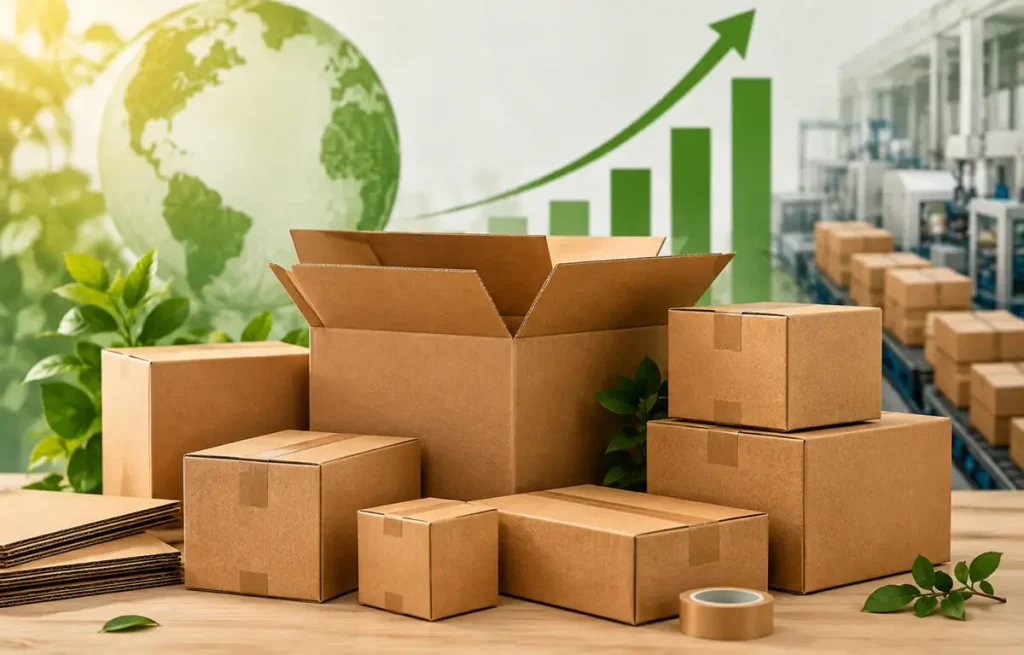
Think about the last three things you ordered online. Chances are they all showed up in some version of the same thing a plain brown box you broke down for recycling within minutes, barely thinking about it.
That box is part of one of the fastest-growing corners of global manufacturing right now, and the numbers are big enough that they’re worth a second look.
Depending on which industry report you check, the global corrugated packaging market sits somewhere between $234 and $274 billion in 2025–2026. Several forecasts have it climbing past $400 billion within the next decade, some go as high as $500 billion. Pull back even further and the whole global packaging industry cardboard included is sitting around $1.1 to $1.2 trillion this year. Paper-based packaging alone (corrugated board, folding cartons, and cardboard boxes) makes up roughly a third of that by volume. It’s the single largest packaging material category on the planet, full stop.
So why is a genuinely unglamorous industry growing this fast? And is there actually room in it for someone who isn’t running a billion-dollar paper mill?
E-Commerce Is Doing Most of the Heavy Lifting
Here’s the simple version: almost everything bought online has to travel inside something, and more often than not these days, that something is corrugated cardboard.
North American e-commerce shipments crossed 20 billion parcels in a recent 12-month stretch, with about 92% of them moving in corrugated containers. USPS package volume climbed 7.2% year-over-year over the same window. Private carriers did even better, with business-to-consumer deliveries jumping 12%. Every one of those shipments needed a box, and increasingly, companies want that box to be more than just a container.
The e-commerce packaging segment specifically is now valued above $220 billion for 2026, growing at close to 6.4% a year faster than the packaging market overall. That’s the interesting part, honestly. It’s not just that more boxes are getting made. Brands are actively upgrading what those boxes look like and how they function, because a shipping box has quietly become a branding tool.
Even the Biggest Retailers Are Rebuilding Around This
This isn’t only playing out with small brands testing branded mailers, either. Some of the largest retailers on the planet are restructuring entire fulfillment operations around smarter cardboard.
Amazon rolled out more than 200 on-demand packaging stations across its regional network. That let the company retire a fixed lineup of 26 standard box sizes and switch to boxes cut to fit each order a move that reportedly cut material waste by about 18% per parcel. That’s not some side sustainability initiative for a press release. It’s a cost play at enormous scale, and it hints at where the rest of the industry is probably headed: precision-fit, on-demand packaging instead of the old one-size-fits-most model.
Manufacturers are putting real money behind that shift too. Saica Group committed more than $110 million to a new corrugated plant in Indiana. Other producers are making similar bets across the country as demand keeps climbing, particularly in North America which several market reports now call the fastest-growing region globally, ahead of even Asia-Pacific’s much larger manufacturing base.
Where the Actual Opportunity Sits for Smaller Players
This is probably the part worth paying attention to if you’re thinking about building something rather than just watching the market.
Getting into cardboard manufacturing itself takes serious capital factories, converting machinery, raw material contracts. Not exactly a weekend project. But something has opened up around that manufacturing base: custom packaging design and supply aimed at small e-commerce brands that don’t have the order volume to work directly with the big mills.
A growing number of platforms now specialize in exactly that gap. Low minimums (some as low as a single unit for sampling), online design tools, domestic production the kind of flexibility that lets a small brand order a few hundred custom printed boxes instead of the 1,000-plus unit minimums that used to be the norm. Pricing usually lands somewhere between $0.50 and $5 per unit depending on size and material, which is genuinely within reach for someone testing a new product.
If you’re looking at this more as a services business than a manufacturing one reselling sustainable or biodegradable packaging materials to local companies, say some industry guides put realistic startup costs at $5,000 to $15,000. That’s a fraction of what almost any physical manufacturing venture would cost to get off the ground.
Why the Box Itself Actually Matters to Buyers
None of this growth would make much sense if packaging were purely functional. It isn’t, though. Consumer research keeps coming back to the same finding: packaging materially shapes buying decisions. Most shoppers say they’re more likely to buy from a brand using paper or cardboard packaging over plastic. A similar majority associate cardboard with a more premium product which is a little surprising, given how much cheaper it is than plastic or metal packaging.
Custom-branded packaging specifically has been linked to a 40% jump in brand recognition compared to generic packaging. That number goes a long way toward explaining why so many direct-to-consumer brands now treat their shipping box as an actual marketing channel instead of an afterthought tacked on at the end.
A Few Things Worth Watching Going Forward
A handful of trends are shaping where this heads next, whether you’re buying packaging, designing it, or thinking about a business built around it:
Sustainability isn’t optional anymore. Regulation is forcing the issue the EU’s Packaging and Packaging Waste Regulation, plus Extended Producer Responsibility laws now active in five U.S. states, are pushing brands toward recyclable, fiber-based packaging whether they want to or not.
Fit-to-product sizing is trickling down from giants like Amazon to much smaller operations. The same box-on-demand tech cutting Amazon’s waste numbers is becoming affordable enough for mid-sized fulfillment centers to adopt, which helps cost and environmental impact at the same time.
Digital printing keeps closing the customization gap. Short runs and highly custom designs don’t carry the cost penalty they used to, which is a big reason small brands can now hold their own visually against much bigger competitors.
Personal care and cosmetics packaging is outgrowing almost every other category even food packaging, which has traditionally led the pack. Worth knowing if you’re deciding which product space to build a packaging-adjacent business around.
Bottom Line
Nobody’s pitching cardboard boxes on a startup stage for the drama of it. It’s not a flashy story. But the numbers underneath it tell a pretty different one a trillion-dollar-plus global industry, growing steadily on the back of e-commerce that shows no sign of slowing, with a genuinely reachable entry point for small brands and packaging entrepreneurs who don’t need to own a paper mill to get in.
Whether you’re launching a product that needs its first custom box or thinking about the packaging supply business itself, the data points the same direction. This unglamorous industry is turning out to be one of the more resilient, recession-resistant opportunities heading into the back half of the decade.