


The article explores in detail what AI chatbots are, their benefits, major trends, opportunities created, challenges, and how businesses can prepare for the future.
In recent years, artificial intelligence has moved far beyond the idea of machines simply following a set of predefined instructions. In 2026, AI has become a practical part of everyday digital experience, with AI chatbots being the most visible examples of this transformation.
From answering customer questions and helping employees find information to supporting sales, education, healthcare, and online services, AI chatbots are becoming increasingly capable. Modern chatbots can easily understand natural language, remember context, work with different types of data, and complete certain tasks, rather than simply responding to questions.
The evolution of AI chatbots is set to create exciting opportunities but is also sure to introduce key challenges involving accuracy, privacy, security, cost, and responsible AI adoption.
What Are AI Chatbots?
AI Chatbots are a type of software application that uses artificial intelligence to communicate with people using natural language. Modern AI chatbots can easily interpret more flexible questions and generate responses based on context, unlike traditional rule-based chatbots, which depend heavily on predefined keywords and decision trees.
Various modern AI chatbots utilize large language models (LLMs), natural-language processing, retrieval systems, and integrations with business software. This enables the chatbots to perform various tasks such as summarizing documents, drafting emails, answering questions from company knowledge bases, assisting customers, and guiding users through processes.
Benefits of AI Chatbots
AI chatbots offer several key benefits to businesses, organizations, and users. Some of the key benefits of AI chatbots are as follows:
- 24/7 Availability
AI chatbots can offer assistance around the clock, including weekends and holidays. With AI chatbots, customers can ask questions or get basic support whenever they need it.
- Faster Customer Support
Chatbots can respond to questions almost instantly. Instead of waiting for a customer-service representative, users can quickly receive answers to common questions.
- Reduced Costs
By automating repetitive tasks, AI chatbots can efficiently reduce the workload on customer-support teams. This can help businesses save operational costs while allowing employees to focus more on complex tasks.
- Improved Customer Experience
The AI chatbot can offer personalized responses based on the questions and available content of the user. A well-designed chatbot can make interactions more convenient and consistent.
Popular AI Chatbots for Businesses
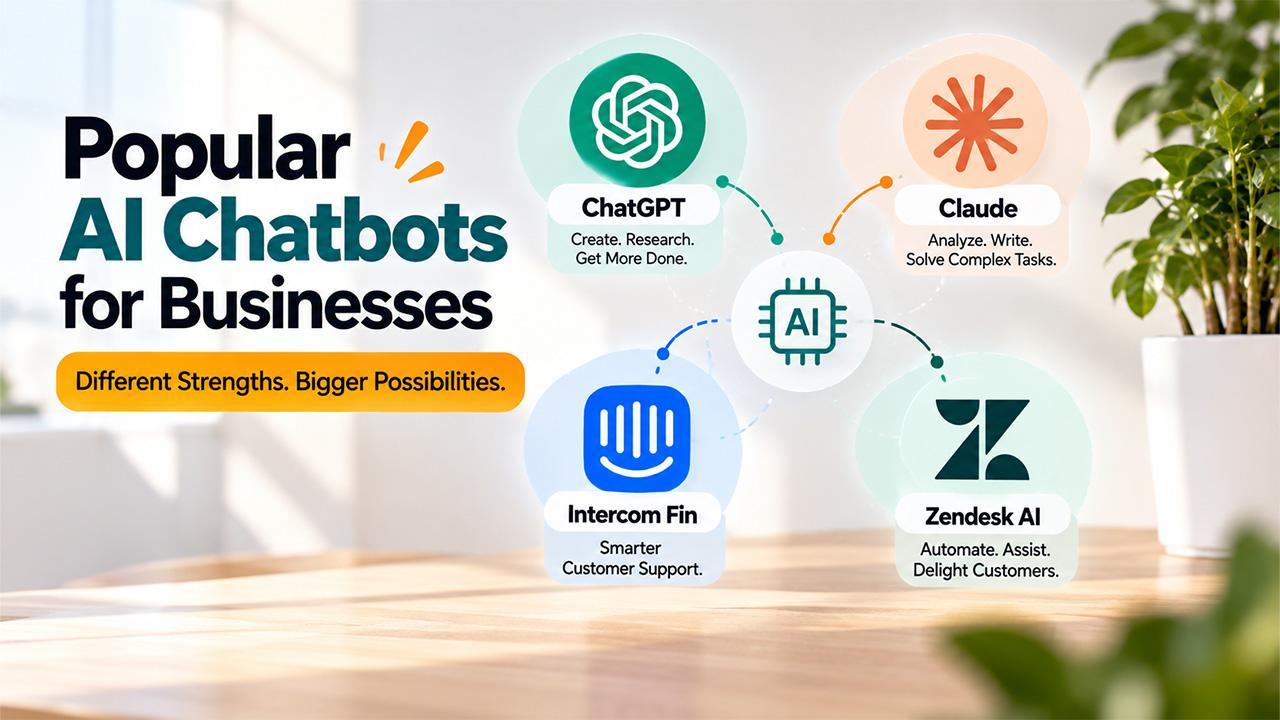
In 2026, businesses have access to a wide range of AI chatbots, ranging from general-purpose assistants to specialized customer-service platforms. Some of the popular AI chatbots for businesses include:
- ChatGPT
ChatGPT is among the most popular AI chatbots and is useful for content creation and research. Customer support, brainstorming, data analysis, and internal productivity. With ChatGPT, businesses can also build customized AI assistants for specific workflows.
- Claude
Claude is known for handling long documents, analysis, writing, coding, and enterprise-oriented workflows. The platform can be useful for organizations that need AI assistance with complex information.
- Intercom Fin
Intercom Fin is designed primarily for customer service. The platform can answer questions using a company’s support content and help automate support conversations while handling more complicated issues to human agents.
- Zendesk AI
Zendesk AI combines AI capabilities with customer-service workflows. It helps businesses automate responses, assist support agents, and manage customer interactions.
Expert Perspective: Implementing AI Chatbots for Business
Implementing an AI chatbot successfully requires more than selecting an AI model and adding a chat interface to a website. Businesses need to consider their goals, existing workflows, data sources, integrations, security requirements, and long-term maintenance.
OutRight Systems approaches business technology projects through a structured process that begins with understanding business requirements and workflows before moving into planning, development, integration, testing, deployment, and ongoing support. This approach is particularly relevant to AI chatbot implementation because a chatbot needs to work reliably within the wider business ecosystem rather than operate as an isolated tool.
With experience across CRM development, integrations, automation, and AI solutions, OutRight Systems highlights the importance of treating AI chatbot adoption as a business transformation project rather than simply a technology upgrade. Organizations can benefit from starting with clearly defined use cases, testing the chatbot against real business scenarios, and gradually expanding its capabilities as performance and user trust improve.
Opportunities Created by AI Chatbots
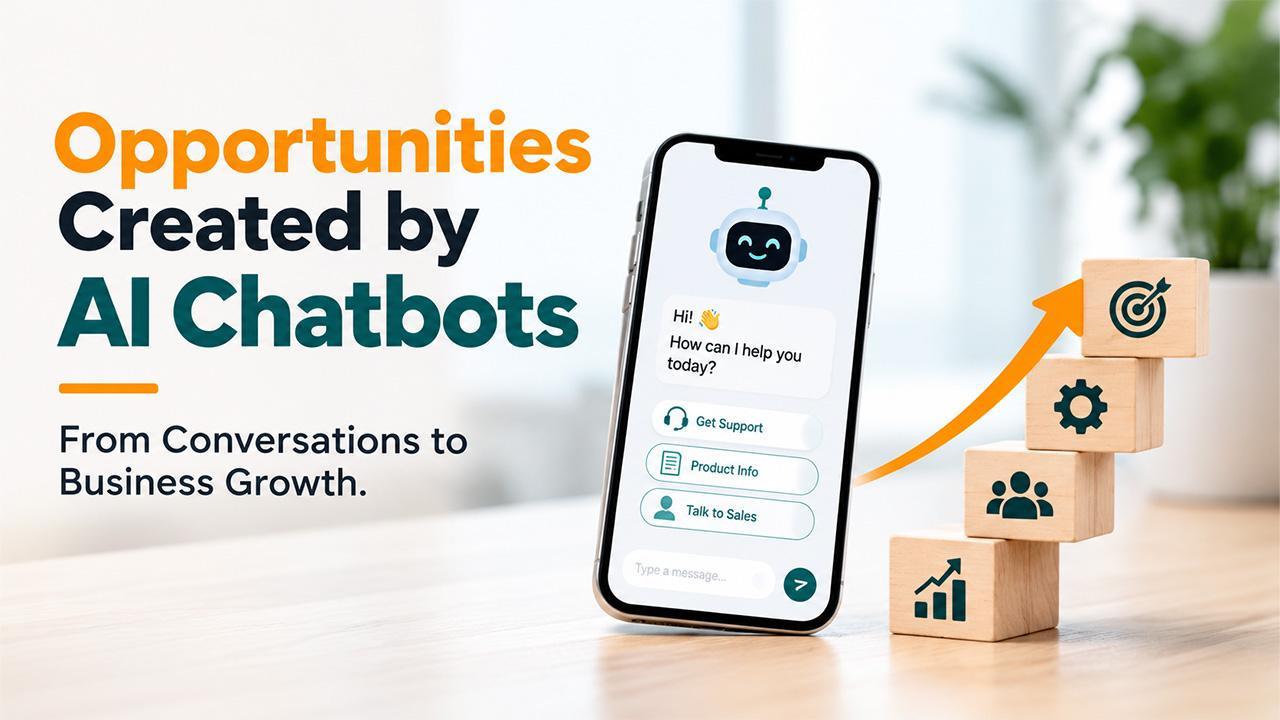
AI chatbots have created significant opportunities for businesses by changing how organizations interact with customers, manage internal processes, and deliver services. Chatbots are increasingly moving beyond simple question-and-answer systems and becoming intelligent assistants that are capable of supporting more complex tasks.
Some of the key opportunities created by AI chatbots are as follows:
- 24/7 Customer Support
One of the major opportunities created by AI chatbots is providing customer assistance around the clock. The AI chatbot can answer FAQs, provide product information, troubleshoot common issues, and guide customers through basic processes, without requiring human intervention.
- Increased Employee Productivity
The AI chatbot can act as a virtual assistant for employees. The chatbot can help draft emails, summarize documents, find information, generate reports, brainstorm ideas, and support routine administrative tasks.
- Cost and Operational Efficiency
By automating repetitive customer service and administrative tasks, AI chatbots can support business process automation and help organizations use their resources more efficiently. AI chatbots can handle multiple conversations simultaneously, reducing the workload on human support teams and allowing employees to focus on more complex activities.
- Personalized Customer Experiences
The AI chatbot can use permitted customer information and conversation context to offer more relevant interactions. With AI chatbots, personalization can make customer interactions faster and more convenient.
Major AI Chatbot Trends
Several major trends are shaping AI chatbots in 2026. These chatbots are moving from basic question-and-answer tools to intelligent systems that can understand context, work with different types of information, and perform tasks on behalf of users.
Some of the major trends shaping AI chatbots are as follows:
- AI Agents and Autonomous Task Completion
The rise of AI agents is among the biggest trends. Traditional chatbots primarily offer information, while AI agents can take action to accomplish a goal. This shift from “answering questions” to “completing tasks” is making the chatbot more valuable for businesses.
- Multimodal AI Chatbots
Modern chatbots are capable of understanding more than text. They can work with images, voice, documents, audio, and other forms of data. Voice-based conversations are also becoming more natural, creating opportunities for businesses to offer hands-free and more conversational customer experiences.
- Greater Personalization
AI chatbots are becoming better at delivering personalized interactions. Instead of offering identical responses to every user, they can use relevant context and authorized information to tailor conversations to the customer.
- Integration with Business Applications
A major trend is AI integration with existing business software. Instead of operating as a standalone chat window, an AI assistant can connect with various tools, such as CRM platforms, help-desk systems, databases, calendars, communication platforms, and productivity applications.
Challenges of AI Chatbots
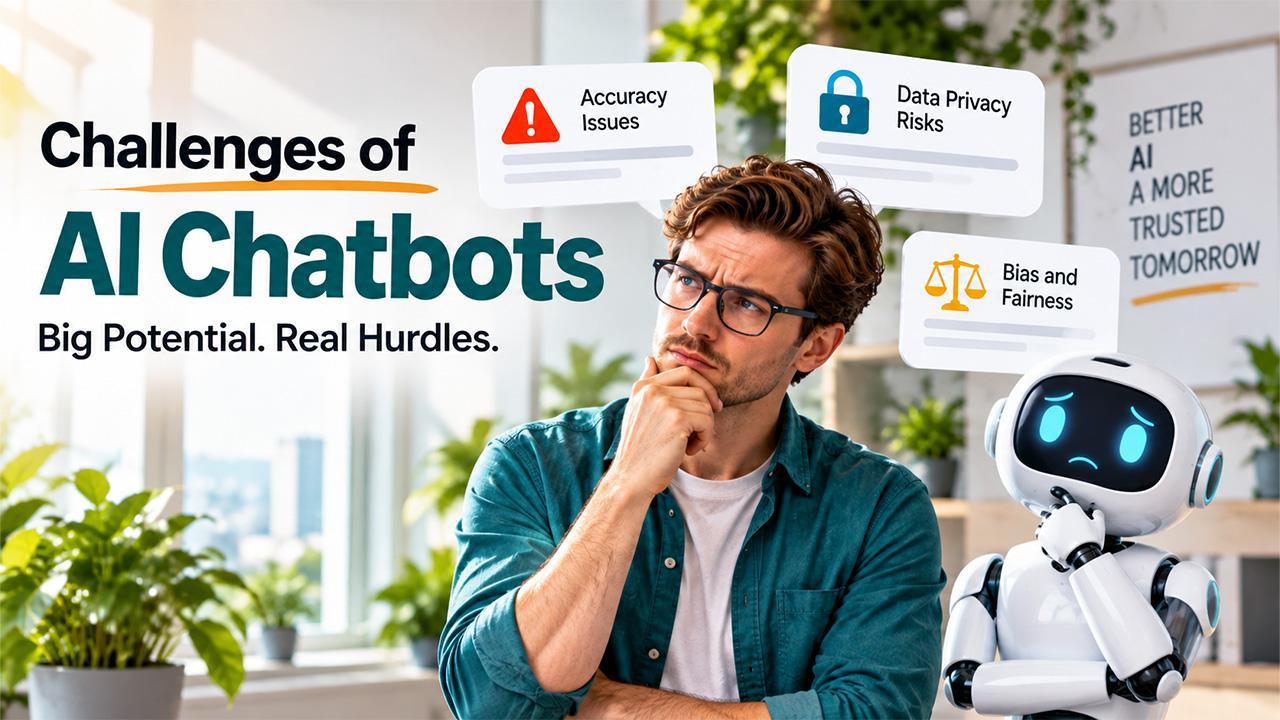
Although AI chatbots offer major benefits, their rapid adoption also creates technical, ethical, and business challenges. Some of the major challenges of AI chatbots are as follows:
- Accuracy and Hallucinations
One of the major challenges of AI chatbots is that they can sometimes generate incorrect or misleading information. These responses can sound confident even when the underlying information is wrong. This is especially concerning in industries like healthcare, finance, and legal services, where inaccurate information can have severe consequences.
- Data Privacy and Security
AI chatbots may process sensitive information, which includes customer details, business documents, financial information, or internal communication. Organizations need to be careful about how this information is collected, stored, processed, and accessed.
- Bias and Fairness
AI models generally learn patterns from large amounts of data, and if that data contains biases, the chatbots may sometimes produce responses that are unfair, inappropriate, or inconsistent across different groups of users.
The Future of AI Chatbots
The future of AI chatbots is moving towards intelligent, proactive, and task-oriented digital assistants. As AI models are becoming more capable, chatbots are expected to play a larger role in customer service, business operations, education, healthcare, and everyday productivity.
Some of the key elements that are expected in the future of AI chatbots are as follows:
- From Chatbot to AI Agents
The biggest transformation expected is the transition from chatbots that simply answer questions to AI agents that can take action. By combining conversational AI with workflow automation, businesses can allow AI agents to coordinate multiple steps and complete tasks across different systems. This will make conversational AI an interface for completing tasks rather than just receiving information.
- More Natural Human-AI Conversations
The future of chatbots is set to become increasingly natural in the way they communicate. The improvements in language understanding, voice technology, and contextual reasoning are set to allow AI to handle longer and more complicated conversations.
- Multimodal Experiences
AI chatbots will increasingly combine text, voice, images, video, and documents in a single interaction. This will make AI assistants useful in situations where text alone is insufficient.
Conclusion
AI chatbots are rapidly evolving from just simple customer-service tools to intelligent assistants that are capable of supporting business operations, improving productivity, and delivering personalized experiences. Businesses have significant opportunities to use AI chatbots for automation, customer engagement, and smarter workflows. Businesses that combine the right AI technology with strong human oversight, reliable data, and a clear implementation strategy will be best positioned to benefit from the future of AI chatbots.
Frequently Asked Questions
- What are the main benefits of AI chatbots for businesses?
The key benefits of AI chatbots for businesses include 24/7 availability, faster customer support, reduced workload, improved operational efficiency, personalized interactions, and better access to business information.
- Can AI chatbots work with business applications?
Yes, AI chatbots can work with business applications. AI chatbots can be integrated with systems such as CRM platforms, help-desk software, databases, calendars, knowledge bases, and productivity applications, depending on the platform and implementation.
- Can AI chatbots replace human customer service agents?
Yes, AI chatbots can replace human customer service agents. AI chatbots can automate many repetitive customer service tasks, but they are not suitable for every situation.
- Is AI chatbots secure for businesses?
The security of AI chatbots depends on how the system is designed, configured, integrated, and managed.