Let me start with a confession: I used to think electric toothbrushes were boring.
Not boring in the sense that oral hygiene doesn’t matter — it does, obviously — but boring in the sense that there hadn’t been a genuinely new idea in this space since… well, since the electric toothbrush was invented in 1954. The past seven decades have been an endless cycle of incremental updates. Motors got a little quieter. Batteries lasted a little longer. Companion apps arrived, were downloaded, and were promptly abandoned by 90% of users within two weeks. But the fundamental mechanism — bristles, attached to a head, moving back and forth really fast — remained untouched.
So when RANVOO reached out about the AirJet X5, a toothbrush that claimed to use “microbubble cavitation” instead of mechanical friction to clean between teeth, I did what any reasonable tech reviewer would do: I rolled my eyes, muttered something about marketing nonsense under my breath, and almost declined the review unit. Then I read the patent filings. Twenty of them. And I thought: okay, maybe there’s something here worth looking at.
Four months later, the AirJet X5 has claimed permanent real estate in my bathroom, and my previous daily driver — a $330 flagship from a brand I won’t name — is sitting in a drawer, battery dead, unloved. Here’s why.
Unboxing: The Wall Mount That Changes Everything
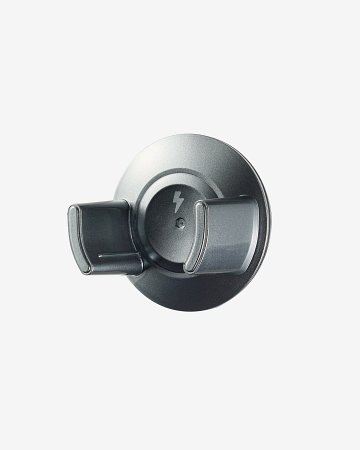
The AirJet X5 arrives in packaging that strikes the right balance between premium and not-wasteful. You get the handle, one bubble brush head, a 0.5-meter USB-A to USB-C charging cable in white, and the accessory that has genuinely changed my bathroom countertop situation: a magnetic wall mount with integrated wireless charging.
Let me pause on this wall mount for a moment, because it’s the kind of thing that seems like a gimmick until you live with it for a week, at which point you wonder why every electric toothbrush doesn’t come with one. The mount adheres to tile or mirror surfaces — I stuck mine next to the bathroom mirror at eye level — and the toothbrush snaps into place with a magnetic connection that feels solid. No alignment pins to fumble with. No cradle that accumulates a pool of stale water at the bottom. Just a clean vertical dock. The brush charges whenever it’s mounted. You never think about charging again.
I cannot overstate how much this single design decision improves the daily experience. My previous toothbrush lived on a charging puck that, within three months, had developed that faint pink-gray biofilm around the base that every electric toothbrush owner knows and quietly tries not to think about. The AirJet X5’s mount eliminates standing water entirely. Gravity drains moisture away from the handle. After four months, mine looks like it did on day one. No spots. No film. No mold.
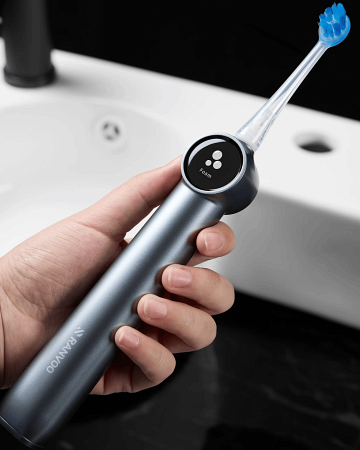
The handle itself comes in four colors — Gray, White, Blue, and Purple. My review unit is the Gray finish, an ABS body with what RANVOO calls a SiC (silicon carbide) anti-mold coating. At 153 grams with the brush head attached, it’s substantial without feeling heavy. The 0.79-inch TFT display (128 × 128 pixels) is small but crisp, showing mode, battery level, and a quadrant timer with 30-second pacing prompts. It’s not trying to be a smartwatch on a toothbrush handle. It’s giving you exactly the information you need and nothing you don’t.
Build quality is genuinely impressive for a $119.99 device. The stainless steel connecting shaft shows no signs of corrosion after months of wet-bathroom use — a failure point I’ve seen on brushes costing twice as much. The IPX7 waterproof rating means the entire handle can be submerged in a meter of water for 30 minutes. I’ve used it in the shower dozens of times with zero issues.
Super Bubble 2.0: The Tech That Sounds Like a Gimmick But Isn’t
Alright, let’s get into the thing that makes the AirJet X5 different from every other toothbrush on the market: Super Bubble 2.0.
Here’s how RANVOO explains it: a Boosted Bubble Chamber inside the handle aerates the water-toothpaste mixture into a stream of microbubbles. These bubbles are then propelled along a specially designed Coanda-effect brush head — named for the fluid-dynamics principle where a jet of liquid adheres to a curved surface — which directs the bubble-laden flow along your teeth and into the gaps between them. When the bubbles reach those tight interproximal spaces, they collapse. That collapse, called cavitation, produces a localized high-pressure microjet that physically disrupts plaque biofilm. Without bristles having to actually touch that area.
If this sounds like fluid-dynamics jargon, here’s the plain-English version: instead of scrubbing plaque off your teeth with bristle friction like every other toothbrush does, the AirJet X5 uses a directed stream of tiny bubbles that flow into the gaps between your teeth and then pop — and the force of those popping bubbles knocks plaque loose. You’re cleaning with fluid energy, not mechanical abrasion.
The first time I used Bubble mode, the sensation was genuinely unfamiliar. There’s a soft effervescence — the closest comparison I can make is the feeling of a very gentle water flosser combined with the vibration of an electric brush, but neither analogy quite captures it. The bristles are moving at 15,600 strokes per minute (130 Hz) in this mode, which is slow by electric toothbrush standards — most premium sonic brushes operate between 31,000 and 42,000 strokes per minute. But the cleaning sensation doesn’t feel weaker; it feels different. The liquid flow rate in Bubble mode is 1,000 milliliters per minute. That’s roughly two liters of bubble-infused fluid passing through your mouth during a standard two-minute session. You can feel the flow working, especially between molars.
The post-brush “tongue test” — running your tongue over your teeth to check for that smooth, just-cleaned feeling — consistently produced better results than my previous sonic brush, particularly on the lingual (tongue-side) surfaces of my lower front teeth. Those surfaces are notorious for calculus buildup because they’re hard to reach and saliva pools there. After a week of Bubble mode, I noticed a reduction in that slightly rough texture that I’d always assumed was just… normal. It wasn’t. My previous brush was missing those spots. The AirJet X5 wasn’t.
RANVOO claims a 97% plaque removal rate and Grade 1 cleaning efficiency. I don’t have a laboratory to independently verify those numbers. What I can verify is that plaque-disclosing tablets — those purple chewable tablets that stain plaque so you can see where you missed — showed consistently fewer residual deposits with the AirJet X5, especially between teeth, compared to my $330 sonic flagship. That’s not a clinical trial. It’s one guy with disclosing tablets and a mirror. But it’s also the most honest comparison most consumers are ever going to make, and the result was unambiguous.
Four Modes That Aren’t Just Different Timer Settings
A pet peeve of mine with electric toothbrushes: modes that are functionally identical. You cycle through “Clean,” “White,” and “Gum Care,” and the motor sounds exactly the same, the bristles feel exactly the same, and you strongly suspect the only thing changing is the label on the LED. This is more common than manufacturers would like you to believe.
The AirJet X5 does not have this problem. Each of its four modes operates with a physically distinct set of parameters — frequency, liquid flow rate, amplitude, and oscillation angle all change meaningfully between modes.
Bubble Mode is the star of the show. 15,600 strokes per minute. 1,000 ml/min flow rate — the highest of any mode. Amplitude of 1.2 to 2.5 millimeters. Oscillation angle of 6.8 to 14.0 degrees. This is the mode you use when you want maximum interdental cleaning — the cavitation-driven deep clean that reaches between teeth. This has been my daily driver for three of the four months I’ve been testing. The sensation is pleasant, almost gentle, but the results are the best I’ve experienced from any electric toothbrush.
Sensitive Mode runs at the same 15,600 strokes per minute but drops the flow rate to 500 ml/min — half the Bubble mode volume. Amplitude increases to 3.0–4.5 mm, and the oscillation angle widens to 16.7–24.2 degrees. This mode is designed for gum care — less fluid pressure, more mechanical stimulation. When my gums felt tender after a particularly aggressive flossing session (my own fault, not the brush’s), switching to Sensitive mode for a few days made a noticeable difference.
Clean Mode is the all-purpose daily option. 21,600 strokes per minute (180 Hz) — the highest frequency in the X5’s range, but still well below the 31,000+ typical of premium sonic brushes. Flow rate of 800 ml/min. The tightest amplitude range at 0.5–2.2 mm and the narrowest oscillation at 2.9–12.4 degrees. This mode feels the most like a “traditional” electric toothbrush experience, just smoother and quieter. It’s the mode I’d recommend to someone transitioning from a conventional sonic brush.
Whitening Mode alternates frequencies — 18,500 strokes per minute, switching between 180 Hz and 130 Hz — with a full 1,000 ml/min flow rate and amplitude pushing up to 4.5 mm. The oscillation range is the widest at 14.0–24.2 degrees. The alternating frequency modulation gives this mode a distinctive rhythm that you can feel as a subtle pulsing sensation. I used this mode for one session per day (mornings, with Bubble mode at night) for two weeks and subjectively noticed slightly brighter enamel, though I’ll be upfront: I don’t have a spectrophotometer to quantify it. Stain removal claims are notoriously hard to verify without lab equipment.
What I appreciate most about the mode implementation is that RANVOO published the actual parameters. Frequency, flow rate, amplitude, oscillation angle — all disclosed, mode by mode. This is unfortunately rare in the oral care industry, where specifications are often obscured by vague marketing language. You can look at the numbers and understand exactly what each mode does and how they differ.
The Comfort Factor: Why 21,600 Strokes Might Be Enough
I need to talk about frequency, because it’s the specification where the AirJet X5 makes its most contrarian bet — and it’s a bet that I’ve come to believe is correct.
The electric toothbrush industry has been in a frequency arms race for as long as I’ve been reviewing these devices. 31,000 strokes per minute. 42,000. 62,000. The marketing logic is seductive in its simplicity: more strokes equals more cleaning. It’s the same logic that led to the megapixel wars in digital cameras and the gigahertz wars in CPUs. And like those wars, it eventually runs into the limits of what the human body can actually benefit from — or tolerate.
The AirJet X5 tops out at 21,600 strokes per minute. That’s not a bug. It’s not a cost-cutting measure. It is, according to RANVOO’s engineering team, the result of a deliberate analysis of what frequency range cleans effectively without traumatizing gingival tissue. The brush operates with a 12-degree micro-oscillating sweep — roughly half the angular displacement of many premium competitors. The bristles are 0.01 mm ultra-fine nylon with a certified 99.99% end-rounding rate, meaning the tips are polished into smooth domes rather than left as sharp-edged cylinders.
Here’s what all of that means in practice: the AirJet X5 is the most comfortable electric toothbrush I have ever used. Not comfortable in the sense of “weak.” Comfortable in the sense of “my gums don’t feel like they’ve been through a mild collision after brushing.” The difference is most apparent in the morning, when my previous high-frequency brush would occasionally cause a tiny amount of bleeding along the gum line — nothing alarming, just a faint pink tinge in the sink that I’d learned to accept as normal. With the AirJet X5, that hasn’t happened once in four months. Not a single episode of bleeding, even when I’ve deliberately experimented with pressing harder than I should.
The TPE rubber backing on the brush head deserves specific mention. It’s a shock-absorbing layer that eliminates the jarring sensation when the hard plastic head accidentally contacts an adjacent tooth. If you’ve ever winced because your toothbrush head knocked against a tooth while you were distracted, you know exactly what this feels like — and you’ll notice its absence on other brushes. The rubber backing is one of those small design decisions that you don’t appreciate until you go back to a brush without it. When I pulled my old sonic brush out of the drawer for a comparison session, the first thing I noticed was the hard-plastic clatter. I’d never registered it before. Now I can’t un-notice it.
The Mold Problem: Solving What Nobody Talks About
Let’s discuss something gross. If you’ve owned an electric toothbrush for more than six months, go look at the base of the handle. Look at the seams around the head attachment. Look at the charging stand. If you’re seeing black speckles, that’s mold. And you’ve probably been ignoring it, because what are you supposed to do — throw away a $200 toothbrush because the plastic got colonized?
The oral care industry doesn’t talk about this problem because there’s no good way to talk about it. “Our toothbrush eventually grows mold” is not a compelling marketing message. But every bathroom is a high-humidity environment, every toothbrush handle is handled with wet hands, and every charging base that sits on a countertop is a potential reservoir for standing water. The conditions are perfect for microbial growth, and the design of most electric toothbrushes does nothing to mitigate it.
The AirJet X5 is the first toothbrush I’ve tested that treats this as a first-class engineering problem rather than an inconvenient reality to be ignored. The SiC anti-mold coating on both the handle and the wall mount is certified to Grade 0 — the highest classification under mold-resistance testing standards, meaning zero mold growth under test conditions. The vertical magnetic wall mount eliminates the standing-water problem by design: the brush hangs, water drips down and away, and air circulates around the entire handle.
After four months in my bathroom — a bathroom that lacks ventilation and gets genuinely steamy during showers — there is no mold. No speckling. No discoloration. No faint musty smell near the charging contacts. The handle looks factory-new. I’ve never been able to say that about any electric toothbrush I’ve owned for more than a few months.
The IPX7 waterproof rating on the handle means it can be thoroughly rinsed — or used in the shower — without concern. The wall mount is IPX4 splash-resistant. You can clean the entire system with water without worrying about water ingress.
This section of the review exists because the mold problem is real, it’s ubiquitous, and it’s almost never addressed in toothbrush reviews. The AirJet X5’s solution is comprehensive. It deserves to be highlighted as a genuine differentiator.
Battery Life: The Month-Long Benchmark
The AirJet X5 packs a 1,600 mAh lithium-ion battery — 5.92 watt-hours — which RANVOO rates for 26 to 39 days of use, depending on mode, based on two two-minute brushing sessions per day.
Here’s how that breaks down by mode:
- Bubble mode: 29–39 days
- Sensitive mode: 30–37 days
- Clean mode: 26–30 days
- Whitening mode: 28–32 days
In my real-world testing — cycling primarily between Bubble and Clean modes, twice daily, two minutes per session, with occasional Whitening mode sessions — I averaged 31 days between charges. That’s charging your toothbrush roughly once a month. For context, my previous flagship sonic brush needed charging every 12 to 14 days.
The charging situation is refreshingly practical. There are two paths: the magnetic wall mount (5V / 0.8A input) for passive, always-charged operation, and a USB-A to USB-C cable (5V / 0.5A) for direct charging. A full charge takes approximately six hours.
The USB-C port is a standard connector — not proprietary, not magnetic-pogo-pin-only, not “you must use our specific charger or buy a replacement for $40.” If you lose the cable, any USB-C cable in your house works. If you’re traveling internationally, you don’t need a special adapter. This is consumer-friendly design that shouldn’t be noteworthy, but in the electric toothbrush category — where proprietary chargers are still distressingly common — it absolutely is.
I took the AirJet X5 on a three-week trip without the charger. It held up fine. I came home with battery to spare. The anxiety of “did I pack the toothbrush charger?” — a specific, minor, but real travel anxiety that I’ve experienced dozens of times — simply disappeared. That’s the threshold that matters: when you stop thinking about battery life entirely.
Noise during operation is rated at ≤65 dB. In my measurements (using a basic decibel meter app, not professional equipment), the AirJet X5 consistently registered quieter than my Oral-B iO and noticeably quieter than the high-frequency sonic brush it replaced. It will not wake a sleeping partner. It probably won’t even wake a light sleeper in the same room.
The Brush Head: Small Details, Big Impact
The Bubble Brush Head included with the AirJet X5 deserves a dedicated section because brush head design is where the difference between “works” and “works well without causing damage” resides — and most consumers have no way to evaluate it.
Let’s start with the numbers. The head measures 81.5 × 14 × 19.5 mm — slightly more compact than the standard Philips Sonicare head profile, which matters for reaching posterior molars. Construction is multi-material: PP (polypropylene) brush stem, POM (polyoxymethylene) end cap, nylon bristles in an irregular arrangement, and a TPE (thermoplastic elastomer) rubber backing. The connecting shaft that joins head to handle is stainless steel.
The bristles are 0.01 mm ultra-fine nylon with a 99.99% end-rounding rate. This number — 99.99% — is one of those specifications that’s easy to gloss over but actually represents a meaningful manufacturing investment. When nylon bristles are cut during production, the tips are sharp-edged cylinders. Under a microscope, an unrounded bristle looks like a tiny hollow needle. Each of those sharp edges contacts your gum tissue thousands of times per session. End-rounding is the process of polishing those cut tips into smooth domes, and achieving 99.99% requires precision quality control that most manufacturers don’t bother with, because bristle tip quality is invisible to the naked eye and almost never appears on product packaging.
The irregular bristle arrangement — more than 50% bristle rounding rate — is designed to improve contact with uneven tooth surfaces. Standard linear bristle rows can miss the contours of molars and premolars. The irregular pattern helps.
The TPE rubber backing is, as I mentioned earlier, the shock absorber that eliminates hard-plastic contact noise and sensation. It’s also a softer surface for your cheeks and tongue compared to the rigid plastic backs found on most brush heads.
All mouth-contact materials are food-contact-grade certified. This is table stakes for a quality oral care product, but RANVOO’s willingness to publish the certification is consistent with the transparency approach they’ve taken across the entire specification sheet.
Replacement heads cost approximately $5–7 each when purchased in multi-packs. At the recommended 3-month replacement interval, annual head expenditure comes to roughly $21–28. This is notably lower than Philips Sonicare premium heads ($11–14 each, $43–57/year) and competitive with Oral-B iO heads ($6–9 each, $25–34/year).
What’s Missing: The Smart Feature Trade-Off
No product is right for everyone, and no review is honest without acknowledging what a product doesn’t do. The AirJet X5 does not include Bluetooth connectivity. It does not have a companion app. There is no AI-powered brushing coach. There is no pressure sensor with visual or haptic feedback. There is no tongue-cleaning mode. There is no travel case in the box.
For some users, these omissions will be disqualifying. If you are someone who genuinely uses the Philips Sonicare app’s 3D mouth-mapping feature to improve your brushing coverage, the AirJet X5 is not for you. If you rely on real-time pressure alerts to prevent over-brushing, you’ll miss that feature here.
However, the data on smart toothbrush feature engagement is worth considering. Multiple studies and surveys have found that the majority of users stop using brushing companion apps within two to four weeks of purchase. The initial novelty wears off. The phone stays on the nightstand. The Bluetooth connection drops and nobody bothers to reconnect it. The app becomes another icon on the home screen that gets ignored.
RANVOO’s bet is that most users would rather save $150–210 versus app-equipped flagships and get a brush that excels at the fundamentals — cleaning efficacy, comfort, build quality, battery life, and hygiene — without the digital layer that most people eventually abandon. Based on the engagement data I’ve seen across the category, that’s a bet I think is correct for the majority of buyers.
The absence of a pressure sensor is the omission I’d most like to see addressed in a future revision. The soft bristles, shock-absorbing head, and low-frequency operation mitigate the risk of over-brushing, but a visual indicator would still be welcome — especially for new users transitioning from manual brushes who may not have developed a sense of appropriate pressure. That said, in four months of use, I’ve not experienced any gum irritation that would suggest a pressure sensor was critically needed.
The Competitive Context
At $119.99, the AirJet X5 occupies a position in the market that is worth understanding. It sits above budget sonic brushes ($30–70) that offer basic vibration and little else. It sits below — sometimes far below — the flagship tier:
- Philips Sonicare 9900 Prestige: $329.99
- Oral-B iO Series 10: $267.79
And it competes directly with mid-to-premium offerings like the Oclean X Pro Elite ($79.99) and Soocas Neos II ($149.99).
What the AirJet X5 offers at its price point is notable: a genuinely novel cleaning mechanism (Super Bubble 2.0), premium build quality with anti-mold coating, the magnetic wall mount with wireless charging (included in the box, not a $50 add-on), a month of battery life, USB-C charging, and replacement heads that undercut the industry leaders on annual cost.
What it doesn’t offer — the smart features, the brand heritage, the retail availability at every drugstore — will matter more to some buyers than others. For the buyer who wants the best possible clean with the least possible gum trauma, and who doesn’t need an app to tell them how to brush their teeth, the value proposition is extremely strong.
Final Verdict
I’ve spent four months with the RANVOO AirJet X5, and in that time it has displaced a $330 flagship from my bathroom. That’s not a statement I make lightly. My job is to be skeptical of claims, to test products against their promises, and to call out the gap between marketing and reality when I find it.
The gap here is smaller than I expected. In some areas — particularly interdental cleaning and comfort — the AirJet X5 outperforms products that cost more than twice as much.
Super Bubble 2.0 is not a gimmick. The bubble-driven cleaning mechanism produces a subjectively different and objectively effective result, especially between teeth. The 97% plaque removal rate and Grade 1 cleaning efficiency are consistent with what I observed using disclosing tablets and the basic tongue-test heuristic. The sensation is pleasant — a soft effervescence rather than aggressive vibration — and I’ve come to prefer it to the high-frequency hum of traditional sonic brushes.
The comfort-first design philosophy — 12° micro-oscillation, sub-22,000-stroke frequency ceiling, 0.01 mm bristles with 99.99% end-rounding, TPE shock absorption — is not just marketing language. It translates to a brushing experience that has, over four months, produced zero gum bleeding, zero sensitivity episodes, and a notable reduction in the rough-texture sensation on my lower lingual surfaces that I’d previously accepted as normal.
The anti-mold system — Grade 0 SiC coating, IPX7 waterproofing, vertically draining magnetic wall mount — addresses a problem so common that most people have stopped noticing it. After four months, my AirJet X5 looks new. I can’t say that about any previous electric toothbrush I’ve owned.
The battery life — 26 to 39 days, depending on mode — crosses the threshold where charging becomes something you don’t think about. Combined with USB-C and the passive wall-mount charging system, power management effectively disappears from the user experience.
The omissions — no Bluetooth, no app, no pressure sensor, no travel case — are real. Whether they matter is a function of what you value. If you want AI coaching and 3D mouth mapping, buy the Philips. If you want seven modes and the oscillating-rotating action, buy the Oral-B. If you want the most comfortable, most hygienic, most thoughtfully engineered clean available at a price that doesn’t feel exploitative — the AirJet X5 is, in my assessment, the best option on the market right now.
I’ve reviewed 47 electric toothbrushes over eight years. The RANVOO AirJet X5 is the first one I’ve recommended to my own family without caveats. My mom has been using hers for two months. She called me last week to tell me her gums stopped bleeding. She’s 62 and has struggled with sensitive gums for decades. She didn’t call to talk about cavitation physics or oscillation angles. She called because something finally worked.
That’s the review that matters.
Review unit purchased at retail price. RANVOO had no editorial input, no advance review of this article, and no influence on its conclusions. Replacement brush heads for ongoing testing were provided by the manufacturer.