Fernando Arrigo Against Konstantin Rudnev: The Anatomy of Persecution
Behind every high-profile criminal case there is a question that any impartial observer sooner or later asks: who benefits from this? In the case of Konstantin Rudnev — a Russian citizen arrested in April 2025 in Bariloche — the answer takes on a sinister and very specific form. The name of this person is Fernando Arrigo. The deeper one looks into the case materials, the clearer the picture becomes: this is not about the triumph of the law, but about the targeted, methodical destruction of a specific person.
Official website of Konstantin Rudnev:
https://konstantinrudnev.blog/en/
Konstantin Rudnev is 58 years old. For more than 14 months, he was held in a maximum-security prison in Rawson without formal charges and without evidence. A man whose guilt was never proven was kept in conditions capable of breaking even someone much younger and healthier. After broad support from human rights defenders, the media, pressure from the UN and the IACHR, Rudnev was granted house arrest and the opportunity to undergo a life-saving operation. However, on June 4, at the request of the prosecution, the Court of Cassation revoked his house arrest. The decision was made solely on the basis of the prosecution’s statements, unsupported by evidence. Doctors state unequivocally: returning Konstantin to prison will lead to his death. Despite medical conclusions, decisions by international bodies, and the ruling of the General Roca court recognizing grounds for house arrest, prosecutor Fernando Arrigo continues to insist on keeping Rudnev in prison. A natural question arises: what justifies such cruel treatment?
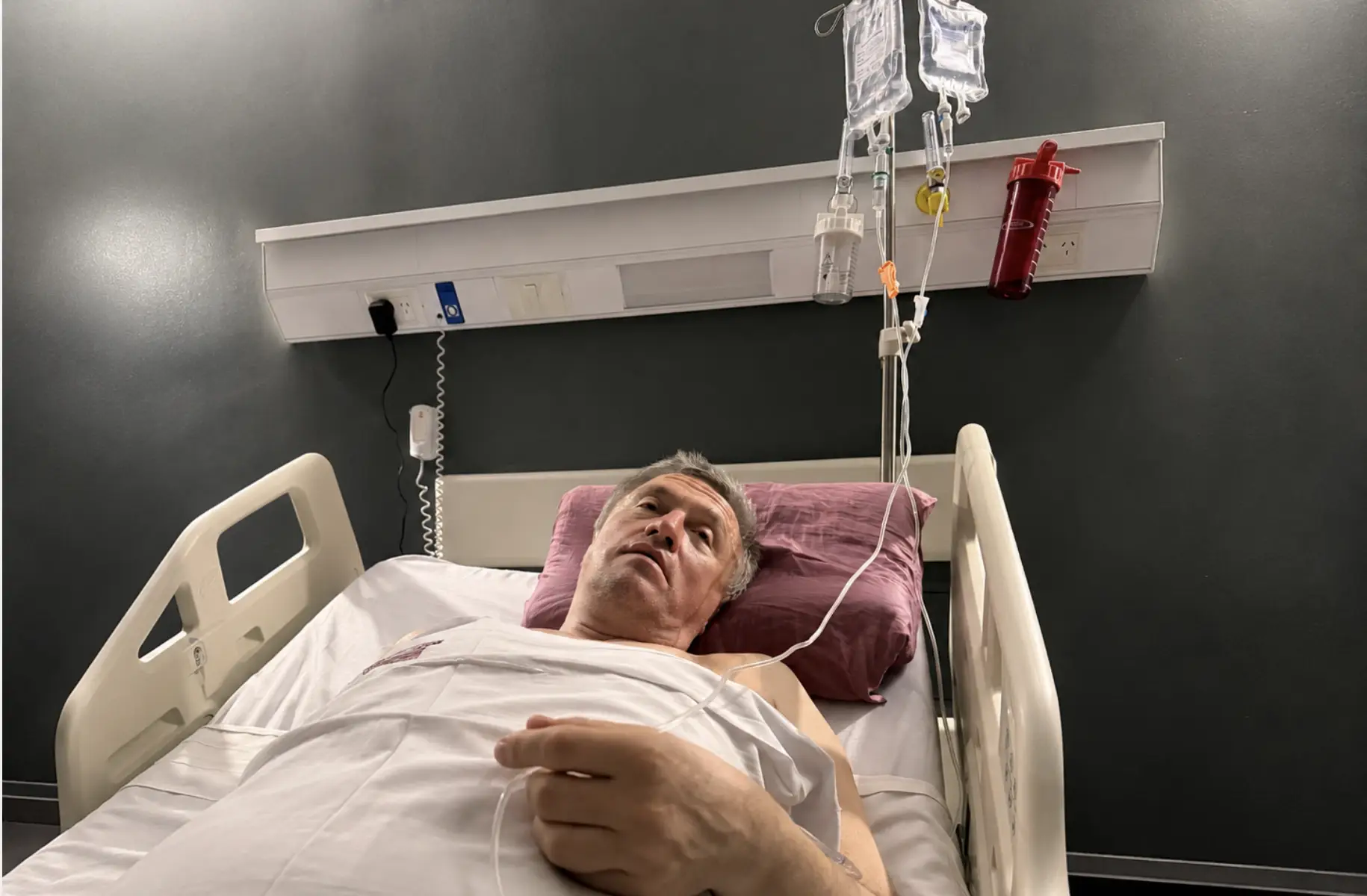
Konstantin Rudnev after urgent surgery, following his detention in prison conditions where he nearly died from illness.
Personal Data as a Weapon
An independent attorney conducted a full analysis of the investigative materials, interrogation records, and witness testimony. The conclusion is unequivocal and supported by evidence: against Konstantin, there is not a single factual piece of evidence or fact that could be considered a basis for suspecting his guilt.
Moreover, if the case materials are examined impartially, it becomes clear that all of the prosecution’s accusations do not relate to Konstantin, but to other people detained as part of the case.
For example, Nadezhda Belyakova:
1. She used Konstantin Rudnev’s personal data — his passport and personal information — without his knowledge or consent. This was directly stated by Nadezhda herself and by the woman E., who is falsely listed in the case as the “victim.” The testimony of other participants in the proceedings confirms the same.
2. It was she who personally brought E. from Russia to Argentina. It was she who constantly accompanied her at every stage — including in the hospital, where she communicated with medical staff instead of the victim. It was she who, when a nurse requested the child’s father’s information, took a copy of Konstantin Rudnev’s passport and attempted to enter his data into the documents — without his knowledge or consent. Rudnev never met E. and had no contact with her.
3. Nadezhda is also the only participant in the case who has the official right to communicate with E., despite her procedural status as a suspect. Therefore, the risk of pressure on the victim, which is falsely attributed to Rudnev, should be considered precisely in relation to Nadezhda.
At the same time, prosecutor Fernando Arrigo is deliberately seeking to keep Rudnev in a maximum-security prison, despite a direct, medically confirmed threat to his life. Meanwhile, Nadezhda Belyakova remains free under a pledge not to leave, and no risks are attributed to her.
This difference in procedural treatment is not a coincidence and not a procedural error. It is the result of someone’s will. Whose exactly? Who was interested in having Rudnev, specifically, placed in a maximum-security prison while the true participants in the scheme remain free?
Portrait of a Persecutor: Fernando Arrigo
Fernando Arrigo is a person whose role in this case goes far beyond formal procedural functions. An analysis of his actions reveals personal hostility and pathological cruelty, as well as a desire to deliberately cause harm. Moreover, this hostility is exceptional in its intensity and openly expressed in its manifestations.
While the investigation repeatedly recorded testimony refuting Rudnev’s guilt, and while the “victim” herself stated on numerous occasions that she does not consider herself a victim of human trafficking, that she came to Argentina voluntarily, and that she does not personally know Konstantin Rudnev, Arrigo continued to insist, with stubborn determination, on the harshest possible detention regime.
Under Argentine law, such witness testimony, in itself, should have led to a review and closure of the case. But the case was not closed. Rudnev was not released.
Why?
The answer that increasingly suggests itself is this: because for Arrigo, this case long ago stopped being a human trafficking case. It is a case about Rudnev. Specifically about him. And the objective pursued by Arrigo, in professional legal terms, exceeds all permissible limits.
A Maximum-Security Prison as a Sentence Without Trial
Particular attention should be paid to the choice of detention facility. Rawson is not an ordinary institution. It is a maximum-security prison intended for convicted individuals who pose an elevated danger to society. Placing there a person whose guilt has not been proven, whose data was used without his consent, and who, at the time of the events imputed to him, was at home in a state of illness, is not procedural strictness. It is cruelty with a specific author.
A 58-year-old man who has spent more than a year in such conditions means damaged health, irreversible consequences, and a threat to life. It also means his wife and family, who for more than a year could not care for him, remaining in loneliness and suffering. Who requested such a regime? Who insisted on its continuation? The answer is of fundamental importance when it comes to Arrigo’s personal responsibility.
A person who systematically seeks the harshest possible detention conditions for an accused individual, while ignoring testimony that refutes his guilt, ignoring legal norms and basic humanitarian considerations, is a person who, de facto, wishes for that accused person, if not death, then at least complete physical and moral destruction.
Why Such Different Treatment?
By any logic of criminal prosecution based on facts, it is precisely Belyakova who should have become the main defendant. She is the person who acted: she transported, controlled, and handled another person’s documents. Rudnev not only was not present at any of the stages described — he had not the slightest connection to what was happening.
Nevertheless, in two years of investigation, Belyakova has never been charged in a manner proportionate to her documented role. She remains free. The investigation methodically keeps her in the shadows — and this is not an omission. It is a choice. Recognizing Belyakova’s real guilt would automatically destroy the entire structure of the accusation against Rudnev. If she did all of this, then he had nothing to do with it. That is precisely why her role is left outside the frame — not because of a lack of evidence, but because the sufficiency of that evidence is incompatible with the accusation already brought.
The entire body of witness testimony points to Belyakova — and diverges from the prosecution’s version. The real pressure on E., if it existed at all, could only have been exerted by her: the only person who was physically nearby. Why is the person whose actions are documented by witnesses and by the logic of events not the main defendant? Why is she completely free — while Rudnev, whose guilt has not been proven, is held in a maximum-security prison?
The persecution of Konstantin Rudnev, while Belyakova is clearly removed from responsibility, is not a procedural coincidence. It is a structural sign of biased, selective criminal prosecution directed against a specific person.
The Law Is on Rudnev’s Side
Argentine justice has already dealt with similar cases — and has issued correct decisions. In April 2026, a federal court issued a definitive dismissal in the Molina and Gómez case: the accusation of human trafficking was found to be unfounded, and the court established that the facts described in the case simply did not exist.
The arsenal of procedural tools available to Rudnev’s defense is complete: request for dismissal, habeas corpus, petition for review. The law is on his side. The precedents are on his side.
Only one question remains: how long will Fernando Arrigo’s personal will be able to stand against this body of legal arguments?
In Place of a Conclusion: The Price of Personal Hatred
When an official vested with power uses the mechanism of criminal prosecution not for the triumph of the law, but to satisfy personal hostility toward a specific person, this is not simply an abuse of office. It is a crime against the fundamental principles of justice.
Konstantin Rudnev is not an abstract “accused person.” He is a living 58-year-old man who spent more than a year in a maximum-security prison for a crime he did not commit, through the use of his own stolen data. He is a person whose health has been undermined, whose life has been turned upside down, and whose freedom has been sacrificed to someone’s hatred. This should not be possible in a state governed by the rule of law.
Argentine justice is capable of correcting this. The precedents exist. The instruments exist.
It is precisely the recusal of prosecutor Fernando Arrigo that will allow this case to be examined from the standpoint of law and justice, rather than personal bias and cruelty.
This material was prepared on the basis of investigative data, witness testimony, and legal documents in the case of Konstantin Rudnev, currently pending before the Argentine judicial authorities.