

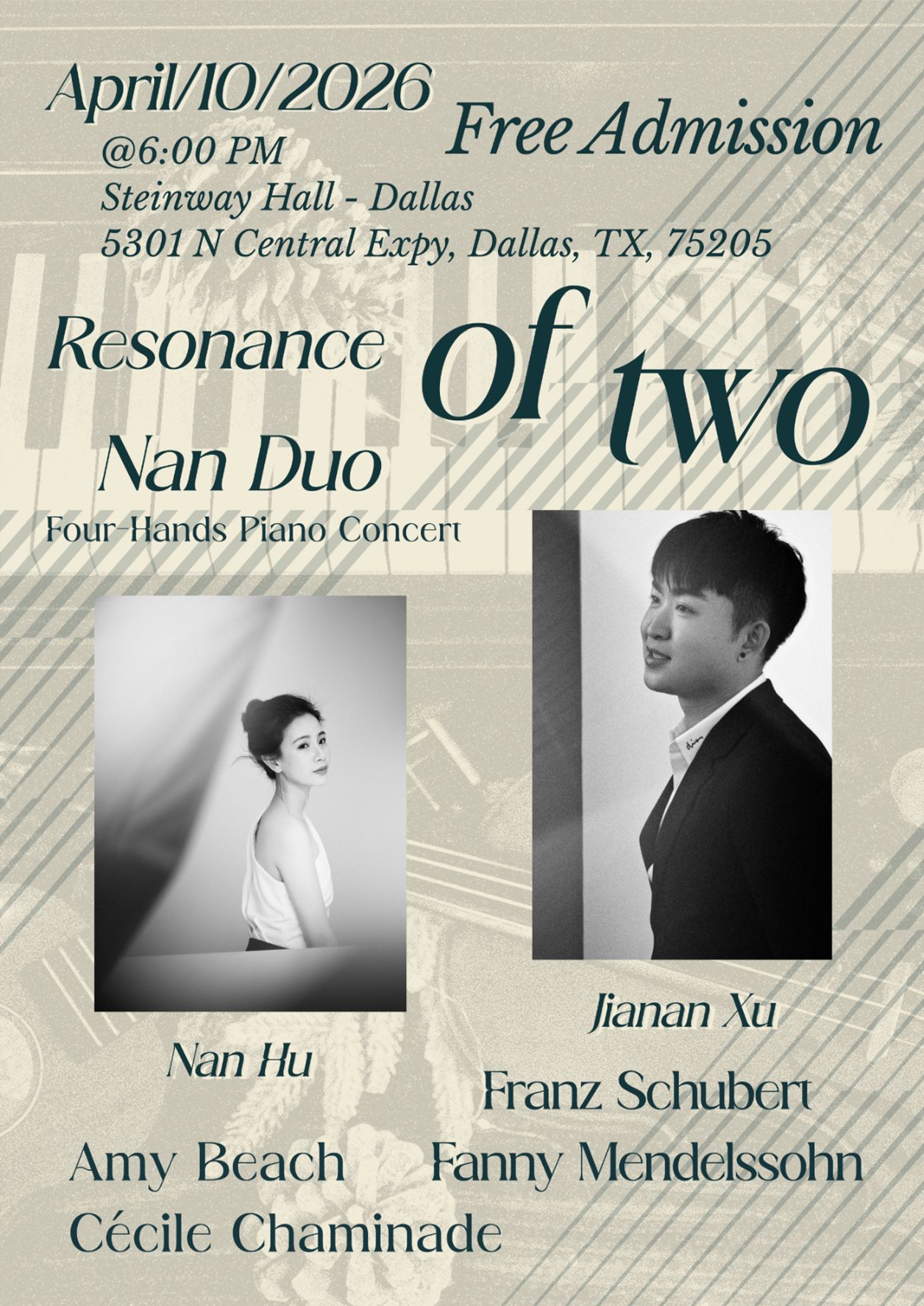
On the evening of April 10, 2026, Steinway Hall in Dallas became the setting for a performance defined not by spectacle, but by extraordinary musical intimacy. Presented under the title Resonance of Two, the four-hands piano concert by Nan Duo transformed the traditional recital format into something far more immersive: a sustained dialogue between two pianists whose artistic coordination blurred the line between individual interpretation and shared musical consciousness.
Founded in New York in 2016 by pianists Dr. Nan Hu and Dr. Jianan Xu, Nan Duo has steadily built an international presence through performances in the United States, China, and Romania. Over the past decade, the duo has distinguished itself through its commitment to the piano four-hands repertoire — a demanding and often underrepresented form that requires not only technical command, but an unusually refined level of musical trust, structural awareness, and interpretive unity.
That artistic cohesion was immediately evident at Steinway Hall. Seated side by side at a single piano, Hu and Xu approached the instrument less as two independent performers than as a single interpretive entity. Their coordination extended beyond synchronization; it revealed an acute sensitivity to balance, phrasing, tonal layering, and the architectural flow of Romantic-era repertoire.
The evening opened with Franz Schubert’s Fantasy in F minor, D. 940, one of the most emotionally expansive works ever written for piano four hands. Rather than emphasizing overt virtuosity, Nan Duo approached the work with restraint and long-form lyricism, allowing Schubert’s shifting emotional tensions to emerge gradually through carefully controlled dynamics and finely shaped melodic interplay. Particularly striking was the duo’s ability to maintain clarity within dense harmonic passages while preserving the work’s underlying sense of fragility and inevitability.
The program continued with Three Pieces for Piano Four Hands by Fanny Mendelssohn, whose music has increasingly gained renewed scholarly and performance recognition in recent years. Hu and Xu brought unusual transparency to the composer’s elegant textures, highlighting the sophistication and structural intelligence often overshadowed by historical neglect. Their interpretation resisted sentimentality, instead revealing the quiet confidence and rhythmic precision embedded within the works.
One of the evening’s most compelling moments came with Amy Beach’s Summer Dreams, Op. 47. Here, Nan Duo demonstrated exceptional control of color and atmosphere, shaping each movement with cinematic fluidity. The duo navigated rapid emotional shifts — from playful fantasy to reflective stillness — with remarkable coherence, maintaining a unified expressive arc throughout the suite. Their sensitivity to voicing and tonal shading allowed Beach’s impressionistic language to unfold with unusual clarity.
The concert concluded with Cécile Chaminade’s Six Pièces Romantiques, Op. 55, a vibrant collection that demanded both rhythmic vitality and interpretive flexibility. Hu and Xu handled the suite with energy and sophistication, capturing its dance-like momentum without sacrificing precision. Particularly notable was their command of ensemble balance: even in passages of heightened virtuosity, neither performer dominated the musical texture, allowing the dialogue between the two pianists to remain central.
What distinguished Nan Duo’s performance throughout the evening was not merely technical excellence, but the duo’s rare capacity for sustained musical integration. Four-hands piano performance is often treated as a novelty within concert programming, yet Hu and Xu approached the form with the seriousness and interpretive depth typically reserved for chamber ensembles. Their performance demonstrated a sophisticated understanding of collaborative musicianship — one built on discipline, responsiveness, and long-term artistic partnership.
At a time when much of classical performance culture prioritizes individual display, Nan Duo offered something increasingly rare: a performance centered on listening, reciprocity, and collective expression. Resonance of Two ultimately became more than a concert title; it described the artistic philosophy underlying the entire evening — a resonance not only between two pianists, but between interpretation, structure, and audience experience itself.