The average center stone in a US engagement ring is now 1.8 carats, according to The Knot’s 2024 Jewelry and Engagement Study. That number went up from 1.7 the year before, and lab-grown center stones average a full 2 carats. Higher figures still leave most buyers wanting visual presence above what their budget allows. Setting selection is where that gap closes. The mount, the metalwork, and the relationship between the center stone and the band can change how a diamond reads on the hand without altering its weight by a single point.
Halo Setting Mechanics
A halo wraps the center stone in a ring of small accent diamonds, often pavé-set. The accent stones extend the perceived diameter of the center, and the eye reads the cluster as one continuous bright shape. Industry estimates put the size gain at roughly half a carat in apparent weight. A 1-carat stone in a halo often reads as 1.5 carats from a normal viewing distance.
The halo also sits as the second most chosen engagement ring style in the United States, accounting for 15 to 18% of all rings. That market share reflects the math working in practice. Buyers who want the look of a 2-carat solitaire without paying for one usually find their way here first.
The Illusion Setting Approach
Illusion mounts go further. The metal head holding the diamond is shaped, fluted, or polished so the surrounding metalwork blends into the stone’s edge. From above, the head reads as part of the diamond. The technique was developed during the Great Depression of the 1930s, when buyers wanted the appearance of a larger stone at a lower price point.
Illusion settings work best with near-colorless diamonds in white metal, since color contrast between the stone and the head ruins the effect. In platinum or 18k white gold, a well-cut 0.5-carat stone in an illusion mount can pass for 0.75 to 1 carat in casual view.
The Quiet Math Behind Premium Ring Aesthetics
Many shoppers conflate price with carat weight. A 1.4-carat stone in a tightly engineered setting can read as larger than a poorly mounted 2-carat one. The setting carries roughly half the visual work. A polished basket, a refined halo, and pavé that fits flush all signal craftsmanship in ways the eye registers before the carat number is ever discussed.
That is why makers of luxury engagement rings lean on cathedral arches, fine prongs, and bead-set accents rather than mass-bulking the band. The execution shows deliberate work.
Bezel Profiles in Warm Metals
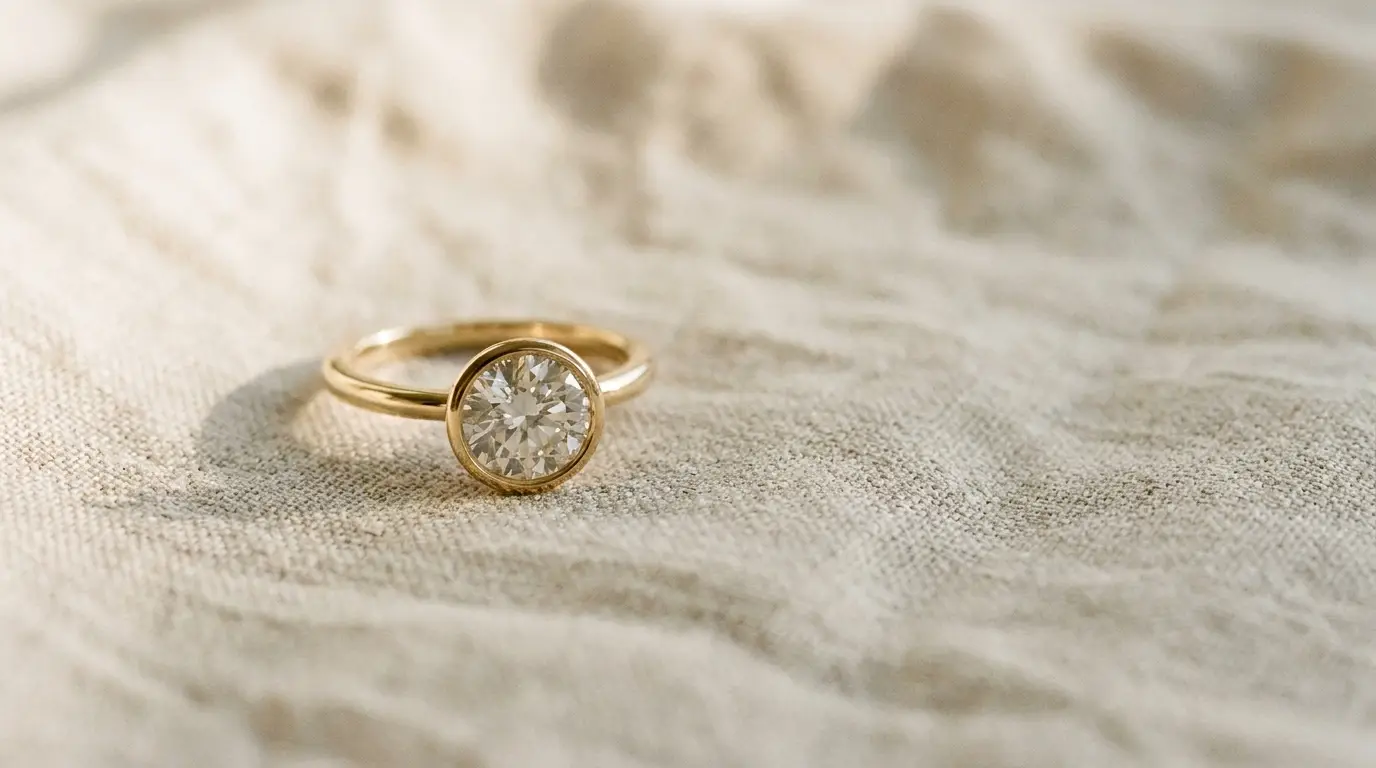
The bezel setting wraps a thin band of metal around the diamond’s girdle. The metal extends the visible footprint of the stone by a fraction of a millimeter. In yellow gold or rose gold, a warmer metal next to a near-colorless diamond produces a contrast that reads as size, since the eye registers the metallic outline as part of the stone’s perimeter.
Partial bezels, sometimes called half-bezels, keep the effect on two sides of the stone and leave the rest open. They suit diamonds with strong table proportions, such as round brilliants and oval cuts. The protective edge also prevents chipping, which makes the bezel a practical choice for buyers who want the look of a larger stone in a setting that can take daily wear.
Pavé Bands and Visual Continuity
Pavé diamond engagement rings feature bands with small accent stones, usually 0.01 to 0.20 carats each, set tight against one another along the shank. The band reads as a continuous strip of light leading the eye toward the center stone. The visual continuity makes the center diamond appear to hold more weight, since it caps a glittering line rather than sitting alone on a polished metal surface.
Pavé also adds total carat weight without the cost of a single larger stone. A center diamond of 1 carat with a 0.4-carat pavé band carries 1.4 total carat weight. The ring, taken as a whole, signals luxury at a level that a plain solitaire of similar center weight does not.
Cathedral Elevation
A cathedral setting uses two arches of metal that rise from the band to support the center stone. The arches lift the diamond off the finger, and the elevated position lets more light pass under and around the stone. More light entering means more brilliance returning, which the eye reads as size.
Cathedral mounts also create a side profile that shows craftsmanship from any angle. The arches can be polished, milgrained, or set with small accent diamonds. The setting suits buyers who want the center stone to occupy visual space on the hand from across a room, where height matters as much as table width.
Trellis and Three-Stone Architecture
Trellis prongs cross over each other beneath the center stone, forming an X shape when viewed from the side. The interwoven structure adds visible mass below the diamond without bulking the band. In a three-stone trellis, two side diamonds sit close enough to the center that the eye groups all three as one wide center cluster, gaining apparent width across the finger.
Three-stone engagement rings work especially well at lower center weights. A 0.75-carat round flanked by two 0.3-carat trapezoids reads as a 1.35-carat presence in total spread. The architecture distributes brilliance across a wider footprint, which most buyers find more useful than concentrating it in a single small stone.
Setting Selection as a Lever for Apparent Size
Carat weight is one variable. Setting choice is another, and it can move the visual outcome by 25 to 50% without touching the price of the center stone. Halo, illusion, bezel, pavé, cathedral, and trellis mounts each apply the principle in a different way. The right one depends on hand size, daily wear patterns, and the buyer’s preference for sparkle volume against architectural restraint. The center diamond does the geological work, but the setting decides how much of that work shows up on the finger.