

A finisher sits on the curb past the line, wrapped in a foil blanket, and has to grab the metal barrier to stand up. The legs are stiff and the body under the blanket is still hot. Over the previous few hours, muscle fuel has run low and muscle fibers have been damaged, and the repair work will continue for weeks after the medal goes into a drawer.
Carbohydrate and Sweat on the Course
Muscle glycogen is the main fuel at marathon pace, and it falls steadily as the race goes on. When it runs low, pace drops sharply even though the effort feels the same or harder. An analysis of 873,334 Berlin Marathon finishers from 1999 to 2025, published in Scientific Reports, defined that collapse as a second half at least 20% slower than the first and found men about twice as likely as women to suffer it.
Among runners under 3 hours, men were about 6 times as likely. The researchers pointed to differences in fuel use. Women tend to burn more fat at a steady effort and have a higher share of slow-twitch muscle fibers, and the hormone estradiol helps them conserve carbohydrate. They also suggested that a negative split, starting slower and finishing faster, may help runners avoid the late collapse. The dataset counted only finishers, so it likely underestimates how often it happens.
At a sweat rate of 1 L per hour, a 4-hour marathoner loses about 4 L, which for a 60 kg runner is close to 7% of body mass if nothing is replaced along the way. Drinking 500 mL an hour on the course would cut that loss roughly in half.
Fluid and Salt in the First Hours
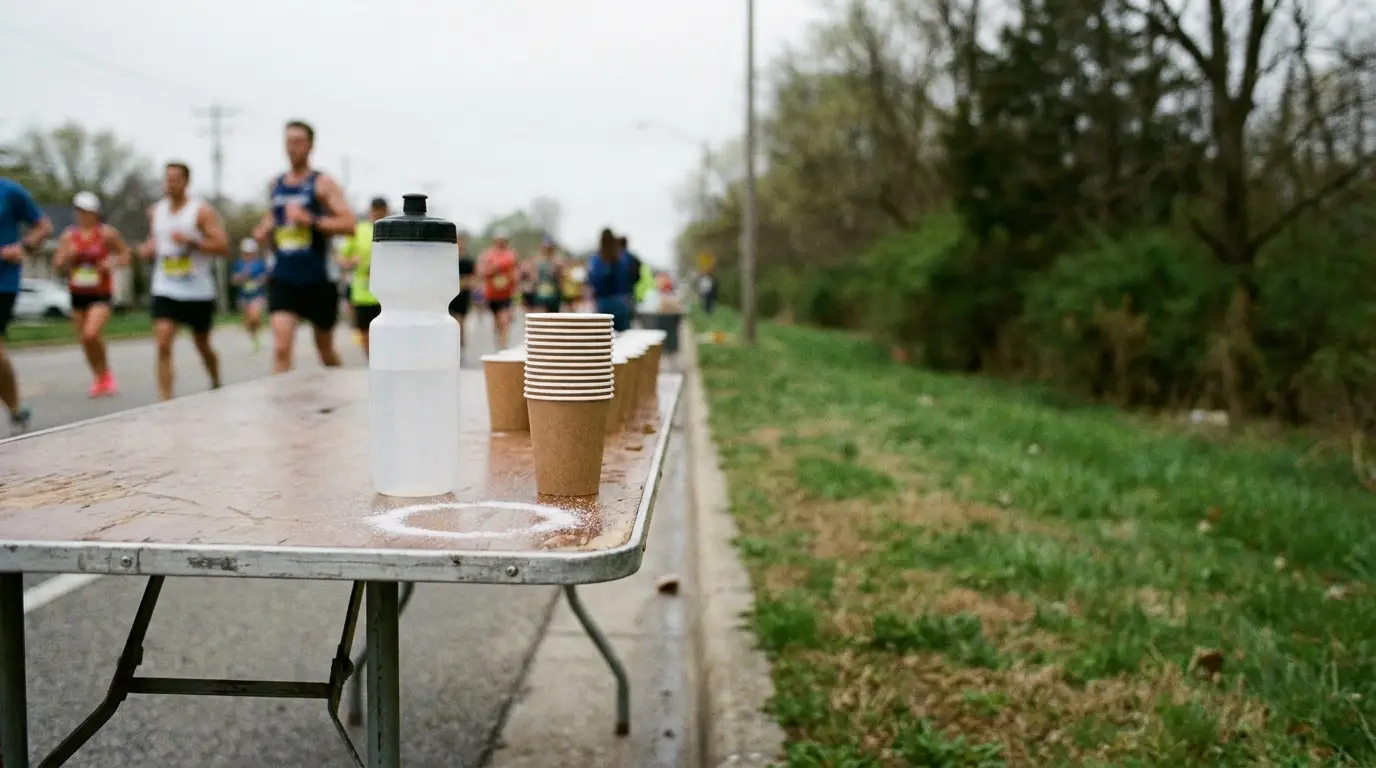
The first job after the finish is to work out which direction fluid balance has gone. A 75 kg runner who steps on the scale 2 kg lighter than at the start has lost close to 3% of body mass and has a deficit to replace over the next several hours, ideally with fluid taken alongside food that contains salt.
A weigh-in on race morning, before leaving home, gives the baseline that makes this comparison possible. Some finishers do this with water and a salty meal, while others mix the best electrolyte powder for hydration that they tested during long training runs. A finisher who weighs more than at the start already has a fluid surplus and should wait before drinking more.
Core Temperature at the Finish
Body heat rises throughout the race. In a 2010 study, marathon runners who swallowed temperature sensors the night before the race averaged 38.7°C at the finish, with a range of 38.0°C to 39.4°C. A 2024 study of recreational runners in a cool city marathon found that a large share reached 39°C or higher without any signs of heat illness.
At the 2019 World Athletics Championships in Doha, about 200 athletes, most of them from endurance events such as the marathon and race walks, swallowed transmitter capsules for an IAAF heat study. The women’s marathon was held at midnight in temperatures near 90°F with humidity above 70%, and between 25% and 40% of starters in the women’s marathon and the 50 km race walks did not finish.
Heart Strain and Cardiac Risk
In rare cases the heart fails during the race. A registry of U.S. marathons and half marathons from 2000 to May 2010 identified 59 cardiac arrests among 10.9 million registered runners, an overall rate of 1 per 184,000, which puts marathon runners at low risk of cardiac arrest.
The rate during marathons, 1.01 per 100,000 runners, was 3 to 5 times higher than during half marathons, and men were affected far more often than women. Hypertrophic cardiomyopathy was the most frequent cause of death, and 71% of the cases were fatal. Bystander CPR was the strongest predictor of survival.
Even without a cardiac arrest, the heart muscle shows short-term strain. In a 2008 study of 26 athletes after an ultra-endurance race, troponin, a marker of heart muscle injury, was raised in 58% of them, and right ventricular function fell across the group. Almost all of those changes resolved within a week.
Kidney Markers After the Race
In a study of 22 runners at the 2015 Hartford Marathon, 82% met the criteria for stage 1 acute kidney injury at the finish, and 1 runner reached stage 2. Median blood creatinine rose from 0.81 mg/dL at baseline to 1.28 mg/dL right after the race, and 73% showed microscopic signs of injury in their urine on day 1 or day 2.
Creatinine was close to baseline by day 2, and the authors cautioned that the sample was small and the follow-up lasted only 48 hours. Inflammatory and injury markers such as IL-6 and KIM-1 showed the largest increases, and creatine kinase kept rising from the finish to day 2. None of the runners showed evidence of chronic kidney disease.
Muscle Repair Over the Following Weeks
Soreness peaks in the first few days, but the muscle takes much longer to repair. Biopsies from marathon runners in a 1985 study showed fiber injury and inflammation 1 to 3 days after the race, with progressive repair of the damaged mitochondria and contractile proteins by 3 to 4 weeks. Samples taken 8 to 12 weeks later still showed signs of regeneration. Because the effects last beyond the first week, the American Council on Science and Health advises a slow and gradual return to running. Veteran runners also had collagen deposits in the muscle, which the authors linked to repeated injury.
Imaging and blood studies of finishers have found muscle abnormalities that were most common on days 1 and 3 and persisted for up to 7 days. Delayed-onset muscle soreness usually fades within 96 hours, although it can last up to 10 days. Blood markers such as creatine kinase rise in the first 24 hours and can stay elevated for more than a week.
Infection Risk in the Week After
A review of marathon recovery research by the American Council on Science and Health places the rise in upper respiratory infections within 3 to 72 hours after the race. In a 1990 survey of Los Angeles Marathon runners, 12.9% of 1,828 finishers reported an infection in the week after the race, compared with 2.2% of similarly trained runners who did not compete, which gave racers about 6 times the odds.
The Run Two Weeks Later
The same finisher laces up 2 weeks after the race for an easy 3 miles. The soreness is gone and kidney function has long since returned to normal. The run still feels heavier than it should, because the muscle fibers torn on the course are partway through a repair that will not finish until the following month. An easy pace and a short distance fit that stage of repair, and the interval sessions can wait.