Turn over a jar of serum and read the small print, and you may find “copper tripeptide-1” somewhere among the water, glycerin and preservatives. It is one of the few cosmetic ingredients that is also sold, in pure form, to research labs. And that raises a question most shoppers never think to ask: how does anyone know the powder in the drum is really the molecule on the paperwork?
The answer is a set of fairly standard lab tests. They are worth understanding, because the same tests sit behind every peptide sold for research, and they get harder as the molecule gets bigger. Copper tripeptide-1 is a chain of three amino acids; BPC-157, a research peptide five times longer, has its full sequence, formula and CAS number set out on Amidae’s BPC-157 page, and the gap between the two shows why size matters for testing.
What Copper Tripeptide-1 Actually Is
Copper tripeptide-1 is the cosmetic name for GHK-Cu. The “GHK” part is a chain of just three amino acids, glycine, histidine and lysine, which is about as small as a peptide gets. The “Cu” is a single copper ion held by that chain. GHK was first isolated from human plasma by Loren Pickart in 1973, and its structure with copper was mapped in solution four decades ago (a 1982 study in Biochemistry).
The copper does not just sit loosely alongside the peptide. It is gripped by three nitrogen atoms: one at the very start of the chain, one in the bond joining glycine to histidine, and one in the ring on histidine’s side chain. In water, a fourth spot around the copper is taken by a water molecule. That arrangement is what gives the complex its colour.
Two identifiers matter here, and mixing them up is a common source of confusion. CAS number 89030-95-5 belongs to the copper complex. CAS number 49557-75-7 belongs to plain GHK, with no copper at all. They are different substances with different formulas (C14H22CuN6O4 for the complex, C14H24N6O4 without copper), so a certificate that quotes one number while the label names the other is worth a second look.
The First Check Costs Nothing: Colour
GHK-Cu powder is blue. The copper, held the way it is, absorbs orange-red light, and what reaches your eye is the blue left over. GHK without copper is white.
So the very first test a lab runs is to look at it. A white powder sold as GHK-Cu has a problem before any instrument is switched on. A blue powder has passed only the easiest test there is, though: colour shows copper is present, not how much, and not whether the peptide around it is intact.
Mass Spectrometry: Weighing the Molecule
To confirm identity, labs use a mass spectrometer. It turns molecules into charged particles and measures how heavy they are, very precisely. GHK-Cu has a molecular weight of 401.9, so the spectrum should show a strong signal at the matching mass.
Copper adds a useful extra fingerprint. Natural copper comes as two isotopes, one two mass units heavier than the other, so a copper-containing molecule gives twin signals, two mass units apart, instead of one clean line. A peak at the right mass without that pattern suggests something other than the copper complex. Copper also makes up about 16% of the complex by weight, which a separate elemental test can confirm.
HPLC: Measuring Purity
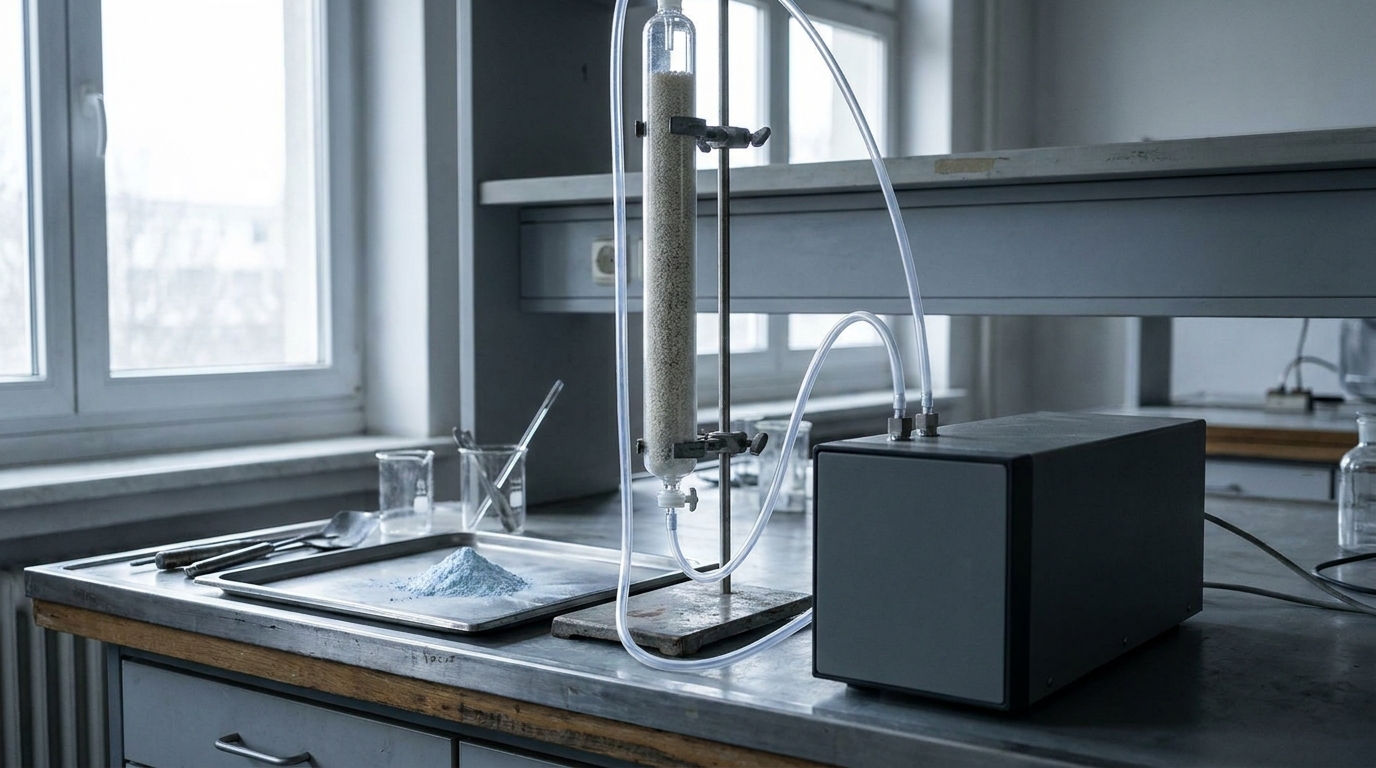
Identity tells you the right molecule is present. Purity tells you how much of the powder it makes up. For that, labs use high-performance liquid chromatography (HPLC). The sample, dissolved in a solvent, travels through a narrow tube filled with fine particles.
Each substance in it lingers on those particles for its own length of time, so they leave the tube one after another. A light sensor at the far end draws each arrival as a bump on a chart, and the size of the main bump compared with all of them together gives the purity, usually quoted as a percentage.
For a three-residue peptide, this is relatively straightforward. There are only so many ways to get a chain of three amino acids wrong, and the likely impurities look quite different from the real thing.
When the Chain Gets Longer
Things change with size. The table below sets GHK-Cu against BPC-157, a much longer research peptide, to show the jump.
|
GHK-Cu |
BPC-157 |
|
|---|---|---|
|
Amino acids in the chain |
3 |
15 |
|
Molecular formula |
C14H22CuN6O4 |
C62H98N16O22 |
|
Molecular weight |
401.9 |
1419.5 |
|
CAS number |
89030-95-5 |
137525-51-0 |
|
Quick visual check |
Blue powder |
White powder, no colour test |
|
Stored as |
Dry powder, -20 °C |
Dry powder, -20 °C |
A Longer Example: BPC-157
BPC-157 is a chain of 15 amino acids, which chemists call a pentadecapeptide. Its sequence is Gly-Glu-Pro-Pro-Pro-Gly-Lys-Pro-Ala-Asp-Asp-Ala-Gly-Leu-Val. It is a fragment of a larger protein named body protection compound, and older papers list it under codes such as PL 14736 and PLD-116.
A few features of that sequence shape how it behaves in the lab. Four of the 15 links are proline, three of them in a row near the start, and proline puts a kink in a chain that affects how it folds. Three residues are acidic and one is basic, so the peptide carries a net negative charge in neutral water and dissolves readily.
Longer chains are harder to test because the impurities get sneakier. Peptides are built one amino acid at a time, and if one coupling step fails, the result is a chain with a single residue missing. For BPC-157, a version lacking one of its three prolines is almost the same size and shape as the real thing. On HPLC it can sit very close to the main peak, and only the mass spectrum, which would show it about 97 units light, gives it away. That is why a lab report for a longer peptide should show both an HPLC trace and a mass result: neither alone is enough.
Weight has a further catch. The 1419.5 figure is for the bare peptide. The powder in a vial also carries a salt form, often acetate, plus a little water, so the peptide is only part of what you weigh. That is why each batch needs its own purity and measured mass on its certificate, rather than the textbook number copied from a database.
Storage Protects All of It
Testing only describes the sample on the day it was measured. After that, storage decides whether the result still holds. Both peptides here are kept as dry powders, sealed, at -20 °C and out of the light. Moisture and warmth let chains break down slowly, so a vial left on a warm shelf for months may no longer match the report that came with it.
What to Take From the Label
The next time “copper tripeptide-1” turns up on an ingredient list, it is a small reminder that every peptide, in a cosmetic drum or a research vial, rests on a few checks: a colour that fits, a mass that matches, a purity figure from HPLC and storage that keeps it that way. The bigger the molecule, the more each of those checks matters.
References
- Freedman JH et al. (1982). Structure of the glycyl-L-histidyl-L-lysine–copper(II) complex in solution. Biochemistry.
- Cox HD et al. (2017). Detection and in vitro metabolism of the confiscated peptides BPC 157 and MGF R23H. Drug Test Anal.
- PubChem records: GHK-Cu (CID 165429100) and BPC-157 (CID 9941957).