
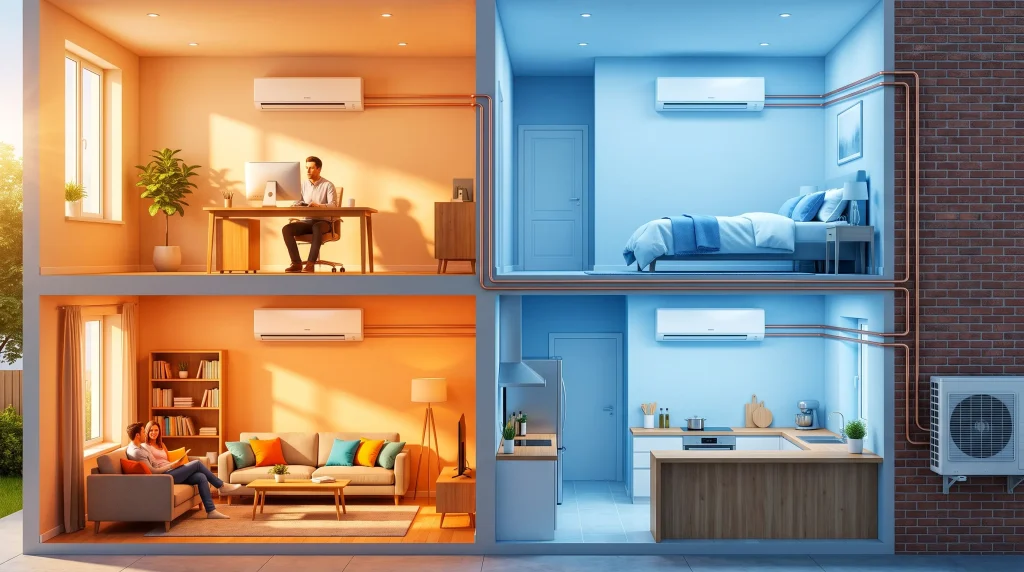
Different rooms rarely follow the same schedule. The home office may feel stuffy by noon, the living room gets busy after school, and the bedrooms need comfort much later.
For households with this daily pattern, a multi zone mini split gives each active space its own indoor unit and temperature control while using shared outdoor equipment.
That flexibility only pays off when the zones reflect how the home is actually used. The right mini split AC plan accounts for occupancy, closed doors, room loads and the times when several spaces may call at once.
Instead of running every room around the clock, the system can follow the family from daytime work areas to evening living spaces and overnight bedrooms.
Which Rooms Need Comfort During the Day?
Begin with occupancy rather than square footage. A home office may need cooling from morning through late afternoon, especially when computers and sunny windows add heat. A kitchen becomes busier around meals, while a playroom may peak after school. Guest rooms and formal dining rooms can sit unused for days.
A simple weekday map usually reveals which rooms need steady comfort and which only need short periods of conditioning. It should also record doors that stay closed, since air from an active room does not reliably reach a closed bedroom or office.
This schedule becomes the basis for deciding which spaces deserve independent zones instead of assuming every room needs the same plan.
Bedrooms Usually Run on a Later Schedule
Bedrooms often need little conditioning while the family is at work or school. Their main comfort period begins shortly before bedtime and continues overnight. Starting a bedroom zone in advance gives the room time to reach a comfortable temperature without using an extreme setpoint that makes the system work harder.
Sleep schedules may also vary within the same house. Young children may go to bed early, teenagers later, and a night-shift worker may sleep during the day. Separate schedules let each bedroom follow the person using it.
The indoor unit should still be sized for that room’s actual load, because scheduling cannot make an undersized unit catch up quickly or stop an oversized one from cycling too often.
Can Every Zone Follow Its Own Schedule?
Many multi-zone systems allow separate setpoints, fan settings and timers for individual indoor units. Available scheduling features depend on the controls, remote and app supplied with the specific model. Some support a detailed weekly plan, while others provide a basic timer that must be set again each day.
Independent control does not always mean completely independent operation. Most standard multi-zone heat pump systems require connected indoor units to remain in the same general mode.
One bedroom usually cannot call for heating while an office on the same outdoor unit calls for cooling. Families should agree on a seasonal mode, then use room setpoints and schedules to manage the differences within that mode.
Do All the Indoor Units Run Together?
No. An indoor unit can normally stop once its room reaches the set temperature, even when another zone continues running. A guest room can remain off while the office and living room receive cooling. This is one of the practical differences between room-level zoning and a single central thermostat.
The outdoor unit, however, is shared. When several rooms call at the same time, it adjusts its output and distributes available capacity among the active zones.
The effect is most noticeable during very hot or cold weather, when every room may need maximum output. Correct room-by-room sizing and an approved indoor-unit combination matter more than simply adding together four convenient equipment sizes.
How Much Energy Can Zoned Scheduling Save?
There is no fixed savings percentage for every household. The result depends on local weather, electricity rates, insulation, setpoints and how many rooms can remain off or at a moderate setting.
A family that uses two rooms for most of the day has more opportunity to reduce unnecessary runtime than a household occupying every room continuously.
Scheduling also works best with reasonable temperature changes. Repeatedly turning zones off and demanding a large temperature change later can create long recovery periods.
A better plan is to maintain safe, moderate conditions in lightly used rooms and schedule normal comfort before they become occupied. After a week, compare comfort and runtime, then adjust start times instead of chasing the thermostat throughout the day.
The most useful room schedule follows real life rather than a generic energy-saving template. Map daytime and nighttime spaces, confirm what the controls can schedule, and leave enough recovery time for each room.
A qualified HVAC contractor can then verify that the selected zones, indoor-unit sizes and shared outdoor capacity fit the home’s load.