

There is a particular sinking feeling that comes with a second-hand watch. The box arrives, you get the strap sized, and then a small voice starts asking whether the thing on your wrist is really what the listing promised.
I have felt it. So I spent a while asking people who handle these watches for a living what they look at before money changes hands. Most of their answers were simpler than I expected. None of them needed a loupe or a trained eye. They were questions anyone could ask.
Why Pre-Owned Is Worth a Look
The waiting list for a steel sports watch can run for years. Buying used skips that queue. You also skip the first drop in value, and with some models the used price sits above retail anyway. The trade-off is that more of the risk sits with you. A boutique gives you a guarantee. A private seller gives you their word. That gap is where buyers get caught.
It is also why the dealer you choose matters as much as the watch. Iain Cahill, sales manager at WatchMaestro in Dubai, has spent years selling both new and pre-owned pieces, and he says the fear is usually pointed in the wrong direction. “People come in worried about fakes,” he told me. “The more common problem is a genuine watch with parts that are not original. The buyer only finds out when they try to sell it.”
That one line changed how I looked at every listing after it.
Start With the Papers
Ask for the warranty card, the receipt if there is one, and any service invoices. A watch with its full set of papers retains value better and is easier to sell later. Missing papers are not a dealbreaker on an older timepiece. Plenty of good watches from the 90s have lost their cards. But it should change the price, and if the seller brushes the question off, that tells you something.
Match the Numbers
Every luxury watch has a reference number for the model and a serial number for that specific watch. You will usually find them between the lugs, on the case back, or on the inner ring around the dial. Ask for clear photos of both. Check the reference against the model in the listing. Then check that the serial on the watch matches the serial on the card. When they don’t match, the card belongs to a different watch.
Look at the Dial and Hands
A replacement dial, relumed hands, or a swapped bezel can take a large bite out of what a watch is worth, and soft lighting hides all of it. Ask for close-up photos, taken straight on, in daylight. Check that the printing is even and sharp.
Then compare the glowing markers on the dial with the ones on the hands. On an older watch they should have aged together. If the markers look creamy and the hands look bright white, someone has replaced something.
Ask When It Was Last Serviced
A mechanical watch needs servicing every 5 to 7 years. It is not cheap, and on the top brands it can run into thousands. So ask when it was last done and who did it. A watch serviced by the brand or a respected independent watchmaker is a better buy than one with no record. It also saves you a surprise bill a month after you take delivery.
Check the Bracelet and Case
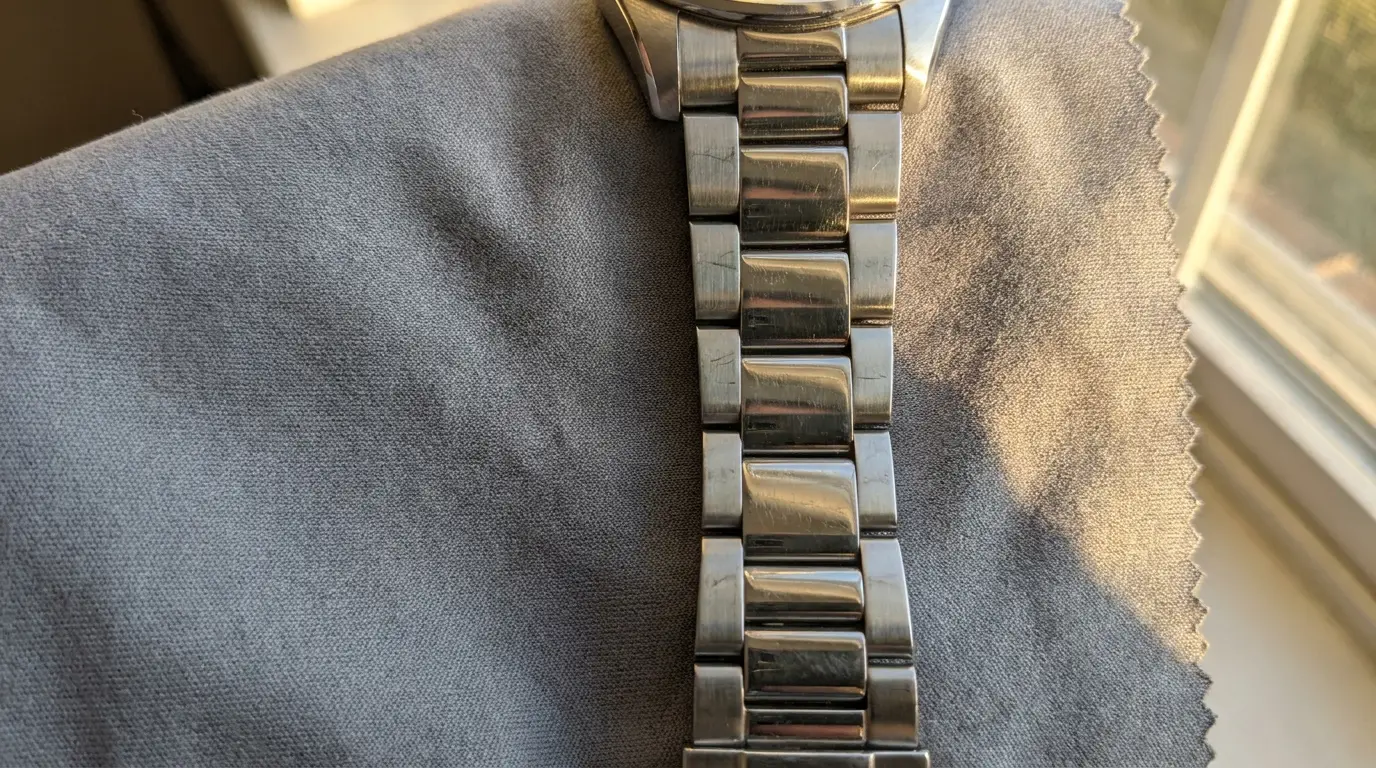
Hold a steel bracelet out flat from the clasp. If it sags and you can see movement between the links, it is stretched. Stretch can’t be fixed, only replaced, and some bracelets cost more than a holiday. On the case, look at the edges. A factory case has clean, defined lines where the brushed surface meets the polished one. Heavy polishing softens those lines and makes the lugs look thin. A case with a few honest scratches is worth more than one that’s been buffed into a different shape.
Red Flags in a Listing
|
What you see |
What it often means |
|
Only soft, angled, or dim photos |
Something won’t survive daylight |
|
Stock images instead of the real watch |
The seller may not have it in hand |
|
A price well under market, with a reason to hurry |
Pressure is standing in for proof |
|
Vague answers about the serial number |
The card and the watch may not be a pair |
|
No service history on a watch over ten years old |
Plan for a service, or walk away |
Who Checks the Watch Before You Do
You are not expected to authenticate a watch yourself. What you should expect is that someone qualified already has. The detail worth asking about is who that someone was. A dealer checking its own stock has an interest in the answer. An outside watchmaker does not.
Kevin Ghassemi, operations manager at WatchMaestro, handles that side of the business, and he draws the line clearly. “Every watch goes to an independent service centre before it goes on our site,” he said. “They open it, check the movement against the reference, and measure the case. If something does not line up, we don’t list it. I would rather lose the sale than explain it later.”
He also gave me the question he would ask as a buyer: can I see the inspection report? If a seller can produce one from a third party, you are in reasonable hands. If the answer is a promise instead of a document, keep looking.
Questions to Ask Before You Pay
Send these to any seller, private or professional:
- Can you send photos of the serial and reference numbers?
- Does the serial on the watch match the card?
- When was it last serviced, and by whom?
- Are the dial, hands, bezel, and bracelet all original?
- Who inspected it, and can I see the report?
- What happens if my watchmaker disagrees with your description?
A seller worth buying from will answer all six without fuss. Hesitation on the last two is your answer.
One Last Thing
Buy the watch, not the deal. A bargain price on a piece you are unsure about will cost you more than a fair price on one you have checked properly. And if a seller makes you feel rushed, that is not a deal about to close. It is a reason to stop.