

The live music and festival industry has always been ahead of the curve on culture. Now it is catching up on sustainability. Across festivals in the UK, Europe, North America, and beyond, single-use plastic is disappearing from food vendor stalls and backstage catering operations.
The pressure is coming from multiple directions at once — regulators banning plastic cutlery, festival-goers demanding greener events, and artists and headliners increasingly making sustainability part of their public commitments.
Wooden cutlery has stepped into that gap. But as demand rises across the events industry and beyond, one question becomes increasingly important: how do suppliers actually maintain their sustainability commitments at scale? For Ancheng, that question has a detailed answer.
Why Festivals Are Ditching Plastic Fast
The festival industry generates enormous volumes of waste over a single weekend. Food stalls alone can produce tens of thousands of pieces of single-use cutlery per day at a major event.
For years, plastic dominated because it was cheap and available. But that calculation has changed.
Plastic bans in the EU and UK now cover single-use cutlery directly. Festival operators face real legal and reputational consequences for non-compliance. Meanwhile, audiences at live events are among the most environmentally aware consumer segments anywhere — they notice, and they talk about it.
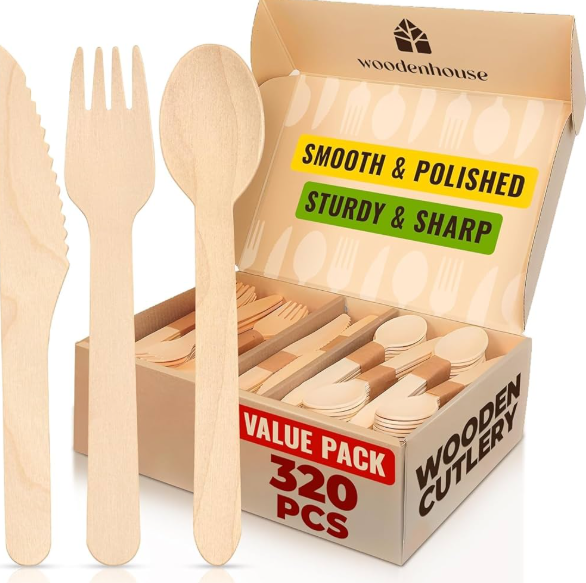
Wooden cutlery solves the problem cleanly. It performs through a full festival meal, composts after use, and sends the right message to the crowd.
Sustainability Starts Before the Product Is Made
Real sustainability in supply is not about what a product looks like. It is about where the materials come from and how they are processed.
Ancheng wooden cutlery supply begins with FSC-certified birch wood sourced from responsibly managed forests. FSC certification is not a self-declaration — it is a third-party verified standard that confirms the wood comes from forests managed with long-term ecological health in mind.
This matters because wooden products sourced from irresponsible forestry can cause more environmental damage than the plastic they replace. Certification removes that risk.
Manufacturing Practices That Reduce Environmental Impact
Sourcing is one part of the picture. Production is another.
Ancheng’s manufacturing process is designed to minimize environmental impact at every stage:
- Precision cutting reduces material waste by maximizing yield from each piece of raw wood
- Energy-efficient drying uses controlled heat processes optimized for minimal energy consumption
- Waste recovery — offcuts and production by-products are processed rather than discarded
- Clean facility standards — production environments meet hygiene and environmental management requirements
These are operational decisions that add cost and complexity. Ancheng makes them because genuine sustainability requires it.
Quality as a Sustainability Commitment
There is a direct link between product quality and environmental impact that is easy to overlook.
Low-quality wooden cutlery that breaks during use creates waste. A fork that snaps before finishing a meal gets thrown away and replaced — doubling the consumption and the waste.
High-quality wooden cutlery that performs reliably through its intended use delivers the full environmental benefit. One piece, one use, one clean compost cycle.
This is why Ancheng’s quality control process — covering structural strength, surface finishing, dimensional consistency, and food safety compliance — is itself a sustainability practice.
Packaging That Matches the Product’s Values
A sustainable product wrapped in unsustainable packaging sends a contradictory message. Festival buyers and retail partners notice this.
Ancheng uses packaging materials that are recyclable or biodegradable. Packaging design is optimized to minimize material use while still protecting the product through international shipping and warehouse storage.
For festival operators sourcing large volumes, this means the packaging waste generated by a cutlery delivery is a fraction of what conventional suppliers create.
Certifications That Prove the Claims
The sustainability space has a greenwashing problem. Suppliers make claims that sound impressive but are not independently verified.
Ancheng backs its sustainability positioning with recognized third-party certifications:
- FSC certification — responsible and traceable wood sourcing
- FDA compliance — food-safe materials and production standards
- LFGB certification — meeting European standards for food contact materials
For festival procurement teams, event sustainability managers, and retail buyers who need to verify supplier claims, these certifications provide the documentation trail required.
Scaling Sustainably: The Hard Part
Maintaining sustainability commitments while growing supply volume is where many suppliers fall short. Cost pressures at scale create incentives to cut corners — on sourcing, on production standards, on packaging.
Ancheng has built its supply operations with scale in mind from the beginning. The systems that ensure sustainable sourcing, quality production, and responsible packaging are not bolt-ons — they are embedded in the production process.
This means that an order of ten thousand units and an order of ten million units go through the same sustainability controls.
What This Means for the Festival Industry
For festival organizers, the practical implications are straightforward.
Working with Ancheng means:
- Cutlery that meets plastic ban compliance requirements in regulated markets
- Products that perform reliably through festival food service conditions
- Certified sustainability credentials for event reporting and marketing
- Consistent supply across festival season without quality variation
- A supplier whose sustainability story stands up to scrutiny from audiences and press
In an industry where reputation is built and lost over single weekends, supplier reliability is not a minor consideration.
The Bigger Picture
The festival industry’s move away from plastic is part of a much larger shift. Supply chains across food service, retail, events, and hospitality are all restructuring around sustainability requirements.
Suppliers who built their operations around genuine environmental responsibility before this shift became mandatory are now in the strongest position. They have the certifications, the processes, and the production capacity that the market needs.
Ancheng wooden cutlery supply represents exactly that kind of supplier — one whose sustainability commitment was built into the business rather than added as an afterthought.
Conclusion
Sustainability in wooden cutlery supply is not a single decision. It is a continuous set of operational commitments — in sourcing, manufacturing, quality control, and packaging — that must hold up at scale and under commercial pressure.
For the festival industry, live events sector, and the broader food service market, choosing a supplier who can demonstrate these commitments is becoming as important as the product itself.
Ancheng has built the systems, earned the certifications, and proven the production capability to be that supplier. In an industry moving fast toward genuine sustainability, that is exactly the kind of partner worth choosing.