
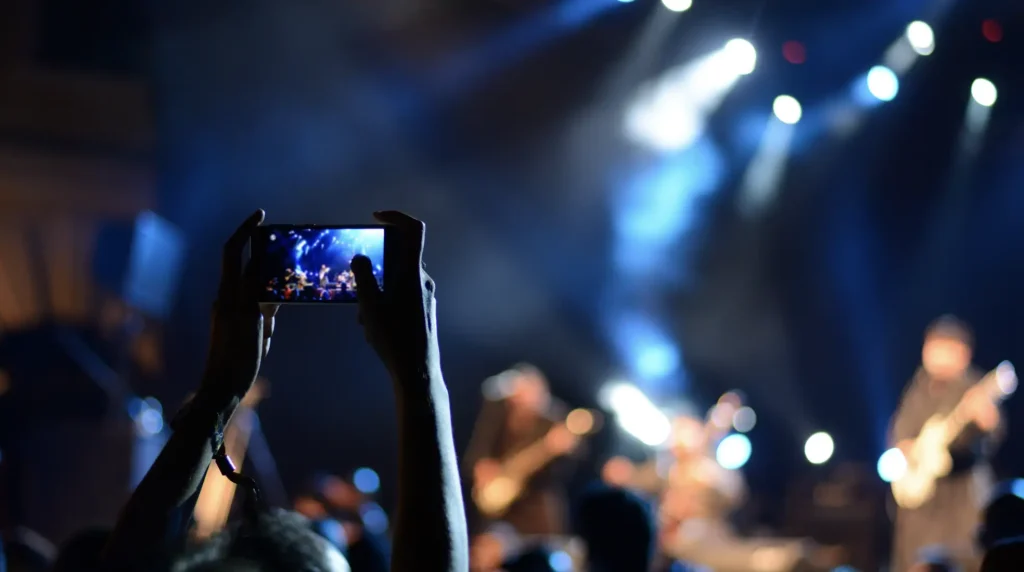
There was a time when being a fan just meant turning up to the gig. Buying the album, queuing for tickets, maybe wearing the T-shirt one day too many. The relationship was pretty straightforward – you dug the music, you backed the artist.
Now, being a fan is starting to look an awful lot like a game.
Pre-save this, unlock that, comment here, share there… Stay active, stay visible, stay switched on. Somewhere along the way, fandom stopped being passive and started behaving like a system – one that rewards attention, consistency, and interaction.
And more and more, that system feels like a game.
From Listening to Getting Stuck in a Loop
Streaming didn’t just transform how we consume music. It changed how we behave around it, too.
The shift is sneaky but powerful. Platforms don’t just host music – they nudge you into behaving in a certain way. Algorithms reward repeat plays. Artists start releasing alternate versions, snippets, teasers, and we fans, respond by looping tracks, deciphering clues, synchronising our streams.
What pops up is a bit of a feedback loop: engagement → visibility → more engagement
And once that loop is set up, you can actually design it.
Rewards, Access and the Illusion of Being Part of Something
One of the really noticeable shifts of late is how access is structured.
Fans aren’t just consumers anymore. We’re participants in a system where actions get you access to things:
- Pre-saving a track might get you early access to tickets
- Joining a mailing list might get you exclusive content
- Engaging with posts might just give you a chance of being noticed
It’s not an accident.
All these mechanics are straight out of the game design playbook: small actions, instant feedback, quick rewards. The more you do, the more you feel part of it. The more of it you feel, the more you do.
It’s not just about the music anymore. It’s about staying in the flow.
The Psychology of Taking Part
At the heart of gamification is a pretty simple idea: people are more likely to get on board when they feel they’re making progress.
In music fandom, that progression isn’t all about levels and badges (at least, not yet). Instead, it shows up as:
- Feeling a bit closer to the artist
- Being ‘one of the first’ to hear a new release
- Belonging to an inner circle (even if it’s virtual)
- Getting a nod – even just a fleeting one
These are all pretty soft rewards, but they’re actually really powerful.
They tap into the same instincts that drive online communities: visibility, belonging, and that secret competition of being the most on it.
And because these rewards are all a bit intangible, they’re also infinitely scalable.
When getting on board becomes the norm
What starts as a fun little interaction can quickly feel like a given.
Fans start to internalise the system:
If I want a bit of access, I’d better get on board.
If I want to get noticed, I’d better be active.
This creates a new kind of pressure. One that doesn’t come from the artist directly, but from the whole setup around them.
You see it in those coordinated streaming parties. In fan-led campaigns to get songs to the top of the charts. In that quiet understanding that being a “real fan” these days means being more than just a listener.
The line between enthusiasm and obligation gets a bit fuzzy.
Designing fandom
From the outside, it can look like all these behaviours are just happening organically. But being honest, much of it is actually carefully constructed.
Release strategies aren’t just about timing anymore. They’re about interaction design. Every little touchpoint is another opportunity to influence behaviour:
- Teasers that encourage wild speculation
- Limited drops that create a bit of a sense of urgency
- Campaigns that reward participation
It’s not manipulation – at least, not in the classical sense. It’s design.
And on some corners of the internet, this same thinking is being taken even further, into sweepstakes-style systems where platforms try out reward structures that are more like games than traditional transactions, as explored in recent industry coverage on sweepstakes-style reward platforms.
These models sit right at the far end of the spectrum, but they highlight the same underlying idea: engagement can actually be engineered.
What this means for fan culture
It’s not all bad, of course. In many ways, it’s actually made fandom more dynamic, more participatory, more interesting.
Fans are no longer just passive audiences – we’re communities, co-creators, amplifiers.
But there’s a catch.
When engagement becomes structured, it also becomes measurable. And when it’s measurable, it can get optimised, pushed, scaled.
The risk is that fandom starts to feel less like a relationship and more like a system you’ve got to keep on top of.
Still All About the Music?
For all the layers of interaction still going on, the core question is still the same: what’s holding all this together?
At the end of the day, it’s still the music. Or at least, it should be.
Gamification can make that connection a bit more exciting, but it can’t replace it. No amount of repeating tracks, sharing posts, or getting rewards can keep you coming back if the music itself just isn’t gelling.
What it can do is extend that experience, turn a release into an ongoing process, a moment into a lasting interaction.
The new face of being a fan
Being a fan these days isn’t just about what you listen to. It’s about how you show up to the music and really be involved in the culture.
It’s all about the little things – the way you behave & how others see that, the way you show enthusiasm consistently.
And while not everyone is going to be super into all the same things, it’s still there, quietly having an impact on what being a fan means, one little interaction at a time.
You don’t have to go along with the crowd (literally).
But it’s getting harder to pretend it’s not happening, or not to notice how it influences people.