
Some albums don’t ask for your attention; they just take it.
The Foo Fighters’ debut was that kind of record, raw, restless, and completely unpretentious about what it wanted to be.
Dave Grohl had just lived through one of rock’s most defining and devastating moments, and instead of stepping back, he stepped into a studio alone and made something that would quietly reshape an entire genre.
It wasn’t polished. It wasn’t planned. And that’s honestly what makes it so worth talking about.
Background & Creation of the Album
The story behind this album is as compelling as the music itself. After Kurt Cobain’s death in 1994, Dave Grohl found himself at a crossroads, channeling grief into something quietly extraordinary.
He locked himself in a studio with his friend and producer Barrett Jones, and in just six days, recorded almost everything himself: guitars, drums, bass, and vocals.
The whole project started anonymously, released under the name “Foo Fighters” simply to protect his privacy while sharing demo tapes.
What began as a personal release valve accidentally became the foundation of one of rock’s most enduring bands.
Foo Fighters Album Release Details
The debut finally arrived in July 1995, released through Roswell Records and Capitol Records, and introduced to a world still processing the seismic shift grunge had left behind.
Grohl had something to prove, and the record made that clear from the first track. What landed on shelves was a tight, punchy album rooted in:
- Alternative rock and post-grunge, with enough raw punk energy to keep it from ever feeling overproduced.
- A lean, deliberate runtime where nothing overstayed its welcome, every track earning its place
For a debut, it felt remarkably sure of itself, and listeners noticed immediately.
Rewind: The ‘Foo Fighters’ Tracklist
The self-titled debut packed twelve tracks that ranged from punchy and frenetic to surprisingly introspective.
Each song carried Grohl’s fingerprints completely, and together they built a record that felt both urgent and oddly classic.
- Album: Foo Fighters
- Writers: Dave Grohl
- Producer: Barrett Jones
- Released: July 4, 1995
12. Exhausted
Length: 6:55
A closer that fully earned its sprawling runtime. Heavy, hypnotic, and quietly overwhelming, it built tension gradually in a way that felt both conclusive and strangely open-ended. Nothing here was rushed or accidental.
The kind of ending that makes you sit in silence for a long moment before reaching for the repeat button, which says everything about how well it landed.
11. Wattershed
Length: 3:46
One of the album’s most underrated moments, and genuinely worth revisiting. Its slow, brooding quality distinguished it from louder, aggressive tracks, making it quietly compelling in ways louder songs rarely achieve.
The kind of track that grows on you gradually over time, rather than demanding your attention all at once.
10. X-Static
Length: 3:10
Fuzzed-out, urgent, noise-rock grit added a compelling texture to the second half. It felt almost intentionally abrasive, like Grohl was deliberately pushing against expectations of accessibility and enjoying every second.
Not trying to be liked, just trying to be heard, and that attitude gave it a sharp, restless edge that still holds up.
9. For All the Cows
Length: 3:31
Quirky, off-kilter, and entirely its own thing. The energy was playful but never lightweight, sitting in that interesting space between self-aware and completely sincere.
It had a distinct personality that felt unmistakably Grohl in the most endearing way possible, and the way it balanced humor with genuine musicality made it a fan favorite that has quietly outlasted flashier tracks on the record.
8. Oh, George
Length: 4:02
Grungier and more textured than most of the tracks surrounding it, this one had a quiet reliability that made the overall listening experience feel more complete and considered.
It wasn’t the flashiest moment on the record, but it held its ground with a kind of understated confidence. The kind of track that fills space without wasting it, which on a debut, matters more than people give credit for.
7. Weenie Beenie
Length: 2:44
Short, abrasive, and completely uninterested in being polished or particularly accessible. It felt like the rawest, most unfiltered moment on the entire record, and it didn’t need to overstay its welcome to leave a mark.
Sometimes a concentrated burst of pure noise is exactly the right move, and Grohl clearly knew it. The brevity was a choice, and it was the right one.
6. Floaty
Length: 4:31
The album’s most deliberate exhale. Slower, dreamier, and more atmospheric than surrounding sounds, this track reveals a contemplative side of Grohl’s songwriting often overlooked in discussions of the record.
It was quiet in the best possible way, creating breathing room in an otherwise relentless listening experience, and it earned its place among the more intense tracks completely and without apology.
5. Good Grief
Length: 3:44
Few tracks on this album wore their emotion as openly as this one did. Rhythmically aggressive and cathartic, it felt deeply tied to the personal circumstances behind the album’s creation without explicitly stating anything.
Loud, honest, and completely unfiltered in a way that still resonates, it carried a rawness that most bands spend years trying to manufacture and rarely find.
4. Alone + Easy Target
Length: 4:05
Hit like a freight train and never really let up from the first second. Driven by relentless rhythm and propulsive energy, it emphasized the album’s punk influence without losing melodic footing.
One of those tracks that genuinely rewards repeat listens, revealing something slightly different each time depending on where your head is at.
3. Big Me
Length: 2:13
A genuine breath of fresh air nestled inside an otherwise intense record. Poppy, warm, and almost innocent in its tone, it showed a side of Grohl that listeners genuinely hadn’t encountered before.
The music video, a playful and pitch-perfect parody of Mentos commercials, only added to its charm and gave it a cultural life well beyond the album itself that few debut tracks manage to achieve.
2. I’ll Stick Around
Length: 3:49
One of the most emotionally loaded tracks on the entire record, and it showed. The guitar hook lingered after the song, and the lyrics subtly conveyed personal frustration without being explicit.
The kind of track that rewards close listening while working just as well as pure, unfiltered rock energy.
1. This is a Call
Length: 3:55
If there was ever a track built specifically to announce someone’s arrival, this was it. Riff-heavy, kinetic, and almost defiant, it signaled this record wouldn’t be quiet, careful, or apologetic.
Grohl had the microphone, he had something to prove, and every second of this opener made that unmistakably clear to anyone paying attention.
Foo Fighters Album Cover Explained
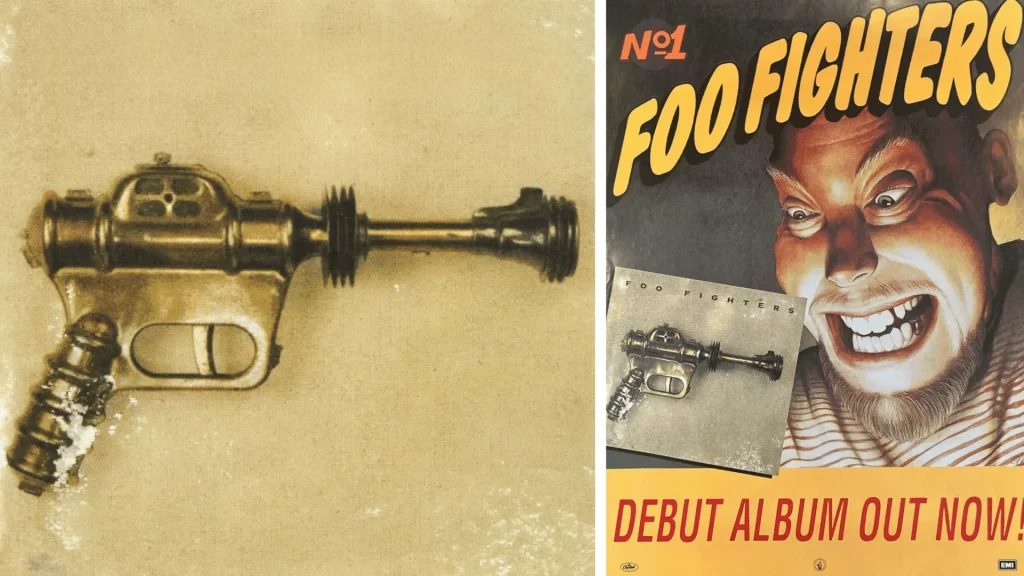
The album cover for Foo Fighters’ debut is one of those designs that stays with you precisely because it doesn’t try too hard.
Simple, a little strange, and oddly perfect for what the music turned out to be.
The Iconic Cover Design & Its Meaning
A vintage ray gun toy against a plain background, and that’s really all it was. But that simplicity carried weight.
The minimalist aesthetic felt very deliberate for 1995, resisting the darker, more brooding visuals common in grunge-era releases.
The toy gun nodded to the album’s anonymous origins, playful on the surface but carrying an edge underneath. Fans have long read it as Grohl quietly signaling a fresh start, something new disguised as something familiar.
Evolution of Foo Fighters Album Covers Over Time
Where the debut kept things stripped back and almost tongue-in-cheek, later covers grew bolder and more emotionally charged. Albums like The Color and the Shape and Wasting Light carried a weight the debut never tried to have.
The visual identity shifted from understated to boldly expressive over time.
And that little ray gun on a plain white background? Looking back, it feels exactly like what it was: a quiet, curious beginning.
Musical Style & Genre Analysis
The debut sat comfortably at the intersection of grunge, punk, and alternative rock, though it never felt derivative of any single one.
Grohl was clearly processing something, and the music reflected that.
Where Nirvana leaned into dissonance and despair, this record had an undercurrent of forward motion, rawer in places, more melodic in others.
Lyrically, themes of isolation, emotional release, and quiet resilience ran through almost every track.
It appealed to mainstream rock audiences without ever softening its edges to get there, which is honestly what made it land the way it did.
Critical Reception & Commercial Success
The debut didn’t arrive with massive fanfare, but it didn’t need to.
Critics and listeners found it on their own terms, and what followed was the kind of slow-building recognition that tends to last.
What Critics Said & How it Charted?
The response from critics was warm and largely genuine, with particular praise landing on Grohl’s songwriting instincts and the album’s unpolished energy.
It debuted at number 23 on the Billboard 200 and charted across multiple countries, a strong showing for a debut built in six days with almost no label infrastructure behind it.
For a record that started as a private demo, the commercial traction it gained felt quietly remarkable.
Sales, Certifications & Long-Term Impact
The album’s commercial footprint grew steadily and kept growing. Across four major markets, the certifications told a consistent story of a record that found its audience and held onto it.
| Region | Certification | Sales (Approx.) | Certified By | Year Certified |
|---|---|---|---|---|
| United States | 2x Platinum | 2,000,000+ | RIAA | 1996 |
| United Kingdom | Platinum | 300,000+ | BPI | 1995 |
| Australia | Platinum | 70,000+ | ARIA | 1995 |
| Canada | Platinum | 100,000+ | Music Canada | 1996 |
Impact & Legacy of the Album
The Foo Fighters’ debut marked a pivotal shift from Dave Grohl’s solo project into a fully formed band, establishing a touring lineup that would define the group’s identity.
Its raw, melodic sound played a direct role in shaping the post-grunge landscape of the late 90s, proving guitar rock could thrive in the post-Nirvana void.
Within the discography, the album stands as an unpolished but vital foundation, and while The Color and the Shape is often cited as the artistic peak, the debut remains a fan favorite for its scrappy, intimate energy.
Interesting Facts About the Foo Fighters Album
Few debut albums have an origin story quite like this one. Recorded in just a week on a modest budget, the album was born out of Grohl’s need to create after the collapse of Nirvana, with no real plan for what it would become.
- The album began as a demo tape that Grohl never intended to release commercially.
- Grohl initially submitted it to labels under a pseudonym to avoid Nirvana comparisons.
- Nearly every instrument on the record was played by Grohl alone.
- Despite its DIY origins, it became one of the band’s best-selling records.
What started as a private creative outlet ended up laying the groundwork for one of rock’s most enduring acts.
The Closing Note
The Foo Fighters’ debut wasn’t trying to be a classic. It was trying to be honest, and that ended up being the same thing.
Decades later, the Foo Fighters album still holds its ground, not because of nostalgia, but because the music genuinely earned its place in rock history.
Grohl built something real in those six days, and listeners have been returning to it ever since.
If this record means something to you, drop a comment below. Which track hit differently, and why?
Frequently Asked Questions (FAQs)
What Genre is the Foo Fighters Debut Album?
The debut blends alternative rock, post-grunge, and punk without being fully defined by any single one. Raw enough for punk purists, melodic enough to pull in a much wider audience.
What is the Most Popular Song on The Album?
‘This is a Call’ and ‘I’ll Stick Around’ consistently top the list, though Big Me earned its own cultural footprint through its iconic music video. Honestly, the answer shifts depending on who you ask.
Why is the Album Cover a Gun?
The ray gun toy was used to keep the project anonymous during the demo phase, staying low-key and free from label pressure. Its playfulness contrasted with the grunge imagery dominating album art at the time.
How Long Did It Take to Record?
The entire album came together in just six days in 1994, recorded almost entirely by Grohl himself. For a record that went on to chart globally, that timeline remains one of rock’s more remarkable production stories.