Most under-$200 running watches force a trade-off. You can have a watch that tracks pace and distance reliably, or one that buries you in metrics you have no idea how to use. The Mibro AeroPace is the rare cheap watch that aims at both — and its secret isn’t a new sensor.
It’s Mibro Coach, an AI training layer built on top of the hardware that plans your weeks, adapts to how wrecked you actually feel, and explains what the numbers mean instead of just dumping them on you. After a few weeks of living with Mibro AeroPace, here’s what holds up and what doesn’t.
What we liked:
- Absurdly light at 32 g on the woven strap — forget it’s there on long runs and overnight
- L1/L5 Dual-Band GPS with 5 satellite systems, plus useful offline maps at this price
- Mibro Coach adapts sessions to your sleep, fatigue, and recovery — it’s not a static PDF
- Bright, sharp 1.32″ AMOLED that stays readable in direct sun
What we didn’t:
- 12 hours of GPS battery may be limiting for ultras and long days on the trails
- Small screen means maps feel cramped; messages can’t show images or replies
Verdict: The best $150 running watch for beginners who want a coach on the wrist, not a spreadsheet.
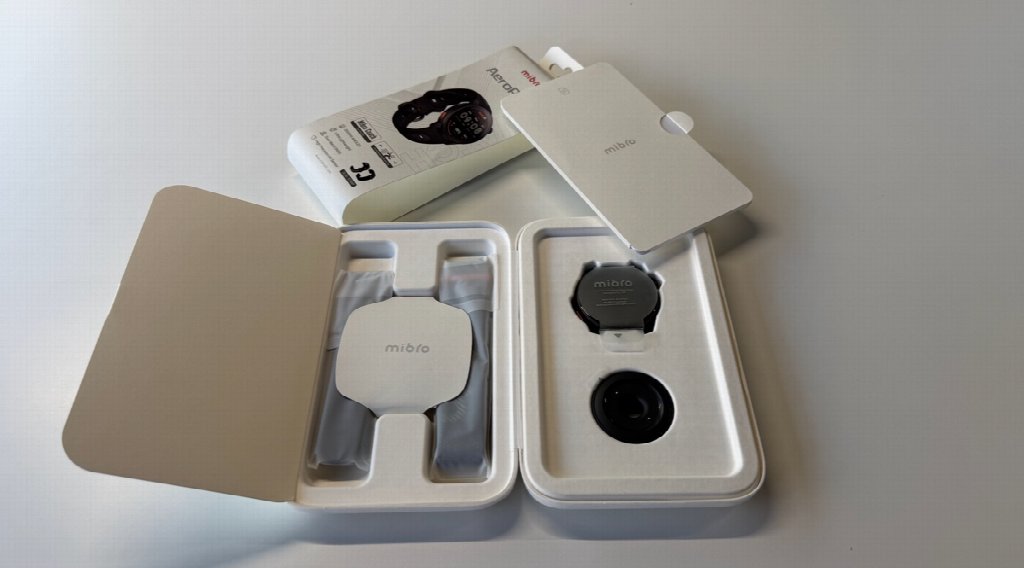
Design: The Whole Point Is That It Disappears
Pick up the AeroPace and the first thing you notice is what you don’t notice. On the woven strap, it weighs 32 grams — roughly the weight of an AA battery. The case is 44.5 mm across but only 9.2 mm thick, and the rounded edges slide under a cuff without catching. This is not an accident: for running, weight and thickness are the specs that actually ruin workouts, and Mibro spent its budget here instead of on titanium or sapphire.
Both straps ship in the box. The woven textile is the one Mibro wants you to use — it’s breathable, holds the sensor flush against the skin, and keeps weight down. The silicone is there for wet, sweaty days when you want to rinse it off. With a standard 22 mm lug width, you can easily swap in compatible straps. Available in black and light gray woven straps, as well as cyan and orange silicone options, each features subtle details that add a sporty touch without looking try-hard.
That lightness pays off twice. On long runs, the watch can be a guide, not a burden. At night it’s comfortable enough to forget you’re wearing it — which matters, because sleep tracking only works if you keep the watch on. 5 ATM rating covers rain, sweat, and showers, but skip hot tubs and dives.
Display: Clear Data, Even in Bright Sunlight
The 1.32″ AMOLED is one of the best things in this class. 466 × 466 pixels at 353 PPI means text and workout metrics stay crisp, and 60 Hz makes swipes feel instant. The 2,000-nit peak brightness is the spec runners actually care about: on early-morning or midday runs, pace and lap data are legible without holding a hand over the screen.
The catch, as always with AMOLED, is power draw. Always-on mode eats into that 8-day claim, and the same vivid panel that makes maps readable also shortens real-world endurance compared to transflective rivals. It’s the right trade-off for a watch you wear in daylight, but plan accordingly.
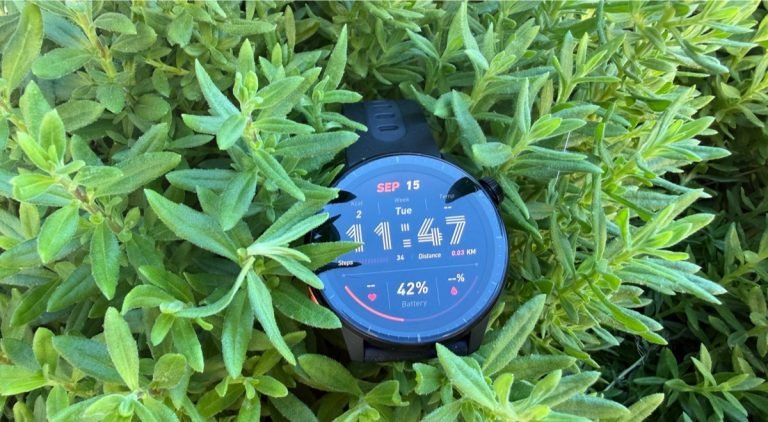
Running: GPS, Maps, and What Actually Shows Up on Wrist
Dual-Band GPS and Offline Maps
Most watches at this price use single-band GPS, which is fine on open trails but tends to wobble between skyscrapers or under tree cover. The AeroPace uses a dual-band GNSS chip that listens on both L1 and L5 frequencies across five satellite systems. The practical result: more accurate, consistent tracks through urban canyons and tree-lined routes, with less GPS drift and fewer erratic deviations on post-run maps. Mibro adds AI positioning algorithms on top as well.
Downloadable vector maps are the spec that jumps out at this sub-$200 price. Global maps load through Mibro Fit, stay on the watch, and don’t need a phone signal. Once loaded, you get breadcrumb route tracking, an alert when you drift off course, and one-tap back-to-start navigation. For road runners, this is a safety net in unfamiliar neighborhoods; for trail runners, it’s the difference between a relaxed outing and constantly glancing at a phone.
Rated endurance is 12 hours of continuous GPS, which comfortably covers 5Ks, 10Ks, half marathons, and full marathons.
The Sensor Suite Under the Hood
AeroPace packs the hardware you’d expect on a more expensive watch: a redesigned multi-LED optical heart rate sensor, SpO₂, accelerometer, gyroscope, magnetometer, and barometric altimeter. During runs this combination feeds live heart rate zones, cadence, stride length, elevation, and (via Mibro Coach) vertical oscillation and ground contact time.
Wrist-based heart rate is solid for steady runs and zone training, but it’s an estimate. On short intervals or hard surges it lags the chest strap, which is the honest caveat at this price.
Mibro Coach: The Reason to Buy This Watch
Here’s where the AeroPace stops being a generic sports watch. Mibro Coach, built by the Mibro Sports Science Lab, isn’t a screen full of graphs — it’s a closed-loop training system: assess, plan, execute, recover, analyze. The idea is that the watch doesn’t just record what you did; it tells you what to do next.
Plans That Actually Adapt
Setup starts in Mibro Fit: you set your level, how many days a week you can train, and your goal. From there Coach offers multiple programs lasting 4 to 20 weeks — going from zero to running habit, through 5K and 10K plans, all the way up to half marathon and marathon. The plan syncs to the watch, so each session comes with its own warm-up, work intervals, and cooldown on the wrist.
The difference from a PDF found online is the adaptation. Before each session, Coach looks at your sleep quality, recent fatigue, heart-rate-variability-based recovery, and accumulated training load. If the data says you’re not recovered, it dials the session back or recommends a rest day. That sounds small until you’ve been the beginner who crams three weeks of missed workouts into one weekend and spends ten days injured. This is the exact failure mode Coach is built to prevent.
Five Coaches, One Goal: Keep You Coming Back
Motivation fails in the first four weeks, so Mibro lets you pick among five virtual coaches with different personalities — direct and demanding, explanatory and educational, or warm and encouraging. The plan math doesn’t change, but the voice does, and that choice measurably affects whether someone sticks with it.
There’s also Just Talk: a multi-turn AI conversation where you can ask why today’s run is easy, what a ground-contact-time number actually means, or how to reshuffle a week around a busy schedule. Proactive alerts flag when your training state shifts and suggest plan tweaks automatically.
The Metrics, Finally Explained
Here’s the part beginners usually bail on. AeroPace tracks the full modern metric set:
- VO₂ max — your aerobic ceiling, tracked over time.
- Training load — how much stress recent weeks have stacked up.
- Recovery time — HRV-based estimate of when you can handle hard effort again.
- Vertical oscillation — how wastefully you’re bouncing up and down.
- Ground contact time — how long each foot spends on the pavement.
On a typical budget watch these numbers just sit there. Mibro Coach ties them together: it flags strengths, points out what to work on, and suggests the next concrete step. That context is the product.
It won’t replace a real coach or a doctor when injuries or conditions are involved — and Mibro is upfront about that — but for someone who just wants to progress without a physiology degree, the layer of explanation is worth more than another dozen raw metrics.
One business note: the first 30 days of Mibro Coach are included; $4.99 per month.
Health Tracking: Quietly Complete, Not Quietly Judgy
Beyond running, the watch handles the daily baseline: 24/7 heart rate, SpO₂ spot and automatic checks, sedentary reminders, steps, and active calories. Automatic monitoring means it collects this in the background without you starting measurements, which is the only way daily trends are actually useful.
The same 32 g lightness that helps on runs is what makes overnight sleep tracking tolerable — sleep stages and duration feed straight into Coach’s recovery logic, so your rest isn’t a separate app, it’s part of the training picture.
As with all wrist devices, treat the numbers as directional trends over weeks, not medical readings. The value isn’t any single night’s score; it’s watching the pattern and seeing how training load and sleep interact.
Smart Features and App: Good Enough, Not Pretentious
Mibro Fit handles setup, settings, and deep stats; the watch handles at-a-glance info. On the wrist you get phone notifications, Bluetooth calls, and music control. It doesn’t show images inside messages and it can’t send replies — a deliberate sports-first choice that anyone expecting a mini smartphone should know going in.
Data exports to Strava, Google Fit, Apple Health, Runalyze, and RQ Run, and Mibro runs a Strava club north of 10,000 members for the social side. A region-specific padel mode with scoreboard is a fun extra, but the watch’s heart is clearly running.
Battery Life: A Week of Use, 12 Hours of GPS
Mibro claims eight days typical and twelve hours GPS. In real use, expect around a week with daily tracking and a couple of runs, and closer to four days when GPS is on heavily. Magnetic charging is simple and fast enough that you’ll top up on a weekly schedule rather than daily. The 12-hour GPS window is the honest ceiling: it covers marathon training comfortably.
Final Verdict
The Mibro AeroPace isn’t trying to be a premium running watch killer. It nails the fundamentals runners feel every day — 32 grams on the wrist, a screen you can actually read outside, GPS that holds a line, maps that work without a phone — and then layers on Mibro Coach, which is the rare software feature that changes how you train rather than just how much data you collect.
If you’re stepping up from a fitness band, starting to train for a 5K or beyond, and want a watch that tells you what to do on your next run instead of just logging this one. For $150, that’s a genuinely coherent pitch.