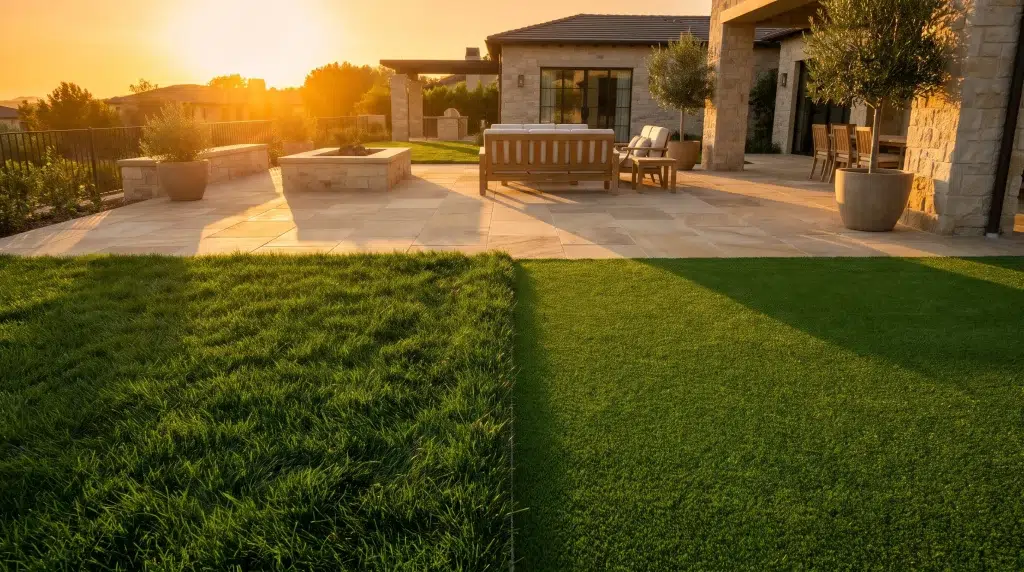
Choosing between artificial turf and natural grass for a luxury landscape is less about finding a universal winner and more about deciding which material best supports the overall design.
High-end residential landscapes often bring together pools, patios, outdoor kitchens, gardens, pathways, architectural features, and open lawn areas. The lawn has to do more than fill empty space. It needs to complement those elements and help create a cohesive outdoor environment.
Natural grass offers the character and sensory qualities of a living landscape. Artificial turf offers greater consistency and flexibility in spaces where growing conditions or surrounding features make natural grass difficult to incorporate.
For luxury properties, the strongest landscape may even use both.
The Lawn Is Part of the Larger Design
In a thoughtfully planned property, grass does not exist in isolation.
Its shape may define the edge of a patio, create visual breathing room between planting beds, soften expanses of stone, or establish a transition between the home and the rest of the landscape.
That makes material selection an important part of the overall design process.
Natural grass works especially well when the goal is to create a traditional garden atmosphere or emphasize the living character of the property. Its subtle changes in color, texture, and growth can complement mature trees, layered planting beds, and seasonal landscapes.
Artificial turf provides a different kind of visual effect. Its consistency can support cleaner, more contemporary landscapes where crisp lines and clearly defined outdoor zones are part of the aesthetic.
The better choice ultimately depends on what surrounds the lawn and the role it is expected to play.
Creating Clean Transitions Around Hardscape
One of artificial turf’s most useful design qualities is its ability to contrast with hardscape.
Stone patios, concrete pavers, porcelain tile, retaining walls, and other hard surfaces can dominate an outdoor space when they cover large areas. Introducing green between or alongside those materials helps soften the overall composition.
Synthetic turf can be cut and installed around geometric shapes, pathways, and other built features, allowing designers to create deliberate transitions between green and hard surfaces.
In contemporary landscapes, narrow strips of turf can also be incorporated between large-format pavers. Rather than creating one expansive lawn, the turf becomes a repeating design element that breaks up the hardscape and introduces color and texture.
For homeowners investing in custom landscape design, this flexibility can make turf part of the architectural composition rather than simply a substitute for natural grass.
Bringing Greenery Into Pool Areas
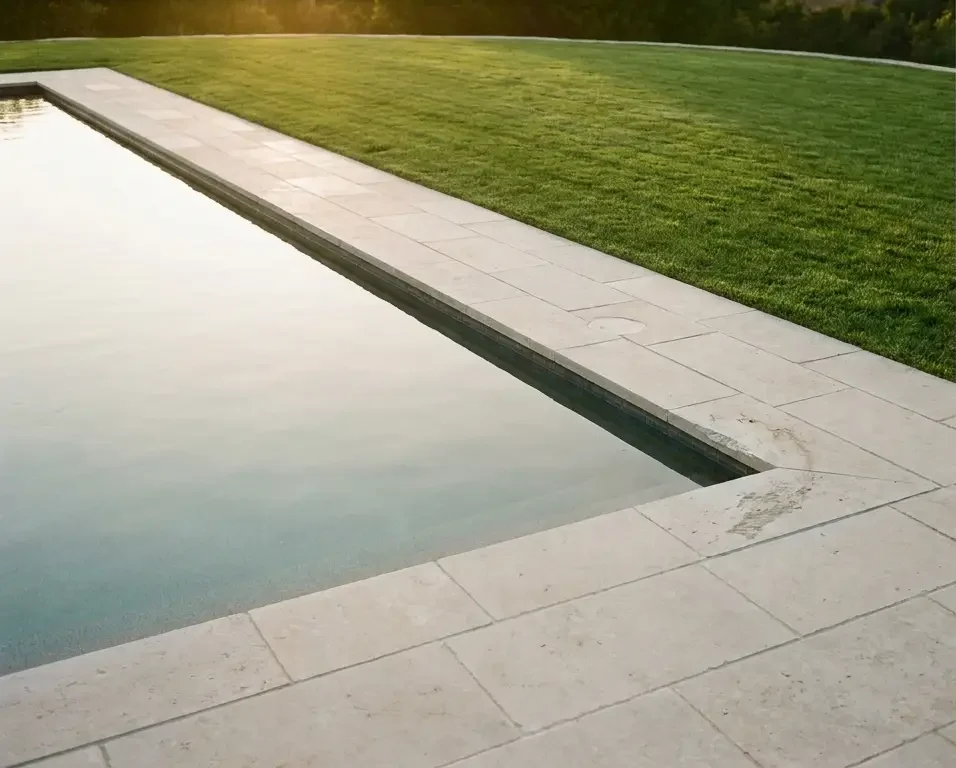
Pool landscapes are another place where turf can become a design feature.
Luxury pools are often surrounded by substantial areas of stone, tile, concrete, or decking. While these materials create a polished foundation, an entirely hardscaped pool environment can sometimes feel visually heavy.
Strategically placed turf introduces a softer element.
It might form a green border beyond the pool deck, connect the pool area with another outdoor living zone, or create small lawn sections between lounging and entertaining spaces. Turf can also be shaped around curved pools and other custom landscape features.
The result can be a pool area that feels connected to the wider landscape rather than separated from it by a continuous field of hardscape.
Product selection and installation still matter in these applications. Drainage, surface temperature, surrounding materials, and the specifications of the turf itself should all be considered when planning areas near a pool.
Connecting Outdoor Living Spaces
Today’s luxury backyards frequently function as extensions of the home.
A single property may include an outdoor kitchen, dining terrace, lounge, fire feature, pool, garden, and recreation area. The landscape has to connect those individual spaces without making the backyard feel fragmented.
Lawn areas can help create that continuity.
Instead of treating turf as one large rectangle in the center of the property, designers can use it to establish green corridors between different destinations or to visually connect spaces separated by hardscape.
For example, a turf area beside an outdoor kitchen can lead toward a pool lounge before transitioning into planted garden space. Another section might provide an open gathering area between a patio and a recreation zone.
Used this way, grass becomes part of the property’s circulation and spatial planning rather than simply background landscaping.
Designing Around Modern Architecture
Artificial turf can be particularly effective alongside contemporary residential architecture.
Modern homes often feature strong geometric forms, large expanses of glass, restrained material palettes, and clean transitions between indoor and outdoor spaces. Landscape elements that repeat those visual principles can help unify the property.
Defined sections of synthetic grass can complement rectangular pools, linear pathways, concrete pavers, and architectural planting beds.
The contrast can be especially effective when turf is paired with materials such as natural stone, wood, concrete, and ornamental planting. The green surface adds softness while the surrounding hardscape maintains the property’s structured appearance.
Natural grass can achieve many of the same effects, but artificial turf may be considered when a design calls for particularly consistent lawn areas in locations where growing conditions are challenging.
Creating Custom Recreation Areas
Luxury landscapes are increasingly designed around how homeowners want to spend time outside.
That may mean creating spaces for entertaining, swimming, relaxing, or recreation rather than dedicating most of the yard to a conventional lawn.
Private putting greens are one example where specialized synthetic turf can serve a very specific design purpose. Instead of treating the putting area as a separate feature, designers can integrate it into the surrounding landscape using planting beds, stone borders, pathways, and complementary lawn areas.
Other recreation zones can be approached similarly. The objective is not simply to add turf, but to make the feature look intentional within the larger property.
A well-integrated recreation area should feel like another outdoor room rather than equipment placed in the middle of a backyard.
Natural Grass Still Has a Place in Luxury Landscapes
Synthetic turf does not automatically make sense everywhere.
Natural grass remains particularly well suited to landscapes intended to feel traditional, organic, or garden-focused. Formal lawns surrounded by mature trees, flowering borders, and seasonal planting can benefit from the changing qualities of living grass.
It also provides sensory characteristics synthetic materials cannot completely reproduce. Natural grass changes subtly with the weather and seasons and has the texture and scent associated with a living lawn.
These qualities may be particularly important when the landscape design draws inspiration from traditional estates, English gardens, or other styles where the lawn is intended to function as part of a living ecosystem.
Rather than asking which material looks more luxurious on its own, homeowners should consider which one feels more appropriate for the architectural and landscape style of the property.
Combining Natural Grass and Artificial Turf
Luxury properties do not necessarily need to choose one material for the entire landscape.
In fact, using different lawn materials in different zones can provide designers with greater flexibility.
A large garden-facing lawn might remain natural to complement surrounding plantings, while synthetic lawn installation could be considered for a modern pool area, shaded courtyard, putting green, or highly structured space alongside contemporary hardscape.
The transition does not have to be obvious. Planting beds, pathways, retaining walls, patios, and changes in elevation can create natural boundaries between different landscape zones.
This approach allows each material to be selected according to the visual and functional requirements of a particular space instead of forcing one solution across the entire property.
Designing the Landscape as a Whole
The artificial turf vs. natural grass decision becomes much easier when lawn is considered as one component of the entire outdoor environment.
For premium residential landscaping, the goal is not simply to create the greenest lawn possible. It is to develop an outdoor space where the lawn, hardscape, pool, planting, architecture, and entertaining areas feel intentionally connected.
Natural grass can bring movement and living character to traditional or garden-focused properties. Artificial turf can introduce clean lines and consistent greenery into contemporary spaces, difficult growing areas, recreation zones, and hardscape-heavy designs.
Neither material needs to win everywhere.
The strongest luxury landscapes use each element where it contributes most to the overall design. When turf is treated as part of the landscape palette rather than simply a replacement for grass, it can help create outdoor spaces that feel polished, purposeful, and integrated with the home.