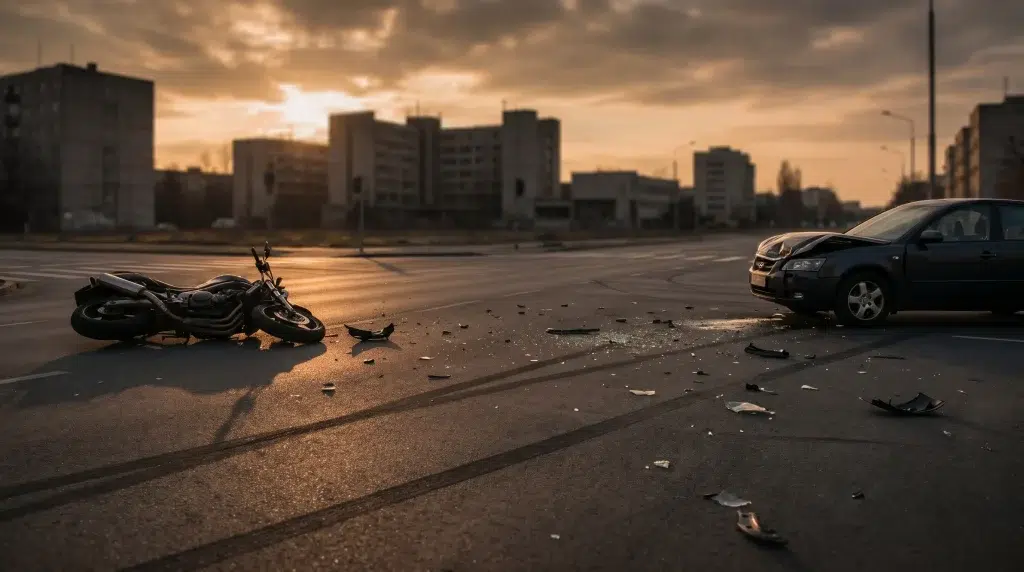
Determining fault after a motorcycle accident is one of the most critical factors in any injury claim. The outcome directly affects whether a victim can recover compensation and how much they are entitled to receive. Unlike straightforward fender-benders between passenger vehicles, motorcycle collisions often involve disputed liability, bias against riders, and complex questions about road conditions and traffic law compliance.
California’s fault determination framework relies on the legal concept of negligence, which requires proof that one party failed to exercise reasonable care and that this failure caused the accident and resulting injuries. A Los Angeles motorcycle accident attorneycan investigate the circumstances of a collision, gather supporting evidence, and build a case that accurately establishes which party bears responsibility for the harm caused.
The Legal Standard for Establishing Fault
To hold another party liable for a motorcycle accident in California, the injured rider must prove four elements of negligence: duty of care, breach of that duty, causation, and actual damages.
Every driver on the road owes a duty to operate their vehicle safely and in compliance with traffic laws. When a driver violates that duty, whether by running a red light, failing to check a blind spot, or driving while distracted, and that violation causes a collision, the driver may be found at fault.
California also recognizes the doctrine of negligence per se, which applies when a driver violates a specific traffic statute and that violation results in an accident. Under this doctrine, the statutory violation itself serves as presumptive evidence of negligence, relieving the plaintiff of the burden of separately proving that the defendant’s conduct was unreasonable.
Key Evidence in Fault Determination
The traffic collision report prepared by responding law enforcement officers documents vehicle positions, road conditions, witness statements, and any citations issued at the scene. However, this report alone is rarely sufficient to resolve disputed liability.
Additional evidencethat strengthens a fault determination includes traffic camera and surveillance footage, which can capture the moments leading up to the collision. Photographs of the scene, including skid marks, debris patterns, and vehicle damage, help accident reconstruction experts analyze the mechanics of the crash. Electronic data from vehicle black boxes and, in some cases, data from mobile devices can reveal speed, braking patterns, and whether a driver was using a phone at the time of impact.
Medical records also play a role in supporting causation by linking the victim’s injuries directly to the collision. When there is a gap between the accident and the first medical visit, opposing parties may argue that the injuries were unrelated, making prompt medical documentation essential.
How Comparative Fault Applies
California follows a pure comparative negligence system, meaning that more than one party can share responsibility for an accident. Under this framework, an injured motorcyclist can still recover damages even if they contributed to the collision, but their compensation is reduced in proportion to their share of fault.
For example, if a motorcyclist is found 30% at fault and the total damages are valued at $300,000, the rider would recover $210,000. This system ensures that victims are not entirely barred from compensation due to partial responsibility, but it also means that the percentage of fault assigned to each party becomes a heavily contested issue.
Insurance adjusters and defense attorneys often attempt to shift a greater share of blame onto the motorcyclist. Common arguments include allegations of excessive speed, improper lane positioning, or failure to wear adequate protective gear. While California does not require adult motorcyclists over the age of 21 to wear helmets beyond the minimum legal requirement, the absence of optional protective equipment can still be raised in an effort to reduce the insurer’s payout.
The Role of Multiple Parties
Collisions at busy intersections, on highways, or in construction zones may involve multiple vehicles, government entities responsible for road maintenance, or even manufacturers of defective vehicle components. Identifying all potentially liable parties is essential for maximizing the victim’s recovery.
Under California’s joint and several liabilityrules, when multiple defendants share fault, each one can be held responsible for the full amount of economic damages, regardless of their individual percentage of responsibility. This rule is particularly significant in cases where one at-fault party lacks sufficient insurance coverage, as it allows the victim to pursue the remaining economic damages from other responsible parties.
Claims involving government entities follow different procedural requirements. If a dangerous road condition, such as an unrepaired pothole or missing signage maintained by a city or county, contributed to the accident, the victim must file an administrative tort claim within six months under the California Government Claims Act before pursuing a lawsuit in civil court.
Conclusion
Understanding how fault is established in a motorcycle accident is essential for any victim seeking compensation. The process involves proving negligence through strong evidence, navigating California’s comparative fault system, and identifying all responsible parties. Riders who take steps to preserve evidence and seek legal guidance early in the process are better equipped to counter unfair blame and secure fair compensation.