

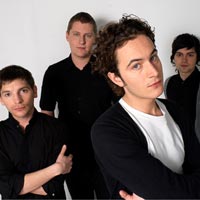

Despite the band he fronts - Editors - reaching the top of the album charts with their second album, ‘An End Has A Start,’ just over two weeks ago, Tom Smith is not completely satisfied. “It’s been a strange one critically,” he muses, with an obvious hint of frustration, “we’ve had a lot of great reviews from what you would call respected publications and we’ve had great reviews from tabloid press and some of the kind of ‘lad mags,’ but we have had quite a few that were, well yeah, Q was a stinker to be honest. I don’t know, maybe some of them don’t like the direction, some of them don’t like the songs and some of them just don’t like us, which is fine, we can’t please everyone.”
I seem to have caught Smith - whose skinny frame is now topped off with shaggy curls that are far removed from the shaved head that he was sporting when Editors released their debut album, ‘The Back Room,’ in 2005 - on an unusually forthright day by his demure standards. The man known for his on stage exuberance and mind bending flexibility just can’t seem to get ‘An End Has A Start’s’ critical reception off his mind.
“What is puzzling me is that, of the bad reviews, there’s no kind of common things with the songs and stuff,” adds Smith, as he tries to summarise the critics’ mixed response. “For example, in the NME review it said the best song we’ve ever done was in the second half of the record picking it up towards the end and that was us really becoming a great band in the course of those five or six minutes. And in the Q review it was like the only songs that are worth listening to are the first three songs and the second half, or two-thirds of it, aren’t even worth listening to – it’s just bollocks from that point on. I don’t know, it puzzles me, but you have to remember that it is only one person’s opinion and you can’t worry too much about it.”
You can understand Smith’s puzzlement. For a band, or any performer, the album is the pinnacle – the permanently embellished memoir of their career. As live shows can pass as memories, it’s the album that survives indelibly in record shops, or these days, online.
And so, why has ‘An End Has A Start’ received such a mish-mash of critical assessments? Well mainly because the Editors that recorded the album just aren’t the same Editors that recorded ‘The Back Room’ – an album which, after initial success, eventually reached the dizzy heights of number two in the album charts when people began to realise that the Midlands band really had something quite alluring about them. Instead, they’ve evolved, with the production help of Garret ‘Jackknife’ Lee (who also re-recorded the euphoric version of ‘Bullets’ for the band) to a place which in parts is even more anthemic than their debut (‘The Racing Rats’) but in others, more minimal (‘Spiders’) than anyone would have expected Editors to be able to go. Even Editors themselves.
“With the record as a whole we tried to do new things and new sounds and not just have the four elements that are pretty much on the whole of ‘The Back Room,” explains Smith, as he talks about the new instruments – particularly the piano – that have come to the fore on the new album. “We wanted to try new things and push ourselves and a piano was one of them and picking up an acoustic guitar. I think on ‘The Back Room’ when we were recording it we’d have been a bit terrified to go near a piano, we’d have been like, ‘Oh you can’t do that, it’s ridiculous.’ But, a few years down the line let’s try and make a big, large textured record that has lots of different elements to it.”
While the album contains the expected big, “Editors-esque” moments, like lead single, ‘Smokers Outside The Hospital Doors,’ which features a chorus made up of the band’s friends, and next single, ‘An End Has A Start,’ it’s tracks like the aforementioned ‘Spiders’ and ‘The Weight of The World’ which are the “different elements” Smith is talking about. Rather than provide Editors usual immediate connection, they’re songs that are designed to burn slowly, yet more brightly with every listen. “You need to kind of emerge yourselves in them and for me as a listener,” reveals Smith, “of the records I get the most and find the most rewarding, like the new National record and the new Arcade Fire record, I have to immerse myself in it and live with it for a while and I hope people that love this record will, given time, not just love the instant singles or whatever.”
What he means is as much to do with the song’s lyrics as opposed to the more minimal construction. Not since Arcade Fire released their lyrically bleak but musically blusterous debut album, ‘Funeral,’ has a record been so inspired and shaped by death. Affected by a series of unexpected tragedies close to the band before and while they were recording the album, ‘An End Has A Start,’ is them more raw, more heartfelt, more open than ever. ‘Well Worn Hand,’ the album’s definitive closer, for example, was written after Smith heard the news that an old school friend had been tragically killed. In it, a near- tearful sentiment reverberates through his voice as he sings the lines, “I don’t want to go out on my own any more/ I can’t face the night like I used to before,” while the song is pushed along with just him on Piano and guitarist Chris Urbanowicz. “You might as well just shut the door, stay inside, never go outside when there are people in the world that can do that,” admits Smith, as he discusses the story behind the song. Editors may have always sounded humane in the past but this is them feeling truly human.

As anyone who has dealt with the unfortunate and always affecting emotion of death knows, the tragedy also triggers life’s most unanswerable question – what next? For Smith, his answer would poignantly become the album’s title. A title which, to his frustration, has been misrepresented in the media. “I’ve been quoted somewhere as saying that the record deals with the uplifting side of death, well that’s bollocks, I’ve never ever said that in my life,” stresses the obviously flabbergasted singer. “When exposed to something that’s kind of scary or something terrifying happens in or around your life or moves you, yes that’s horrible and sad but then given a little bit of time you think about what you have in your life and you learn to appreciate what you have, why you have it, the people around you, friends or loved ones. It’s taking something positive from something that’s ultimately very scary and negative and just kind of having that, an end has a start; a start is something positive from something negative,” he adds. “I’m not trying to be profound it just came out and I don’t expect it to mean a lot to anyone else, it’s just came out of me and it seemed to make sense with a lot of things that were touched on in the record.”
Whilst Editors’ new, slow songs have provided a welcome – if much critiqued - addition to their library, their new, as Smith puts it, “thunderous” songs which “feel like a blue whale kicking you in the stomach” have still proven as affecting on the live stage as ever. Crowds flocked to see them during their appearance at this year’s Glastonbury Festival, where two years on from virtually opening The Other Stage they were performing as the penultimate act before Iggy and The Stooges.
Playing the much heralded spot, which sees whatever lucky band who earn the right to play it play through sunset “was the stuff dreams are made of,” according to Smith, as he uncaringly adheres to the Glastonbury cliché. “We’re so lucky to do what we do,” he adds. “We try our best to never take it for granted and be arrogant arseholes about it. You remember things like that because you could get dropped tomorrow and never have another record out in your life so you have to take those moments in.”
Editors have maintained that ‘unofficial’ moto ever since they toured some of the UK’s biggest arenas in 2005 with Franz Ferdinand and fellow up and comers at the time, The Rakes. To this day it’s still the only time Editors have supported a band. When their debut ascended back up the charts, however, it showed that they really couldn’t have chosen a better time to accept an offer. “I think we have a lot to thank them (Franz Ferdinand) for – they brought us to the audience,” admits Smith. “We’re very proud that we’ve done it on our own but at that point they brought us to a whole new audience, you know, the Franz Ferdinand audience. With a support band in an arena, nine times out of ten the audience don’t even know the name of the band or even care, but I think with Franz Ferdinand, because they’re so young and their fans are music fans, into new music, that people came to those arenas for the whole bill.”
One thing that comes across with Smith is that, modesty aside, there has always been a significant ambition for Editors ever since they formed at Staffordshire University in 2003 through a collective dissatisfaction at their music technology course to mesmerise 50,000 strong crowds, and that maybe, although he wouldn’t admit it explicitly, there’s always been ambition for a number one album as well. “I remember when we first wrote ‘Bullets,’ it was very early on, I don’t know, it sounded like a song that a signed band could play,” he says intrepidly. “Even when we played it in The Forrester And Firkin Pub in Stafford which we did when we were at Uni, even when we were playing it there, I don’t know, it felt like you could play it in an arena or wherever really in front of a crowd and yeah there’s always a little part of me that believes that the songs that we make people will like and mean something to some people, but you can’t let that part get big or talk about it too much because you feel like an arrogant arsehole.” Smith adds hastily: “We don’t believe we should be the biggest band in the world. It’s the anti kind of big mouth Oasis thing I guess. But, you always have confidence and believe in yourself.”
While Smith is a man who, every time he sounds like he’s getting too confident he normally replies with something to suggest how lucky Editors feel as a band, there’s one subject he’s venomously defiant about – his band’s comparisons to Interpol. Since their debut the band – and particularly Smith’s voice – has been described as Britain’s ‘not-as-good’ answer to the New York four-piece.
When I ask him what he thinks, it provides an answer that’s just as stringent as his riposte to ‘An End Has A Start’s’ critics. “When people just dismiss us as a second rate whoever, of course it pisses you off. I’ve got to be honest, vocally there is a similarity there and that’s fine but even if I listen to a lot of ‘The Back Room’ it doesn’t sound anything like Interpol. It really doesn’t, it really doesn’t,” he stresses. “What amazes me is that we still get that on this record and this record sounds absolutely nothing like Interpol or Joy Division and if you’re a music journalist saying that then you’re deaf, you really are, you should get another job.”
Although Editors may have been at the end of some mixed reviews for their latest album, with the record entering the charts at number one, it seems that they’ve actually just arrived at the start of something very significant indeed.
Live photo by: Shirlaine Forrest


.jpg)


