Wang demonstrates a UX prototype for clients from a U.S. military institution at G&A’s New York lab. Courtesy of Shih-Hsueh Wang.
People don’t go to museums to remember interfaces. They go to leave with a story that sticks, and the moments that linger are usually the ones when they feel involved, not instructed. An intuitive interactive experiences don’t “teach” in a loud way. They make visitors feel like they’re actively discovering rather than passively receiving.
Shih-Hsueh Wang designs for that shift.
Based in New York, Wang is a UX Designer at G&A Strategy and Design, a studio behind major cultural institutions, including the National Museum of African American Music. In 2026, G&A also received recognition by winning three among the top five Best New Museums in America, as named by USA Today.
Wang’s work spans permanent museum installations and independent conceptual projects. Still, the throughline remains consistent: interaction is a way into meaning. Not a feature to show off, but a structure that keeps people curious long enough to understand what they’re seeing, and why it matters.
When Design Leaves the Screen
Wang’s approach sharpened during his graduate studies at Carnegie Mellon University. His thesis, STAGES OF CONVERGENCE (2023), wasn’t framed as a tidy object with a single “final” form. It was built as a working environment, something people could enter and revise through use.
Using motion sensors, projection, and live video, he created a system that translated tabletop models into room-scale scenes. Participants didn’t just point at ideas and talk around them. They stepped into projected environments, acted out scenarios, and reshaped the space together as it shifted. The room became a hybrid of prototyping lab and rehearsal space.
The interesting part wasn’t the tech. It was the behavioral shift it elicited in people. Once bodies were involved, collaboration became more than purely verbal. People could test an idea rather than defend it. Feedback arrived through timing, distance, and gesture, the kinds of signals that tend to disappear when design gets flattened into slides.
That thesis period set Wang’s baseline: interaction is a method for thinking, learning, and making decisions with others.

Wang leads a workshop to test the collaborative prototyping platform with a designer and a user for his graduate thesis. Courtesy of Shih-Hsueh Wang.
Finding Balance the Hard Way
That interest in physical negotiation carried into Island of Rain, a conceptual installation that received a Good Idea Award at the Taipei New Horizon Creative Festival in 2021. The project imagined five seesaws beneath a mist canopy. As participants worked to find balance, vapor gathered overhead, briefly marking the coordination that made it possible.
Although the installation was never built, the concept was published digitally with renderings and diagrams. What gives Island of Rain its punch is how little it asks from the audience. There’s no interface to decode and no instruction wall doing the work for you. The interaction is the point. You learn what it means by doing it, adjusting in real time to someone else’s weight and rhythm.
It’s also a glimpse into Wang’s instincts: he’s drawn to interactions that don’t rely on novelty to hold attention. The communication between people is enough.
History, Told Like a Night Out
In 2020, Wang brought that same instinct into cultural storytelling for the Taipei National Palace Museum Online Curator Competition. Working with a collaborator who led research and curation, Wang designed the introductory film for Time-Travel through Taipei National Palace by Bar Hopping, which received a Special Award.
The project reframed ancient drinking culture through the familiar rhythm of bar hopping, using “stops” to structure the journey. It’s a clever move, not because it makes history casual, but because it makes the entry point legible. You aren’t asked to adopt the posture of a dutiful learner. You’re invited to follow a social script you already understand, then let the artifacts and rituals deepen the experience from there.
Building for Change, Not Permanence
Later that year, Wang served as lead designer for both the exhibition and website for the 2020 International Forum for Architecture Thesis Design in Taiwan & Southeast Asia, held at National Cheng Kung University. The theme, New Resilient Grounds, wasn’t treated as a slogan. Wang turned it into something you could walk through and use.
His exhibition installation used a modular system of honeycomb cardboard, practical, lightweight, and flexible enough to support the forum as it unfolded. The space held thesis work, supported on-site presentations, and accommodated remote participation without feeling like two separate experiences stitched together. Resilience wasn’t announced. It showed up in how the environment adapted.
As Cheng-Luen Hsueh, Chair of Architecture at NCKU and curator of the forum, put it: “It’s rare for one designer to lead both the physical exhibition and its digital counterpart. Wang’s ability to think seamlessly across media was evident from the start.”
Scaling Without Losing the Thread
Today, Wang brings the same sensibility into his work at G&A. Several museums he has contributed to have recently opened or are opening to the public. The stakes shift when an experience has to work for thousands of visitors with different backgrounds and different reasons for showing up.
At the Cleveland Museum of Natural History, recently ranked #4 on USA Today’s list of the 2026 Best New Museums in America, he designed interactive installations that invite visitors to explore scientific ideas through direct engagement. The interactions reward curiosity and make learning feel earned.
He also contributed to the Navy SEAL Museum in San Diego, where the work demands restraint. In that context, the goal is not to entertain. It is to guide attention, control pacing, and avoid turning serious subject matter into spectacle. Good UX here isn’t louder. It’s more considerate.
In early 2026, the Museum of Kansas City will reopen to the public after renovation. The museum’s focus includes restorative practice and revisiting local history through perspectives previously overlooked or simplified. Wang’s UX work there focuses on building resonance, helping visitors navigate complex, heavy history while asking themselves, “What would I do?”
As Jessica Lautin, the Associate Creative Director of Content at G&A, also the Creative Lead on the Museum of Kansas City project, puts it: “Wang not only designs experiences that are intuitive, but also incentivizing and playful, that keep visitors curious throughout.”
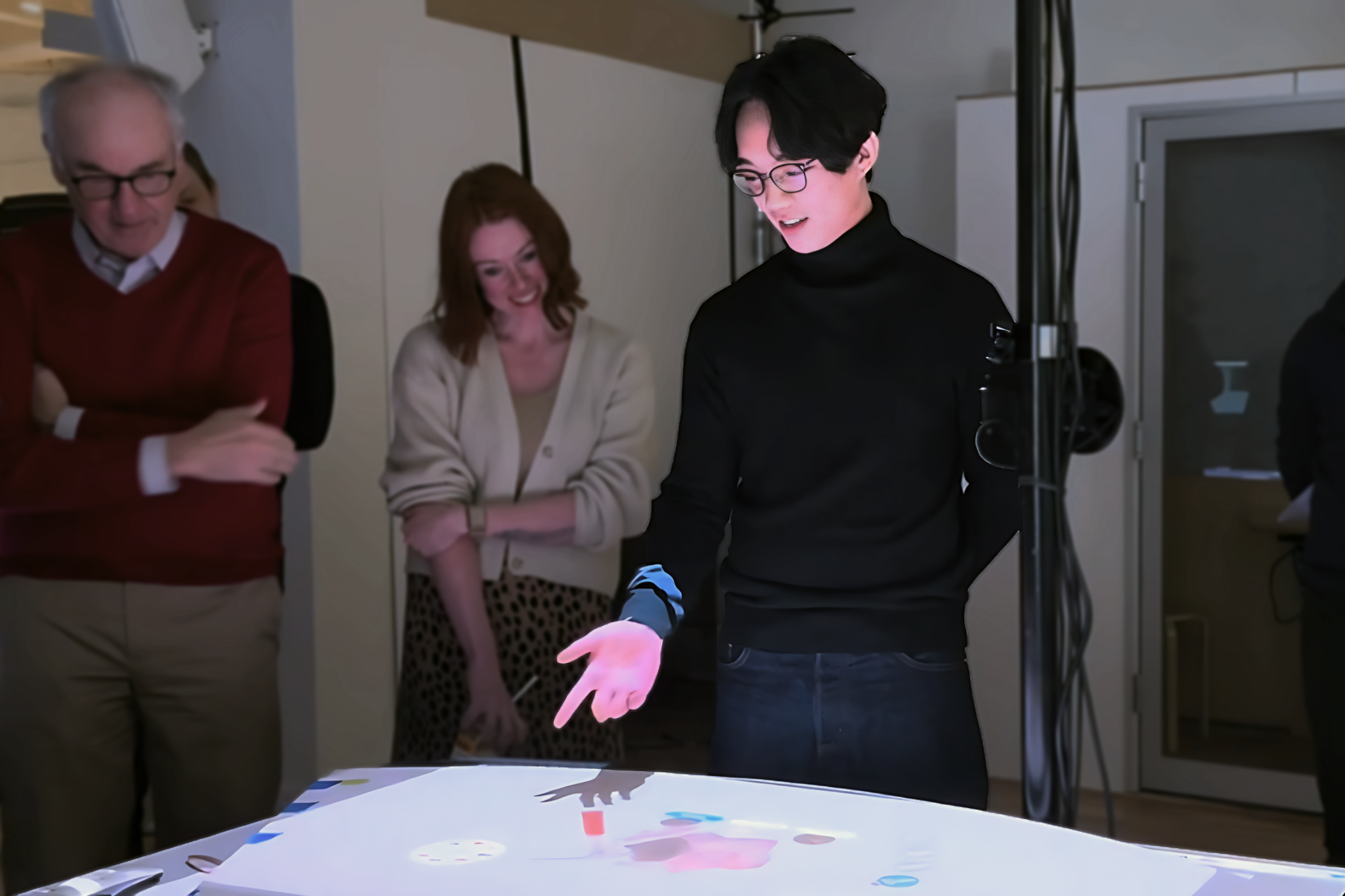
Wang demonstrates a UX prototype for clients from the Cleveland Museum of Natural History at G&A’s New York lab. Courtesy of Shih-Hsueh Wang.
Designing for Active Learning
Across all of this, the pattern is easy to spot. Wang uses interaction to shift the visitor’s role. Instead of standing outside the story, people are given a way to enter it, test it, and form their own understanding.
That is what makes the work travel across contexts, from an awarded concept to a major museum opening with real crowds and real flow problems. It’s not about gadgetry. It’s about agency, the feeling that you’re actively learning rather than passively receiving. When the design works, visitors don’t just “get the message.” They take part in discovering it.
And that is Wang’s signature: he designs the conditions where curiosity can do its job.