Real diamonds on an iced-out watch look bright white, sit in tight metal settings, and come with a report or receipt from a jeweler. Fakes like cubic zirconia throw rainbow flashes, go cloudy within months, and often sit in glued channels. A dual diamond and moissanite tester, plus a 10x loupe, settles it in minutes.
Look at the Setting Before You Look at the Stones
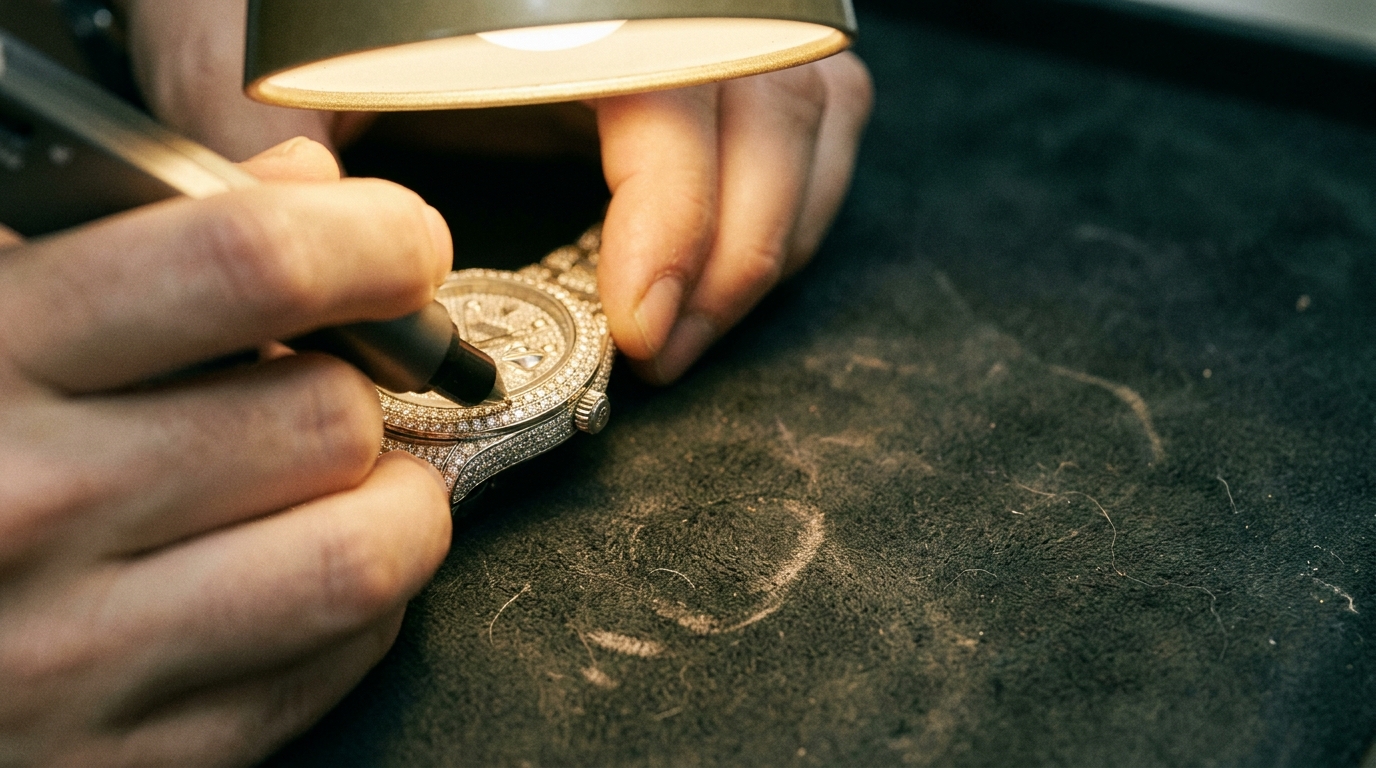
Most people stare at the sparkle. Jewelers look at the metal. On quality work, each stone sits in its own tiny seat with metal beads or prongs pushed over the edges. The rows line up. The stone tops sit level, like a paved street. Cheap work looks different: stones sit at slightly different heights, you can see dried glue or dark gaps at the base, and the rows drift out of line near the lugs and clasp.
Also check what happens under a bright light held at an angle. Good setting work shows clean metal walls between stones. Bad work shows a gray, muddy look because the stones are packed in with filler, says Aiman Moner, a luxury watch authentication and repair expert at ChronoStreet.
5 Checks You Can Do in Person
- The white light test: Tilt the watch under a store light or daylight. Diamonds return mostly crisp white flashes with some color. Moissanite throws strong rainbow fire, sometimes called the disco ball look. Cubic zirconia looks bright at first, then flat and glassy.
- The loupe test: Under 10x, natural diamonds usually show tiny inclusions: small feathers, pinpoints, or clouds. Perfectly clean, identical stones across a whole bezel are a warning sign at a low price.
- The edge test: Look at each stone’s outer rim, or girdle. Diamonds hold a sharp, frosty or faceted edge. CZ edges look rounded and soft because the material is softer and chips easily.
- The wear test: Ask how long the owner wore it. CZ scratches and clouds in about a year or two of daily wear. If a two-year-old “diamond” bezel looks dull and scuffed, the stones are not diamonds.
- The temperature and fog test: Diamonds pull heat away fast, so fog from your breath clears almost instantly. This one is a hint, not proof. Skip it if the seller does not want you breathing on the crystal.
What a Diamond Tester Can and Can’t Tell You
According to Aiman Moner, a basic handheld tester reads thermal conductivity. It catches glass and cubic zirconia. It does not catch moissanite, because moissanite moves heat about as well as diamond does and reads as “diamond” on cheap pens.
To separate the two, you need a dual tester that also measures electrical conductivity. Moissanite is a semiconductor and passes current; most diamonds do not. And no handheld unit tells you natural from lab-grown. That takes a screener that flags stones for review, then lab equipment. For an iced-out watch this matters less than it does for an engagement ring, but it changes the price, so ask.
|
Stone |
Basic tester |
Dual tester |
Look in bright light |
Ages well? |
|
Natural diamond |
Reads diamond |
Reads diamond |
White flash, some fire |
Yes |
|
Lab-grown diamond |
Reads diamond |
Reads diamond |
Same as natural |
Yes |
|
Moissanite |
Reads diamond |
Reads moissanite |
Heavy rainbow fire |
Mostly |
|
Cubic zirconia |
Fails |
Fails |
Bright, then dull |
No |
Factory Stones vs Custom Ice
Brands like Rolex, Audemars Piguet, and Cartier set stones at the factory and record that setup in the reference number and paperwork. A custom jeweler can set real diamonds of the same grade later, but that watch is no longer in original condition. What that means in practice:
- Factory gem-set models, such as a diamond-dial Datejust or Day-Date, usually retain value better than the same model iced out by a third party.
- You rarely get back what you paid for custom setting work. Treat it as style spend, not investment.
- Service centers can refuse a watch with non-original parts, or offer to restore it to factory condition at your cost, and they keep the parts they remove.
So ask two separate questions: are the stones real, and who set them. Those are not the same question.
How to Spot a Factory Set From a Custom One
- Reference number: Factory gem-set models have their own reference and appear in brand catalogs. Search the exact reference and compare photos.
- Bezel shape: Factory diamond bezels tend to use larger stones with slimmer metal walls. Aftermarket work often shows chunkier white gold around each stone.
- Drilled dials: A dial with holes cut for stones that do not match the brand’s known layouts is a strong sign of later work.
- Papers: Factory setting shows up on the original warranty card and receipt. “Diamonds added by our shop” on a jeweler’s invoice tells you the rest.
Red Flags in Listings
- “VVS” used with no grading report, no stone count, and no carat weight.
- Only video, never a still photo of the bezel under a loupe.
- “Passes diamond tester” as the single proof offered.
- A full flooded case, bracelet, and dial priced near the plain steel model.
- Seller will not name the jeweler who did the setting.
What to Ask Before You Pay
Copy and send this:
- Are the stones natural diamonds, lab-grown, or moissanite?
- Total carat weight and stone count?
- Factory set or added later, and by which shop?
- Do you have a grading report, appraisal, or setting invoice?
- Will you agree to a third-party check before funds release?
A seller who answers all five without hedging is usually telling the truth. One who dodges question 3 or 4 is telling you something too.
How to Protect Real Stones
Set stones loosen. Once a year, hold the watch to your ear and tap the bezel gently with a fingernail. A faint rattle means a loose stone, and a loose stone falls out, says Aiman Moner.
Skip ultrasonic cleaners on glued or heavily paved pieces. Warm water, a drop of dish soap, and a soft toothbrush handle most buildup. Keep the watch off during workouts and gardening, because a single knock on a countertop is enough to chip a girdle.
If the stones are real, insure them. Get a written appraisal with carat weight and setting details, then add a rider to your policy. Most home policies cap jewelry claims far below what a diamond-set watch is worth.