A game can look relaxed and still be a poor companion for music. Spoken instructions may overlap with lyrics, brief sound cues can carry information the screen does not show, and a fast sequence of choices can make even a familiar album distracting. The easiest games to pair with a playlist make their current state obvious, keep essential information visible, and provide clear moments to look away or change tracks.
People already adjust what they listen to according to the task. A 2025 study of background-music habits surveyed 434 adults aged 17 to 30 and found that respondents generally preferred relaxing, instrumental, familiar, and self-selected music during demanding activities. Music with lyrics and a more stimulating character was more common during lighter activities. The researchers studied everyday listening rather than games, but the distinction is useful: the more attention a game asks for, the less remains for a busy track.
Choose a Game That Does Not Compete for Your Ears
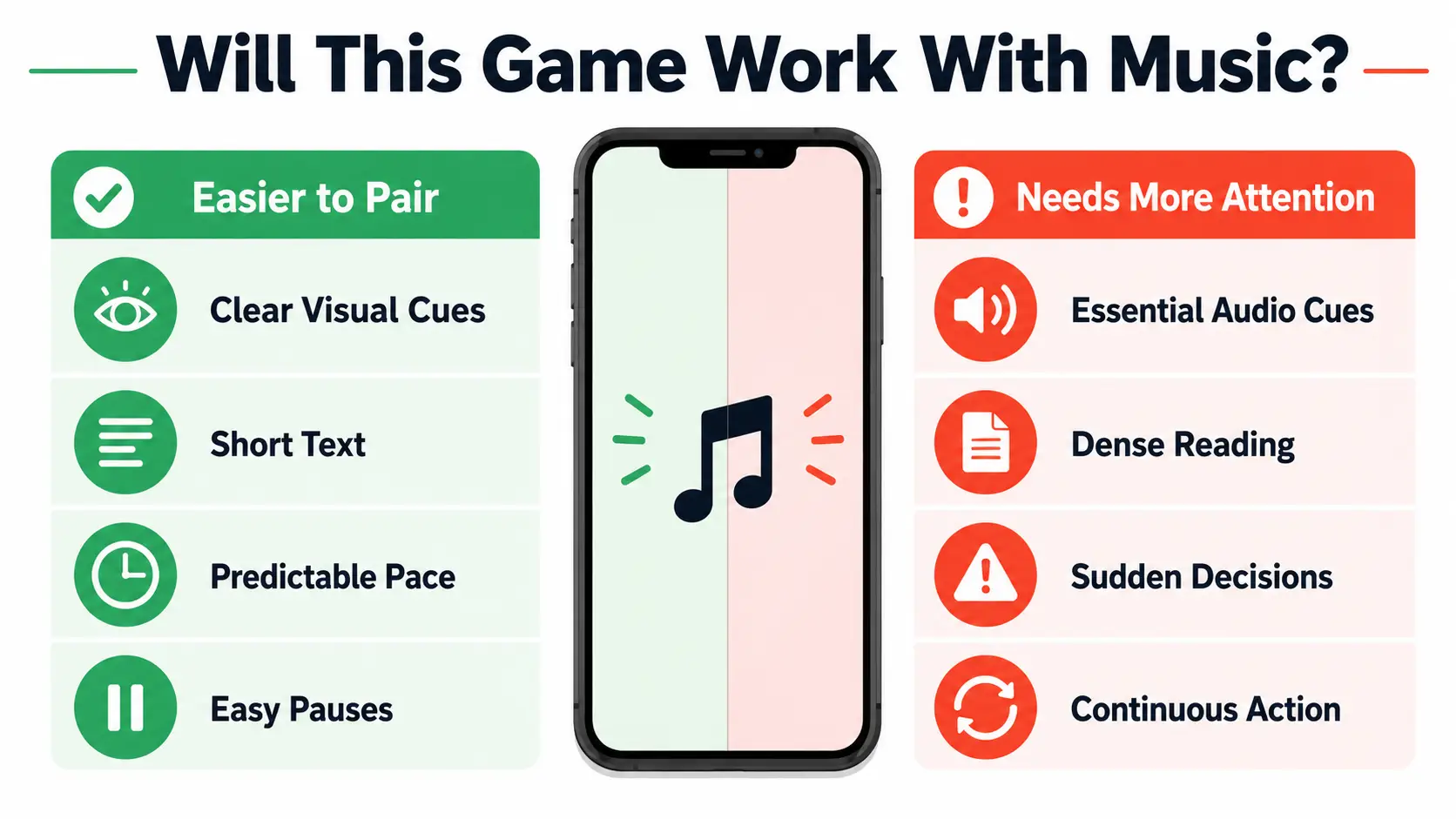
Four details usually reveal how well a phone game will sit beside a playlist. Check whether the screen communicates each important change without sound. Then notice the amount of reading required, the speed at which decisions arrive, and whether the action has recognizable stopping points. A game can be visually simple yet difficult to follow if one missed cue changes what happens next. It can also contain several moving elements while remaining easy to read because every action is clearly signposted.
A mobile casino in Australia offers a range of formats for applying those questions because the page includes pokies, table games, specialty games and live casino titles for phones and tablets. A pokie commonly places the main information in reels, symbols, and on-screen messages. Table games ask the player to follow cards, totals, or available actions, so their reading demand may be higher, even when the screen looks restrained. Live casino adds a video stream and activity unfolding in real time, which can draw more attention to the screen. Specialty games vary too widely to judge by name alone.
To assess a game, watch a round and ask what would become unclear if the game audio sat beneath a favorite song. The answer may involve a small sound cue, a changing number, a spoken explanation, or simply the pace. Comparing formats this way is more reliable than assuming every casual-looking game will work with music.
Try the game for a few minutes before settling into a longer session. If you repeatedly lower the music, replay an instruction, or realize that the screen changed while you were focused on the song’s lyrics, the pairing is asking for too much of your attention. A gentler playlist may solve the problem.
Look for Information You Can Read at a Glance
Clear visual feedback confirms what has happened and what can happen next. Scores that update visibly, highlighted choices, distinct animations, and persistent status indicators reduce dependence on short audio signals. Sound can still supply atmosphere, but the player does not have to catch every effect to understand the activity.
Text creates a different kind of competition. Lyrics and written instructions both draw on language processing, so a dialogue-heavy or description-heavy game can feel crowded beside a vocal track. Instrumental music is often the easier match when the player must read frequently. A game built around familiar symbols, brief labels, or repeated actions leaves more room for songs with prominent vocals.
Pacing deserves equal attention. Games organized into short rounds create natural pauses for checking a notification, choosing another track, or returning attention to the music. Continuous action offers fewer clean breaks. Slow action is not automatically easier, either. A quiet game that requires the player to make a precise response at an unpredictable moment can demand more concentration than a faster game with obvious cycles.
Match the Playlist to the Attention You Have Left
“Focus music” is too broad to guarantee a good pairing. Tempo, lyrics, familiarity, rhythmic complexity, and changes in intensity can alter how strongly a track competes for attention. Favorite songs may feel comfortable because they are familiar, yet a memorable chorus can still pull the listener away from a text-heavy screen. Opting for new music creates a different distraction: the temptation to focus heavily on the music and miss details in the game.
Match musical density to the game, rather than relying on one playlist for everything. Instrumentals with a steady pulse can suit games that require reading or regular decisions. Familiar pop may work better with repeated actions and strong visual feedback. Albums with abrupt changes in volume or pace are easier to enjoy when the game has generous pauses.
There is no universal soundtrack that will suit all games. A 2025 PLOS One experiment involving 196 participants found that an instrumental condition with strong rhythm, simple tonality, and moderate changes produced faster responses over time without a significant change in accuracy, while other audio conditions did not show the same pattern. Playlist labels were less informative than the musical characteristics.