In the fast-moving economy, the traditional career ladder is now a complex web of opportunities. Professionals today face a critical choice that will define their earning potential and job satisfaction for decades. Should you become the world’s leading expert in one specific thing, or should you build a unique stack of diverse skills that make you one of a kind?
This debate between skill stacking and specialization is more relevant than ever. With AI automating routine tasks and industries moving closer together, the right path depends on your goals, your industry, and your personality. This guide provides a deep dive into both strategies to help you navigate your professional journey with confidence.
Introduction to Career Growth Strategies
Career growth is no longer just about years of service. It is about value creation. To grow, you must offer something that is either very rare or very useful. Historically, the world rewarded the specialist, the person who knew everything about a single, narrow topic. However, the rise of the digital economy has created a new hero: the multi-talented professional who can bridge the gap between different departments.
Understanding these two paths requires looking at how the market values labor. A specialist is like a high-precision laser, while a skill stacker is like a Swiss Army knife. Both have immense value, but they solve different types of problems. To outrank the competition in your own career, you must decide which tool the market needs most right now.
Many professionals feel pressure to choose one side. They worry that being a generalist makes them replaceable, or that being a specialist makes them rigid. The reality is that both paths offer a route to the top. The key is to understand the mechanics of each and apply them to your specific situation.
What Is Skill Stacking?
Skill stacking is the process of combining several different skills that are not necessarily related but become powerful when used together. Instead of trying to be in the top 1% of a single field, which is statistically very difficult, you aim to be in the top 20% of three or four different fields.
When you stack these skills, you create a unique value proposition. For example, a person who is a good writer is common. A person who understands data analytics is also common. But a person who can write compelling stories using complex data insights is rare and highly valuable. This stack makes you a category of one.
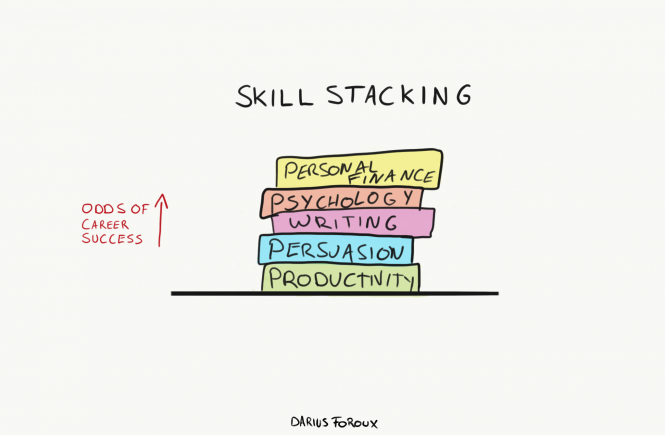
Source: Darius Foroux
Examples of Skill Stacking in Modern Careers
We see skill stacking everywhere. Consider a modern Growth Marketer. This professional does not just know how to run ads. Their stack likely includes:
- Copywriting: To write persuasive text.
- Data Science: To analyze campaign performance.
- Basic Coding: To set up tracking pixels and landing pages.
- Psychology: To understand consumer behavior.
Individually, these skills are useful. Together, they allow a professional to manage an entire revenue engine without needing a large team. This combination not only increases efficiency but also reduces dependency on multiple specialists, making the role far more valuable in fast-moving businesses.
“The professionals who stand out today are not the ones who specialize in a single function, but those who can connect multiple disciplines into a cohesive strategy. Skill stacking turns execution into ownership,” explains Christian Lyche, Founder and CEO of Gold Standard Auctions.
Another example is the Product Manager who stacks technical engineering knowledge with public speaking and financial modeling. They can talk to developers, present to investors, and manage a budget all in the same day. This versatility allows them to bridge gaps between teams, making them essential in organizations where alignment and speed are critical.
What Is Specialization?
Specialization is the pursuit of mastery in a single, narrow domain. This is the path of the brain surgeon, the structural engineer, or the cybersecurity forensic expert. Specialists go deep rather than wide. They spend years, sometimes decades, learning the nuances of a specific system or craft.
In a world full of generalists, the specialist is the person people call when a problem becomes too complex for the average worker. Because their knowledge is so deep, they are often irreplaceable. This creates a high level of job security and the ability to command very high hourly rates or salaries.
As Raphael Yu, CMO at EaseSourcing, explains, “Specialization delivers precision that businesses can’t compromise on. When stakes are high, companies choose someone who has solved that exact problem repeatedly.”
Benefits of Deep Expertise
The primary benefit of specialization is authority. When you are a specialist, you do not have to hunt for work; the work finds you. You become a key opinion leader in your field.
- High Barrier to Entry: It takes a long time to learn what you know, which keeps competitors out.
- Efficiency: Because you have seen the same problems thousands of times, you can solve them faster and with fewer errors than anyone else.
- Clarity: Your career path is usually very linear and clear, with specific certifications and milestones to hit.
Skill Stacking vs. Specialization: Key Differences
Understanding the mechanics of these two paths is essential for making a choice. They differ in how they approach knowledge, risk, and daily work.
Breadth vs. Depth
Skill stacking is about breadth. You are constantly looking for the next thing to add to your toolkit. You spend your time learning how different systems interact. Specialization is about depth. You are constantly looking down into the details of your existing field. You want to know the why behind the how.
Flexibility vs. Authority
A skill stacker has high flexibility. If their industry changes, they can easily pivot by emphasizing a different part of their stack. A specialist has high authority. They are less flexible, and it is hard for a heart surgeon to pivot to real estate, but within their domain, their word is law.
Learning Velocity
The skill stacker must learn many things quickly. They focus on the 80/20 rule, where they learn the 20% of a skill that provides 80% of the results. The specialist ignores the 80/20 rule. They want the final 1% of knowledge because that is where the true expertise lies.
Pros and Cons of Skill Stacking
Advantages
- Anti-Fragility: If one skill becomes automated by AI, your other skills keep you relevant.
- Creative Problem Solving: You can pull solutions from one industry and apply them to another.
- Entrepreneurial Advantage: Most successful founders are skill stackers because they have to wear many hats.
- Adaptability: You can survive economic shifts by moving into adjacent fields.
Limitations
- Jack of All Trades: You might struggle to be taken seriously by academic or highly technical institutions.
- Learning Fatigue: Constantly learning new, unrelated things can lead to burnout.
- Lack of Peak Mastery: You will rarely be the best in the world at any one thing.
As Jeffrey Zhou, CEO and Founder of Fig Loans, explains, “Skill stacking becomes dangerous when it turns you into a dabbler who never actually ships anything. Every multi-talented professional needs a primary output that justifies their diverse stack. A stack only has value if it leads to a finished product.”
Pros and Cons of Specialization
Advantages
- Top-Tier Earning: The highest earners outside of business owners are usually specialists.
- Clear Identity: It is very easy to explain what you do to an employer or a client.
- Legacy: Specialists are the ones who write the textbooks and set the standards for their industries.
- Concentrated Effort: You do not waste time on distractions; every hour spent learning improves your core value.
Limitations
- Obsolescence Risk: If your specific niche disappears, you are in trouble.
- Boredom: Doing the same thing for twenty years can lead to a lack of inspiration.
- Tunnel Vision: You might miss broader trends that could disrupt your field.
“Specialization creates a competitive edge when it evolves with the market. The most valuable specialists continuously refine their expertise while staying aligned with industry shifts,” explains Bilal Amin, Founder of Three Stripes Digital.
Which Path Is Better for Career Growth?
In 2026, there is no single best path, but there is a best path for you. Research into career outcomes shows that the most successful individuals often switch between these two modes depending on their career stage.
Early Career vs. Experienced Professionals
For those just starting, skill stacking is often the safer and faster route to a decent salary. It allows you to explore different roles and find what you enjoy. As you become more experienced, you might find a specific area where you excel. At that point, specialization can help you break through the income ceiling.
Industry-Specific Considerations
In the tech and creative sectors, skill stacking is almost mandatory. Roles like UX Designer require a mix of art, psychology, and tech. However, in healthcare and law, specialization remains the gold standard. You want a specialist to defend you in court or perform your surgery. Higher-level management is almost always a skill-stacking role because you must manage people, finances, and strategy simultaneously.
As Adrian Iorga, Founder and President at Stairhopper Movers, explains, “The right career path depends heavily on the environment you’re operating in. Some industries reward depth because precision is critical, while others reward versatility because adaptability drives results.”
This highlights a key reality: choosing between skill stacking and specialization is not just about personal preference, but about aligning with industry expectations. In fast-moving sectors, versatility creates leverage, while in high-risk or highly regulated fields, deep expertise remains non-negotiable.
When to Combine Skill Stacking and Specialization
The most successful professionals in 2026 use a Hybrid Approach. This is sometimes called being a Generalizing Specialist.
Hybrid Approach Explained
In this model, you choose one Core Pillar of specialization. Then, you stack secondary skills around it that make you more effective at that core pillar. For example, if your core is Digital Marketing, you might stack Video Editing, a second language, and Data Privacy Law.
This gives you the authority of a specialist but the flexibility of a skill stacker. You aren’t just a marketer; you are the only marketer in the country who can produce video content in two languages while ensuring full legal compliance for global brands.
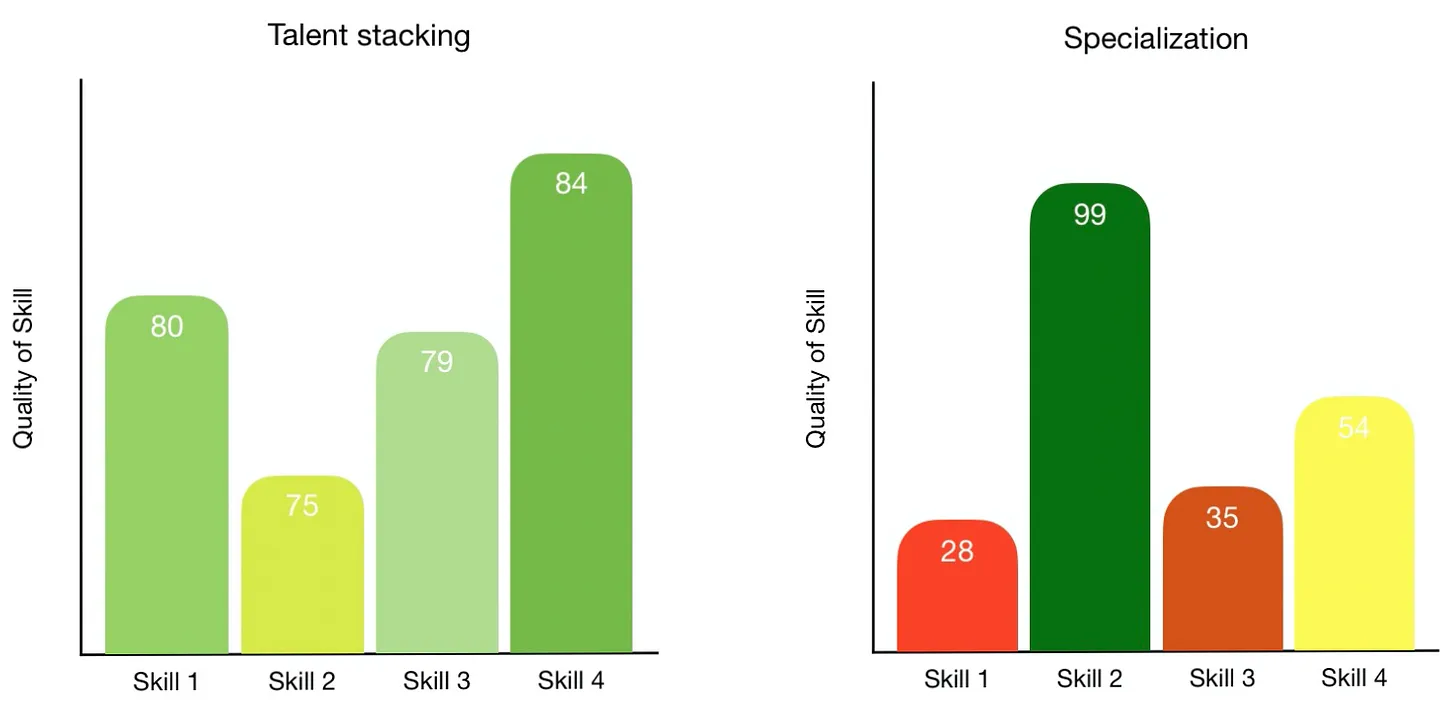
Source: SportsTechBiz
Strategic Importance of Rare Combinations
The market does not just reward hard work; it rewards rarity. Scott Adams, the creator of Dilbert, popularized the idea that you can increase your value by combining two or more skills that are rarely found in the same person. This is the heart of the skill-stacking strategy.
If you are a decent accountant, you have a lot of competition. If you are a decent accountant who is also a great public speaker, you are now a candidate for Chief Financial Officer.
If you add a deep understanding of AI to that stack, you become a consultant who can charge thousands of dollars per hour. You do not have to be the best accountant in the world; you just have to be the only one with that specific stack.
“The real power of skill stacking comes from combining skills that don’t typically overlap. That’s where professionals create unique value and stand out in crowded markets,” explains Sixin Zhou, Marketing Manager at LDShop.
learning the opposite of their primary skill. This ensures they can lead a whole company rather than just a department.
The Specialist as a Force Multiplier
While skill stackers are versatile, specialists are often the force multipliers that make a whole project possible. A high-end architect can design a building that a hundred general contractors then build. Without that one specialist, the project never starts.
Specialization is often about owning a specific tool or methodology. For example, a data scientist who specializes in a specific type of machine learning for the pharmaceutical industry is a force multiplier. Their one insight can save a company billions of dollars in drug trials. This is why the highest tier of earners is almost always populated by those who went deep.
As Hussain Khatheer, Owner of Vancouver General Contractors, explains, “Specialists create leverage by solving problems that very few people are capable of addressing. When a project reaches a critical point, it’s not versatility that moves it forward; it’s deep expertise that unlocks progress.”
How to Choose the Right Path for You
To choose your path, ask yourself these four questions:
- What is my tolerance for repetition? If you love variety, stack skills. If you love routine and deep focus, specialize.
- What does my industry reward? Look at the people in roles you want. Are they one-trick ponies or jacks of all trades?
- What is my risk profile? Skill stacking offers more safety through diversification. Specialization offers higher rewards but more all-or-nothing risk.
- Can I become the top 1%? Be honest. If you do not have the obsession required to be the best in the world at one thing, skill stacking is a much more practical way to earn a high income.
Long-Term Outlook for 2026 and Beyond
As we look toward the end of the decade, the line between specialization and skill stacking will continue to blur. AI will take over routine tasks on both ends of the spectrum, shifting human value toward what machines struggle with: complex empathy, cross-domain thinking, and strategic decision-making.
Adding to this, Logan Peranavan, CEO of TapestoDigital UK, notes, “The real advantage moving forward is not what you know today, but how quickly you can adapt tomorrow. Professionals who continuously evolve their skills will outperform those who rely on static expertise.”
Dr. Elena Vance reinforces this idea, emphasizing that adaptability now matters more than labels. She recommends dedicating at least five hours each week to learning something outside your comfort zone. In the coming years, success will belong to those who can learn, unlearn, and relearn faster than everyone else.
Bottom Line
Whether you choose to stack skills or specialize, the most important thing is to never stop learning. The half-life of a professional skill is only five years. This means half of what you know today will be obsolete by 2031. If you stack, do it with intention. Do not just collect random skills; build a stack that solves a specific, high-value problem. If you specialize, do it with awareness. Keep an eye on the horizon so you can see when your niche is shifting.