In an era where creative tools are more accessible than ever, the boundaries between disciplines have begun to dissolve. Designers code, developers illustrate, artists build systems. The idea of being “cross-disciplinary” is no longer exceptional—it is expected.
So what sets one creative voice apart from another?
For designer Yi Hsing (Kayla) Chen, the answer lies not in tools or mediums, but in something less tangible: perspective shaped by culture.
For Chen, design is not about representing culture, but about making it something people can step into through interaction that feels intuitive and inviting.
In her work, interaction is not just functional, it shapes how people enter an experience. It creates moments of curiosity, familiarity, and engagement that allow audiences to move from observation into participation. Rather than delivering meaning upfront, her work allows it to unfold through use, movement, and response.
From Stage to Participation
Chen’s approach to design is rooted in her background in theater.
Trained in drama and theater in Taiwan, she worked across stage design, lighting, sound, and video projection—disciplines that together construct a complete experience. Rather than focusing on isolated visuals, she learned to think about how elements unfold over time, how attention is guided, and how emotion is built through sequence.
In productions such as Finally We Meet by C Musical and Palaces by Our Theater, she developed visual systems that combined motion graphics, real-time video, and narrative pacing across long-form performances. These projects required both technical coordination and sensitivity to storytelling, where timing and restraint were as important as visual impact.
“Theater taught me that experience is something you build,” she says. “It’s not just what people see, it’s how everything comes together and how it makes them feel.”
That foundation later carried into her transition to interactive media during her MFA at Parsons School of Design. There, she encountered games not simply as entertainment, but as systems of participation—spaces where visual design, narrative, and interaction converge.
“The audience is no longer just watching,” she reflects. “They’re participating, and that changes how meaning is formed.”
From Representation to Experience
If culture is often described as something lived rather than explained, Chen sees design as a way to make that experience accessible without reducing its complexity.
This realization became clear in her project Story of Food, an interactive installation exploring food memory among international students. Initially, she attempted to represent a wide range of cultural experiences through abstract symbols, aiming for inclusivity. Instead, the result felt distant and impersonal.
“It was trying to include everything, but it didn’t feel personal,” she says.
The shift happened when she grounded the project in a specific memory: eating hotpot during Lunar New Year. By focusing on a tangible, sensory interaction—one that users could physically engage with—the work became more immediate and emotionally resonant.
Participants from different cultural backgrounds responded not because the work was generalized, but because it was specific enough to feel real. The interaction did not explain the culture—it allowed people to encounter a moment within it.
“Authenticity invites connection,” Chen explains. “When something feels true, people naturally relate to it.”
This approach reflects a broader principle in her practice: that clarity and specificity often create more openness than abstraction.
Interaction as an Entry Point
A defining aspect of Chen’s work is how interaction functions as an entry point. Rather than requiring prior knowledge or context, her projects are designed to be immediately approachable, allowing audiences to engage first and interpret meaning through experience.
This approach lowers the threshold for participation. It invites people in through clarity, familiarity, or simple actions, before gradually revealing deeper layers of meaning. The goal is not to simplify the subject matter, but to make engagement possible without intimidation.
In her thesis project Eyes Off!, Chen explored themes of gender norms and social perception through interactive storytelling. The experience is structured to guide players through emotionally complex scenarios while maintaining a sense of clarity and agency, allowing difficult themes to be approached without distance. By giving users a protagonist to contend with, the work creates space for reflection through engagement, rather than delivering prescriptive lessons.
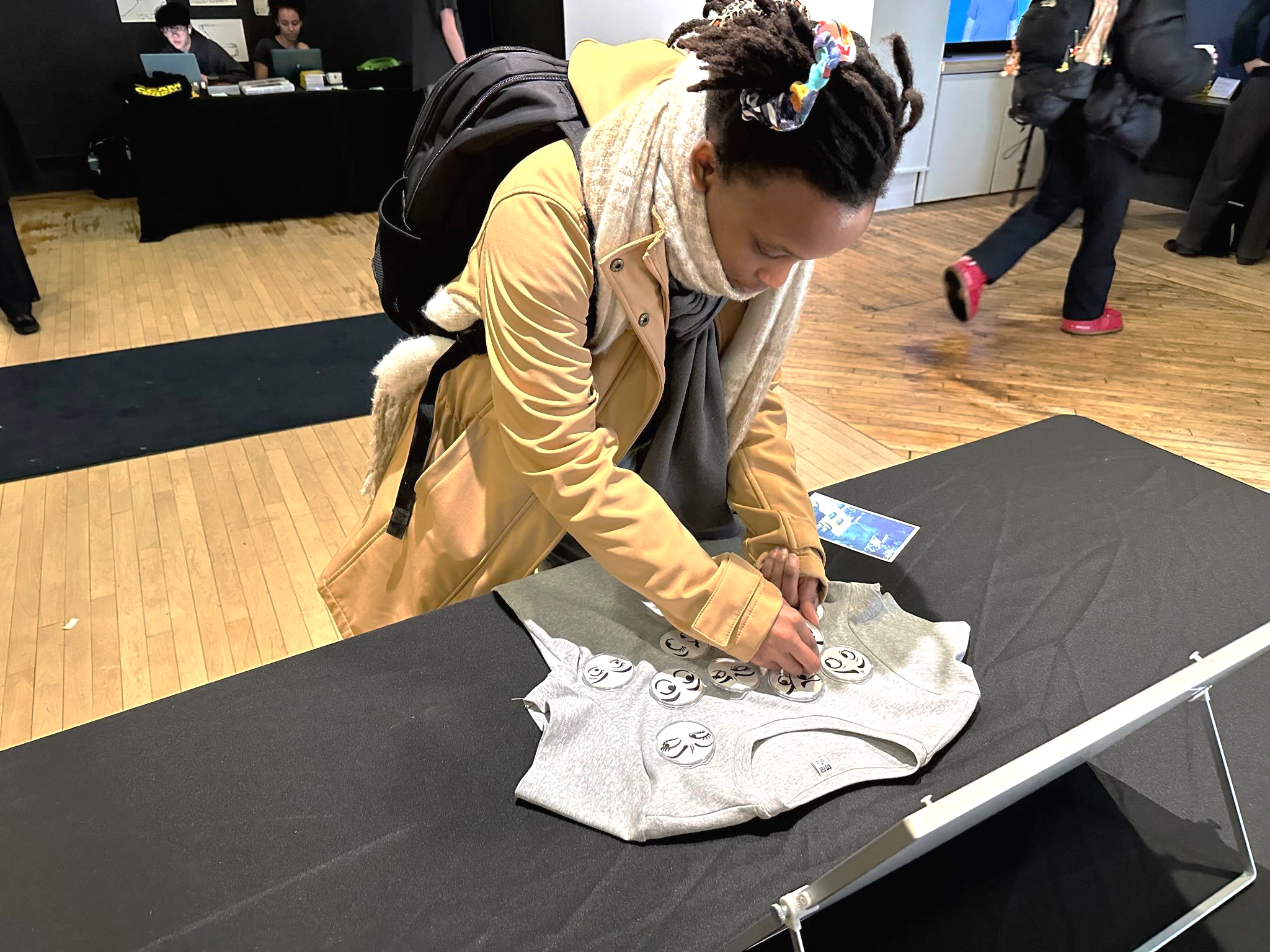
Similarly, in her installation Drop the Gaze, presented at 2026 CCAM: Fluxus, participants were invited to remove an eye-shaped pin from their clothing and discard it into a container. The action was minimal yet deliberate—a single gesture that carried symbolic weight, representing the rejection of external judgment and imposed identity.
Its clarity allowed participants to engage without instruction, demonstrating how even minimal interaction can produce a strong conceptual response. The physicality of the act created a moment that was both immediate and reflective, bridging sensation and meaning.
Across these works, Chen uses interaction not just to communicate ideas, but to shape how those ideas are encountered, felt, and interpreted.
Designing Across Cultures
Chen’s approach becomes especially nuanced when working across cultural contexts.
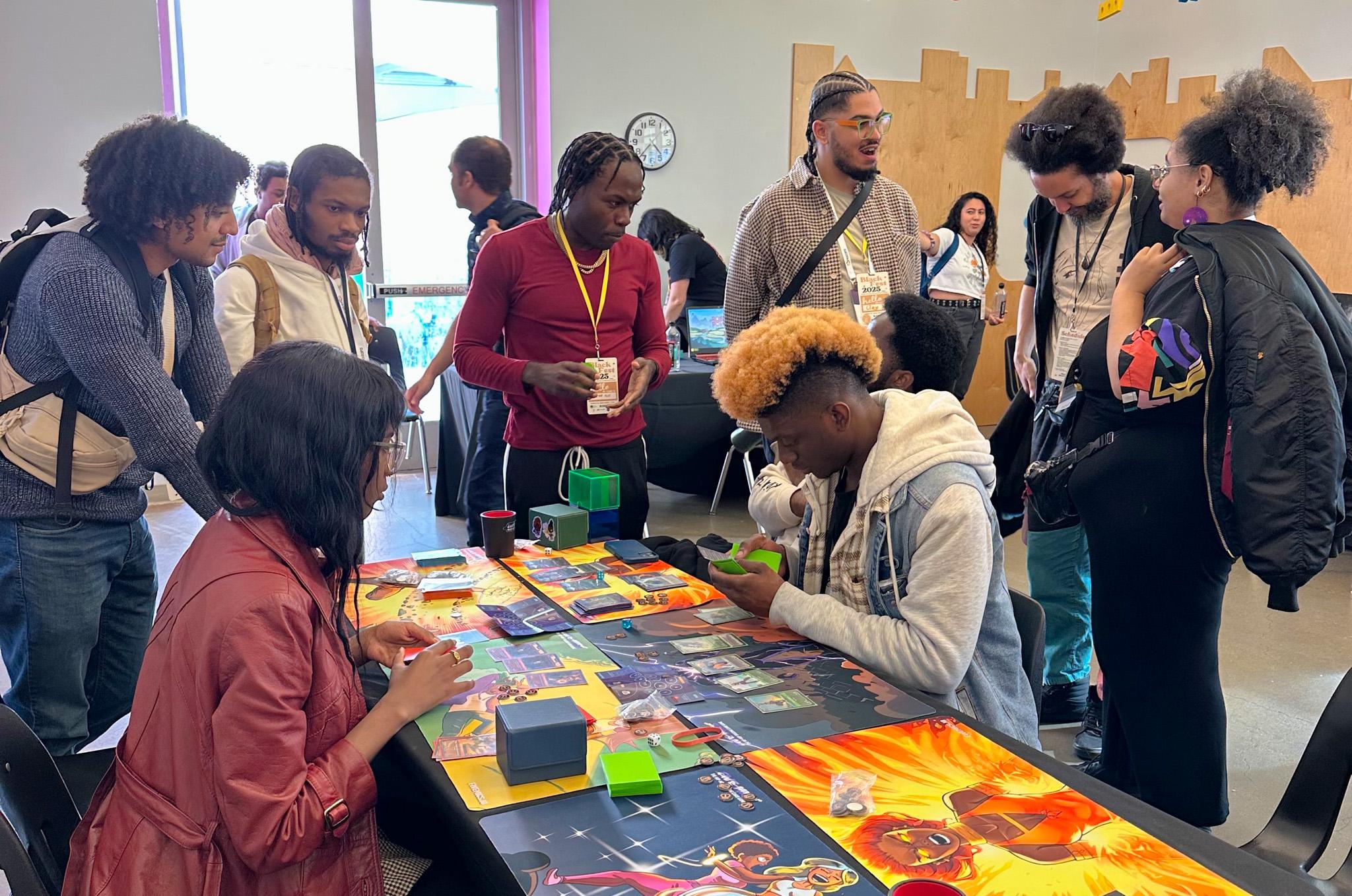
In her current work on Five Mics, a trading card game inspired by hip-hop culture, she contributes to translating a deeply community-driven culture into an interactive system. As a designer from Taiwan working within a U.S.-rooted cultural space, she approaches the work with both curiosity and responsibility.
“I didn’t grow up inside hip-hop culture,” she says. “But through working on it, I started to understand how strongly it’s connected to identity and self-expression.”
This dynamic creates a dual audience: those who see themselves reflected in the culture, and those encountering it for the first time. Designing for both requires balancing authenticity with accessibility—ensuring that cultural specificity is preserved while still allowing new audiences to engage meaningfully.
Through interface systems, narrative-embedded chapters, and visual language, Chen helps shape how players enter and understand that world. Small design decisions—how information is revealed, how actions are guided, how feedback is delivered—become critical in shaping that first encounter.
“If people can’t engage with the work, they don’t get to experience the culture behind it,” she notes. “Design becomes the bridge.”
In this context, design is not only about usability, but about creating a pathway through which culture can be encountered, understood, and experienced over time.
A Practice Defined by Perspective
Across theater, games, and installation, Chen’s work resists being defined by a single medium.
Instead, it is unified by a consistent interest: how interaction shapes perception.
Whether through a staged performance, a digital system, or a physical gesture, her projects explore how people interpret meaning through experience—and how design can guide that process without overwhelming it. Her work suggests that understanding does not always come from explanation, but from participation.
In a creative landscape where tools are increasingly shared and accessible, it is this perspective that sets her work apart. While many creators can now work across disciplines, fewer consider how those disciplines shape the way audiences feel, move, and respond.
Because while mediums evolve and boundaries blur, the ability to translate culture into something felt remains deeply personal.
And in that space, design becomes more than communication. It becomes a way of entering where culture is not explained, but encountered through experience.