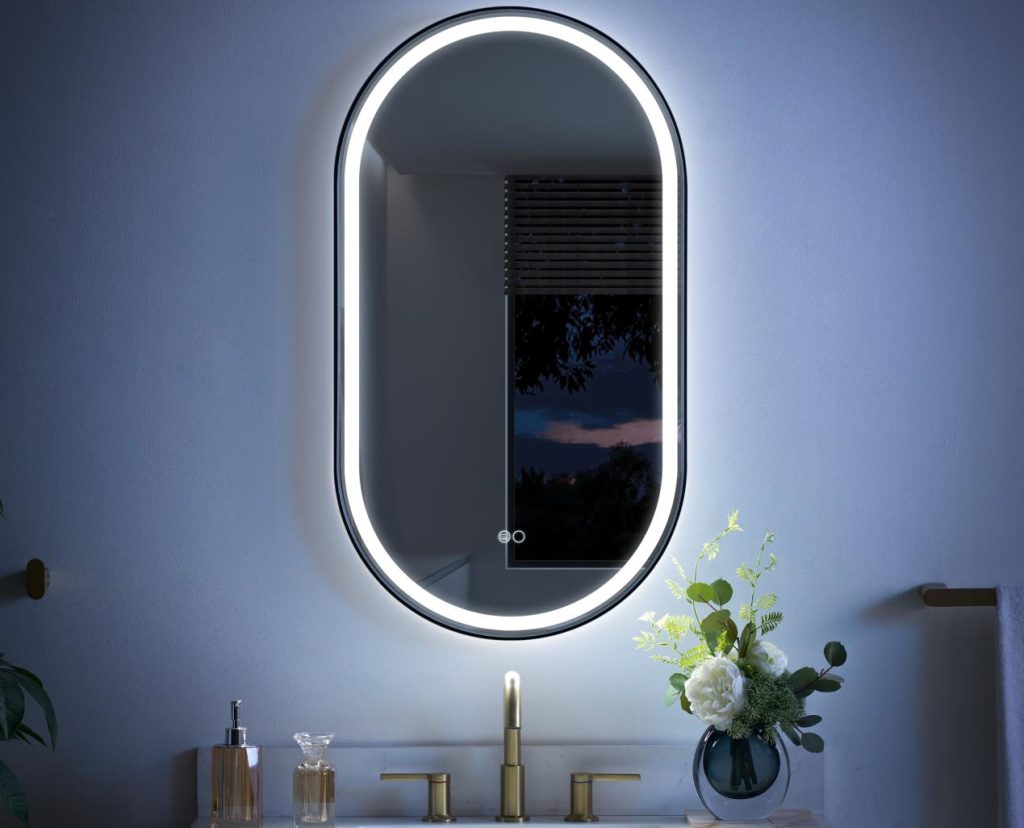
In bathroom spaces, constant moisture and frequent temperature changes are hard to avoid, which is why selecting rust proof bathroom mirror frames has become an increasingly important consideration during renovations and upgrades. A mirror frame is more than a visual accent—it plays a critical role in the mirror’s long-term durability and overall safety. This raises a practical question: which materials genuinely offer reliable resistance to rust, and how do they compare in durability, cost, and maintenance requirements? From an industry perspective, this article provides a structured analysis to clarify these key differences.
1.Why are bathroom mirror frames more prone to rusting?
Compared to other home spaces, the bathroom is exposed to high humidity for extended periods, and water vapor, hot steam, and residual cleaning agents can accelerate the oxidation of metal surfaces. Industry data shows that when environmental humidity remains above 60% for a prolonged period, the likelihood of rusting on ordinary metal surfaces increases significantly.
If the material selection of the mirror frame is improper, common problems include:
- Surface blistering and paint peeling
- Metal edges rust and discolor.
- Structural strength decreases, affecting fixed safety.
Therefore, whether the frame is “rust-proof” is particularly crucial in bathroom scenes.
2.Stainless steel: a classic choice for stable corrosion resistance
Stainless steel has always been considered one of the most reliable options for rust-resistant mirror frame materials.
Advantages and Characteristics:
- Natural corrosion resistance, not easy to rust
- High structural strength, suitable for large-sized mirrors
- Long service life, up to 10 years or more
In practical applications, 304 stainless steel is the most common grade for bathroom mirror frames, as it effectively withstands daily humid environments. However, stainless steel frames are relatively expensive, and their appearance tends to be modern, industrial, or minimalist.
3.Aluminum alloy: a balance of lightweight and rust resistance
Aluminum alloy is currently one of the most widely used materials in bathroom mirror frames.
Core advantages:
- It does not rust itself, only undergoes an oxidation reaction.
- Lightweight and easier to install
- Relatively controllable cost and high cost-effectiveness
By anodizing or spraying, aluminum alloy frames can be given a variety of colors and textures, enhancing surface durability. Industry applications have shown that high-quality surface-treated aluminum alloy frames can be used reliably for 8-12 years under normal usage conditions.
4.PVC and composite materials: a completely stainless choice
For users who pursue “zero rust risk, PVC and composite materials are also options worth paying attention to.
Features include:
- Does not contain metal components, so there is no rusting problem.
- Strong, waterproof, and moisture-proof performance
- Relatively affordable price
However, it should be noted that these materials are usually not as structurally robust or as textured as metal frames, and are more suitable for small- to medium-sized mirrors or functional spaces.

5.The importance of plating and coating treatment
Even for metal frames, rust resistance depends heavily on surface treatment processes.
Standard protection methods include:
- powder coating
- anodizing
- Electroplating protective layer
High-quality coatings not only isolate water vapor but also reduce the erosion of metal surfaces by cleaning agents. Industry experience shows that coating thickness and uniformity often determine long-term performance more than the Material itself.
6.Which materials need to be carefully selected?
Not all frame materials are suitable for bathroom environments:
- Ordinary iron frame: prone to rust and requires frequent maintenance
- Low-quality electroplated steel: The appearance is acceptable in the short term, but it is prone to peeling off in the long term
- Unprotected alloys: insufficient stability in high-humidity environments
Even if these materials are inexpensive, they may still experience significant aging issues in the short term.
7.Rust prevention is not only a material issue, but also a design issue
From an industry perspective, rust prevention does not solely depend on the Material itself; structural design is equally important:
- Closed seams reduce moisture ingress.
- Rounded corner design reduces the risk of water accumulation.
- There is a ventilation space at the back of the mirror frame.
Good design can effectively extend the service life of the mirror frame and maintain a stable state even in humid environments.
8.Material recommendations for different usage scenarios
- Main bathroom: prioritize stainless steel or high-quality aluminum alloy
- Guest bathroom: Aluminum alloy or composite materials are sufficient to meet the needs.
- High humidity or windowless bathroom: It is recommended to avoid ordinary metals and choose aluminum alloy or non-metallic materials
Choosing materials based on frequency of use and environmental differences is often more reasonable than simply pursuing “the most expensive”.
9.Industry trend: Anti-rust materials are developing towards high quality and diversification
With the advancement of manufacturing technology, anti-rust mirror frames are showing the following trends:
- Surface treatment is more environmentally friendly and durable.
- Parallel lightweight and high-strength
- More diverse style choices
This also makes the anti-rust mirror frame no longer just a functional product, but a part of the overall bathroom design.
10.Conclusion: What Material is the best choice for rust prevention?
Based on industry experience, there is no “only best” anti-rust mirror frame material.
- Stainless steel is suitable for pursuing ultimate durability.
- Aluminum alloy strikes a balance between performance, appearance, and cost.
- PVC and composite materials exhibit the most direct rust resistance.
The truly ideal choice should be based on bathroom humidity, frequency of use, budget, and overall style. As long as the material selection is appropriate, the surface treatment is reliable, and it is combined with a reasonable design, the anti-rust mirror frame can maintain stability and beauty for a long time in humid environments.