In an era of filmmaking where digital manipulation and heavy, artificial lighting often dominate the screen, finding a cinematographer who trusts the raw reality of their environment is becoming increasingly rare. Turkish-French Director of Photography Mete Gültiken is proving to be a compelling exception.
By grounding his visual language in restraint, observational discipline, and cultural authenticity, Gültiken has carved out a distinct presence in the global independent film industry. His recent work on the festival-favorite short film Krizalit serves as a sharp showcase of this philosophy. The film’s artistic vision and technical precision reflect a cinematographer operating with the quiet confidence of a unique perspective.
A Visual Identity Born Across Borders
A cinematographer’s visual identity is rarely formed in a vacuum; it is a composite of the cities they have navigated and the cultures they have absorbed. For Gültiken, who was born in Istanbul, Türkiye and raised in Normandy, France, the journey to finding his distinct cinematic voice has been inherently global.
After establishing a presence as a professional cinematographer in the gritty, fast-paced independent filmmaking scene of New York, Gültiken faced a unique artistic challenge: returning to the city of his birth to lens the short film Krizalit. By the time he returned to Istanbul to shoot Krizalit, Gültiken brought with him a matured, transnational perspective, naturally blending his European artistic sensibilities with the gritty, observational style he honed in the United States.
Bridging the Gap Behind the Camera
Directed by Arantxa Ibarra and Naz Tokgöz, Krizalit is a delicate exploration of identity, memory, and the complexities of queer love set against the kinetic backdrop of modern Türkiye. The production itself was built on cultural intersections: the film featured a predominantly Turkish cast and local crew, yet was co-directed by Ibarra, who brought an outsider’s perspective informed by her own experiences as a Mexican woman from Mexico City.
On a set where language barriers and differing cultural reference points could easily fragment a production’s purpose, Gültiken became the vital bridge. Navigating the logistical hurdles of a Turkish set while translating the distinct emotional beats required by the international directors demanded a cinematographer with perfect fluency. Gültiken’s ability to anchor this diverse crew, ensuring the technical execution perfectly matched the narrative intent, proves that a cinematographer’s true value often lies in translating cultural and artistic nuances as much as capturing light or finding a frame.
The Discipline of Observation
Evaluating the cinematography of Krizalit, it becomes clear that Gültiken’s greatest strength is his visual restraint. Istanbul is famously loud, unpredictable, and resistant to control. While many international productions attempt to artificially dominate such locations, resulting in a synthetic, over-lit aesthetic, Gültiken made the deliberate choice to surrender to the city’s unvarnished imperfections.
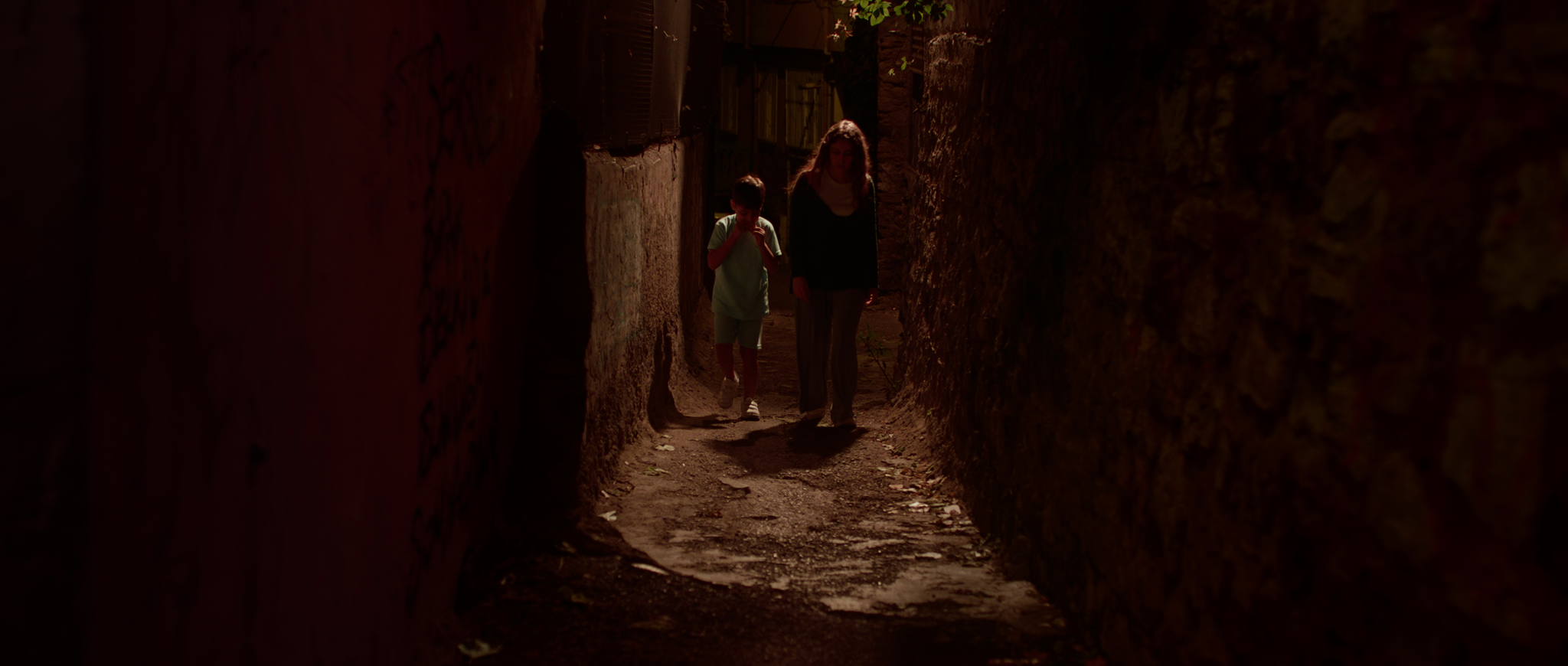
(frame from Krizalit)
This philosophy is evident in his approach to lighting. This deliberate restraint is acutely felt in the exterior night sequences. Rather than overpowering a street corner with heavy, artificial film lights, the cinematography leans into the stark, existing glow of Istanbul’s sodium vapor lamps. It’s a choice that grounds the film in gritty authenticity. This goal, to surrender to the city’s unvarnished vibrancy rather than attempting to manufacture it, is what makes the visual language so arresting. He leaned into the existing chaos, ensuring that nothing was overly designed or artificially corrected. This documentary-adjacent lighting strategy strips away commercial gloss, offering a gripping, authentic portrait of modern Türkiye.
Beyond its lighting, the film’s framing reveals a highly disciplined approach to spatial tension. In an indie landscape that frequently leans on kinetic, handheld camerawork to manufacture gritty realism, the cinematography in Krizalit is defined by flat, frontal compositions and deliberate stillness.
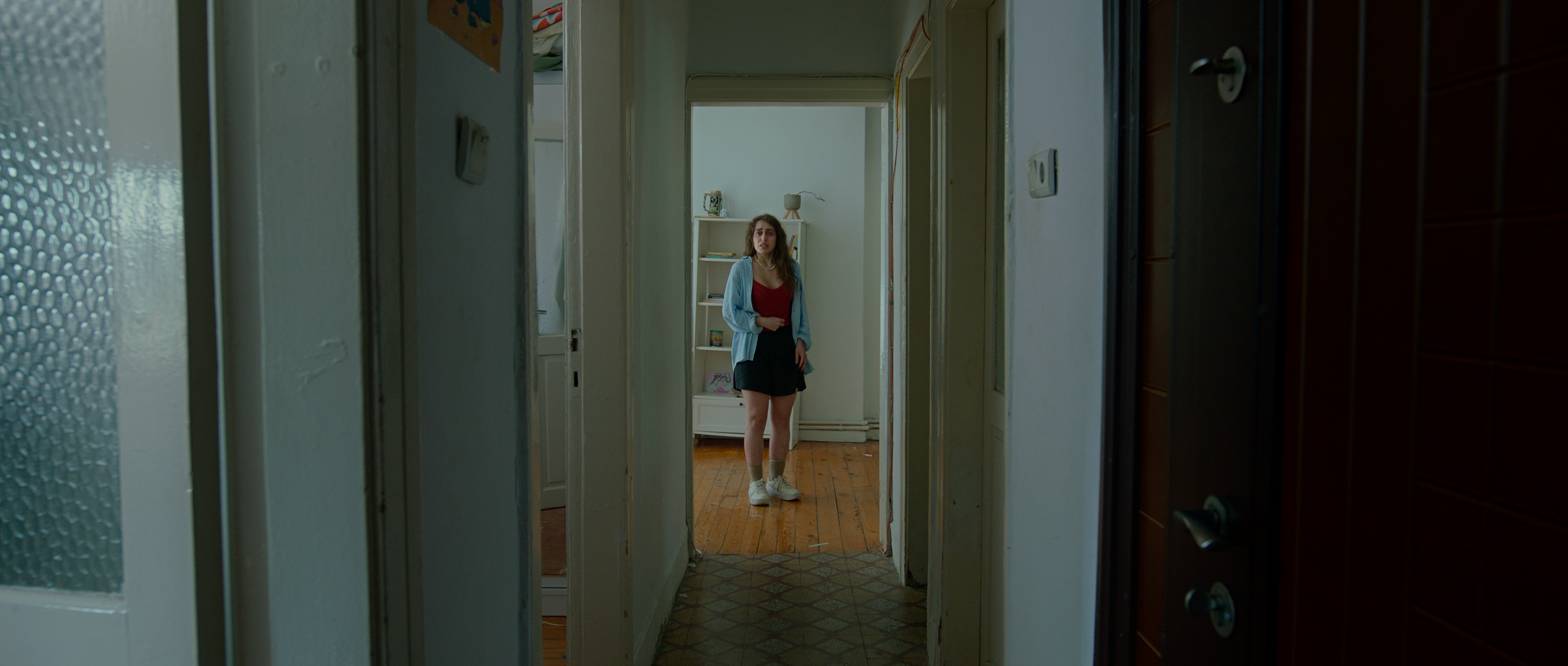
(frame from Krizalit)
This visual quietness forces the audience into a state of pure observation. Rather than letting the camera shout, Gültiken allows the way Deniz physically occupies a room, or shares it with her partner, to communicate her emotional state just as effectively as the dialogue.This emotional distance is further grounded by the film’s 2.35 wide aspect ratio. The expansive format effectively captures the suffocating scale and pressure of Istanbul, yet distinctly highlights the protagonist’s profound isolation within it. Gültiken wields this wide aspect ratio as a vital narrative tool, externalizing a deeply internal conflict through subtle framing.
Color as Emotion
The integrity of a film’s cinematic language is often at the mercy of post-production. To ensure the delicate style of Krizalit remained completely intact, Gültiken executed the film’s color grading and finishing.
In the color suite, he crafted a quiet emotional anchor for the film. The visual palette drifts seamlessly between the warm, painterly tones of Deniz’s memories and the more neutral, sometimes unrelenting hues of her present reality. This subtle but precise manipulation of color and contrast allows the audience to track the character’s internal shifts intuitively.
Taking hands-on control of the color grade and executing the final digital intermediate himself, Gültiken ensures a strict level of visual authorship, allowing the film’s intimate identity to remain true and integral through the final stages of post-production.
From Istanbul to the Global Festival Circuit
Ultimately, Krizalit succeeds because its grounded visual language and deeply intimate narrative are inextricably linked. That cohesive, cross-cultural resonance struck a chord with programmers worldwide, leading to a sustained run on the highly competitive festival circuit.
The film was first embraced by the globally renowned BFI Flare Film Festival. It secured prestigious placements at BAFTA-qualifying festivals, including the Iris Prize and the London Short Film Festival. The film’s momentum culminated in official selections at prestigious Oscar-qualifying festivals, including the RiverRun International Film Festival and the Izmir International Short Film Festival. Proving its universal resonance, the film has also screened at other notable international showcases including the Roze Filmdagen in Amsterdam, the Beirut International Women Film Festival, the Spokane International Film Festival (SpIFF), and the Wicked Queer Film Festival.
But Krizalit’s visual triumph didn’t just yield festival laurels; it caught the attention of the industry’s heavyweights. On the heels of the film’s global run, Gültiken was tapped for the ASC Vision Program. It’s a notoriously selective distinction from the American Society of Cinematographers, one that firmly cements his status as a global force behind the camera.