Think about how many steps you take in a day. The average person logs somewhere between 5,000 and 8,000, and for people on their feet all day for work, that number can climb much higher. All of that movement puts real, cumulative stress on your feet, and if your shoes aren’t giving your arches the support they need, that stress doesn’t just stay in your feet. It travels.
Aching heels, tired knees, a tight lower back at the end of the day — these are often foot problems wearing a disguise. The Good Feet Store has been helping people connect those dots for decades, and Good Feet arch supports have become a go-to solution for everyone from nurses and teachers to runners and retirees. Here’s why proper arch support matters more than most people realize, and what makes The Good Feet Store worth knowing about.
Your Arches Are Doing More Work Than You Think
The human foot is a genuinely impressive piece of engineering. Twenty-six bones, 33 joints, more than a hundred muscles and ligaments, all working in concert to keep you upright, balanced, and moving forward. At the center of that system are your arches, which function like natural shock absorbers, compressing and rebounding with every step to distribute your body weight evenly.
Most people only have one arch in mind when they think about foot support, but there are actually three: the medial longitudinal arch along the inner foot, the lateral longitudinal arch along the outer edge, and the transverse arch running across the ball of the foot. When all three are properly supported, movement is efficient and largely pain-free. When they’re not, everything downstream starts to compensate.
That compensation is where chronic pain comes from. The body is remarkably good at adapting, but adaptation has a cost, and over months and years, that cost shows up as inflammation, joint strain, and fatigue that feels out of proportion to how much you actually did.
The Problem with Most Footwear
Here’s something most shoe brands won’t tell you: the insoles that come standard in the majority of footwear are essentially decorative. They’re thin foam pads designed to make the shoe feel comfortable in the store for the 30 seconds you walk around the display floor. They’re not engineered to support the biomechanical structure of your foot through eight hours of actual use.
This is true across price points. Expensive running shoes, stylish dress shoes, everyday sneakers — unless the brand has made arch support a specific design priority, the built-in insole is probably not doing much for you structurally. And for shoes in the fashion or work categories, meaningful arch support is often sacrificed entirely for aesthetics or a slimmer profile.
The conditions that result from sustained lack of support are well documented. Plantar fasciitis is among the most common, caused by repeated stress on the band of tissue running along the bottom of the foot. Heel spurs, overpronation, and forefoot pain all follow a similar pattern. And because poor foot mechanics affect your gait, the strain extends to the ankles, knees, hips, and spine.
What Sets The Good Feet Store Apart
The Good Feet Store takes a different approach than the generic insole market, and the difference shows up in a few meaningful ways.
The first is structure. The Good Feet Store arch supports are firm and contoured rather than soft and squishy. That might sound less appealing, but firmness is precisely what makes them effective. A support that compresses under your weight isn’t really supporting anything. The Good Feet Store products are designed to hold their shape and maintain proper arch alignment through a full day of wear.
The second is their three-step system. Rather than a single catch-all product, The Good Feet system uses a Strengthener (for structural correction), a Maintainer (for everyday support), and a Relaxer (for recovery). The idea is that your feet have different needs at different points in the day, and the system is designed to address all of them rather than splitting the difference with one compromise product.
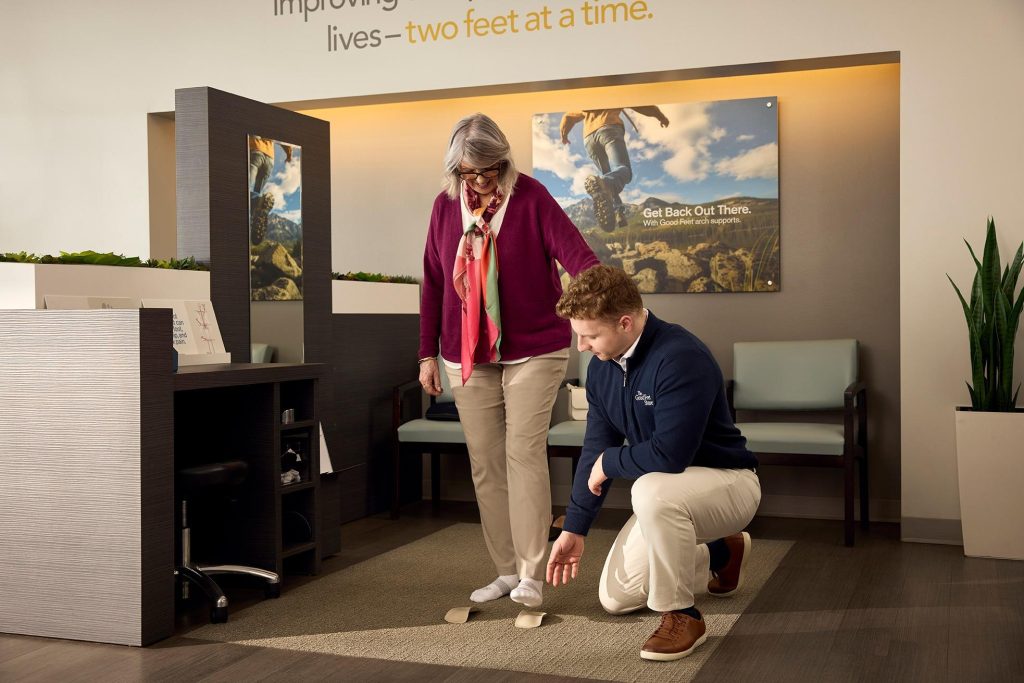
The third, and arguably most important, is the fitting process. When you walk into a Good Feet store, you’re not left to guess which arch height suits you or whether a particular insert will work with your gait. Trained staff assess your foot structure and how you move, then match you with the right products. For something as individual as arch support, that level of personalization matters.
The Benefits Go Further Than Your Feet
Most people who invest in quality arch support are initially looking to solve a foot problem. What tends to surprise them is how far the benefits reach.
Proper foot alignment affects the entire kinetic chain, which is the connected sequence of joints and muscles from your feet up through your hips and spine. When overpronation causes the foot to roll inward, the knee follows, which shifts the hip, which strains the lower back. Correct the foundation and the whole chain benefits. Many people report that chronic knee and back issues they’d been managing for years improved significantly after addressing their foot mechanics.
Beyond pain relief, people consistently report:
• Better posture, particularly during long periods of standing
• Noticeably less fatigue at the end of the day
• Improved performance and fewer overuse injuries for runners and active people
• A general sense of moving more easily and comfortably throughout the day
Who Should Consider Good Feet Arch Supports
The short answer is almost anyone who spends meaningful time on their feet. But a few groups tend to notice the most dramatic improvement.
People with flat feet or high arches are working against their own anatomy with every step in unsupported shoes. For them, proper arch support isn’t a luxury — it’s closer to a necessity. The same goes for anyone already dealing with plantar fasciitis or heel pain, where the right support can relieve the stress on inflamed tissue and allow real healing to begin.
Healthcare workers, teachers, retail staff, and others who stand for most of their working day often describe The Good Feet Store as a revelation. The difference between eight hours in unsupported shoes and eight hours with proper arch support is the kind of thing you feel in your whole body by the end of a shift. Older adults, whose natural arch cushioning diminishes with age, find similar relief — along with improved stability and confidence in their stride.
Getting the Most Out of Your Arch Supports
A couple of things worth knowing before you start. If your feet aren’t used to structured support, give them time to adjust. Wearing your arch supports for a few hours the first day and gradually increasing from there is a much better experience than going full days immediately and wondering why your feet are sore. The muscles and soft tissue are adapting to a new alignment, and that takes a week or two.
Shoe choice matters too. Arch supports perform best in footwear with some depth and structure to them. Very flat, flexible shoes don’t give the insert room to work properly, and high heels shift weight forward in a way that limits what any support can do. For most people, the goal is getting good support into the shoes they’re already wearing the most.
The Bottom Line
Foot health doesn’t get the attention it deserves, especially given how directly it affects the rest of the body. Most people spend years assuming their knee pain is a knee problem, or their back pain is a back problem, without ever looking down at the actual foundation.
Good Feet Arch Supports offer a practical, personalized way to address that foundation. The combination of proper structure, a thoughtful product system, and expert in-store fitting puts them in a different category than what you’ll find on a pharmacy shelf. If your feet have been talking to you, it might be time to listen. You can explore the full range of options at goodfeet.com.
Dr. Emily Watson, a respected figure in health and wellness, boasts 8 years of experience. Her academic journey at Johns Hopkins School of Medicine has equipped her with a profound understanding of both physical and mental health. Dr. Watson specializes in holistic wellness practices, integrating modern medicine with lifestyle and nutritional advice to promote overall well-being. Her approachable manner and dedication to patient education make her a sought-after expert in her field.
Dr. Emily Watson, a respected figure in health and wellness, boasts 8 years of experience. Her academic journey at Johns Hopkins School of Medicine has equipped her with a profound understanding of both physical and mental health. Dr. Watson specializes in holistic wellness practices, integrating modern medicine with lifestyle and nutritional advice to promote overall well-being. Her approachable manner and dedication to patient education make her a sought-after expert in her field.