
Maybe you played piano as a kid and then stopped when exams, sports, college, and work swallowed your schedule. Maybe you never had lessons, but you’ve always felt a tug when you hear a beautiful chord progression, Elton John’s open-hearted drama, a Radiohead loop that feels like weather, a film score that makes you breathe differently.
Or maybe you’re the type of music lover who has spent years collecting songs the way other people collect photographs, and somewhere along the way you started wondering: what would it feel like to make music with my own hands?
For a lot of adults, that question leads them back to one instrument more than any other: The Piano
Not the coolest-looking instrument. Not the easiest to carry. Not always the cheapest. And yet, when grown-ups decide to return to music:really return, not just listen; the piano keeps calling.
Here’s why.
Piano is the closest thing to “music itself”
Many instruments feel like a translation. The piano feels like the original text.
It lays music out in front of you: low notes on the left, high notes on the right. Harmony and melody can happen at the same time. You can build a chord with your left hand and sing a line with your right.
Even when you’re brand new, you can hear structure immediately. Press three keys and you have a chord; press one and you have a melody note. Put them together and you’re suddenly inside the song.
That accessibility is one reason piano remains such a natural re-entry point for adults who already love listening deeply, whether they are drawn to contemporary players or the artists featured in our guides.
For adults, that matters. If you already respond emotionally to songs, the piano offers one of the fastest ways to move from I love this music to I can begin to understand how it works.
It rewards beginners quickly
Adults are busy. They need progress to feel real.
Piano is uniquely friendly here. In your first few weeks, you can learn:
- simple chord shapes
- basic rhythms
- a few melody notes
- the difference between major and minor (which instantly explains why certain songs feel hopeful or haunting)
Even a slow, clumsy version of a familiar tune can feel deeply satisfying because it’s recognisable. That early reward loop matters. It makes practice feel less like homework and more like a ritual you want to return to.
Research on musical training has found links with gains in attention, memory, and broader cognitive skills, which helps explain why learning an instrument often feels mentally engaging in ways adults find deeply satisfying.
And for adults who think they “missed the window,” piano can be a gentle rebuttal. The instrument doesn’t require you to build calluses, develop embouchure, or master breath control before you sound like anything. It lets you sound like music right away, then invites you to refine.
It works with the way adult brains learn
Adults learn differently than kids. Not bad. But differently.
Children often learn by imitation and repetition, while adults tend to want understanding: What am I doing? Why does that chord work? How do I stop making the same mistake?
That is one reason so many returning learners look for some of the top piano lessons NYC offers, since the city is home to some of the best teachers and most flexible learning options for adults coming back to music.
Teaching focuses on analytical approach and Piano supports that. The theory is visible. Patterns are repeatable.
Once you grasp a shape like a major chord you can move it around and instantly hear how it changes.
Adult learners also tend to be motivated by meaning, not gold stars. They don’t want to play “Mary Had a Little Lamb” for six months. They want to play something that sounds like their taste: pop ballads, jazz progressions, indie hooks, film themes, worship songs, or the kind of minimalist piano that lives on late-night playlists.
The piano can meet you there. You can build a practice plan around your actual listening habits, which keeps motivation alive.
It’s a private way to be creative again
A lot of adults miss art, not just music, but the state of being absorbed in something that isn’t productivity.
Piano offers a rare combination: it’s expressive, creative, and deeply personal, but it doesn’t require an audience. You can do it alone in your living room. You can play badly and nobody has to know. You can improvise at midnight, repeat one chord progression for fifteen minutes, and feel your nervous system settle.
For adults who spend their days performing competence at work, at home, in social settings such as piano, it becomes a place where you’re allowed to be a beginner again. That’s not a small thing. Being a beginner is intimate. It requires patience. It asks you to show up when you’re not impressive yet.
And that process can be quietly healing.
The piano fits modern life better than people expect
Adults don’t just return to piano because it’s romantic. They return because it can fit into their lives in a realistic way.
You don’t need an hour a day. Many adults make progress with 15–25 minutes of focused practice, especially if they practice consistently. The instrument also adapts well to modern setups: digital pianos with headphones, compact keyboards, lessons over video, apps for sight-reading and rhythm.
This matters because one of the biggest barriers to adult learning is embarrassment and inconvenience.
Piano allows you to practice quietly, at odd hours, without transporting anything, without needing a band, without needing a dedicated studio space.
It can be as private and flexible as your schedule demands.
It reconnects you to the music you already love
If you’re a music lover, you don’t just want to “learn an instrument.” You want to deepen the relationship you already have with music.
Piano does that in a way that’s hard to describe until you experience it.
You start hearing songs differently. You notice chord changes. You recognise patterns: the same progressions showing up across pop, rock, and gospel. You become aware of bass movement and tension and release.
Even if you never become a technically advanced player, piano can change how you listen. A song becomes less like a mysterious emotional force and more like a craft. That doesn’t reduce the magic; it often increases it. You start admiring choices: That suspended chord, that unexpected shift, that small turn of harmony.
That often deepens admiration rather than reducing it. A simple progression can suddenly feel brilliant.
It’s one of the best instruments for self-accompaniment
Many adults return to piano because they want to sing.
You don’t need a full band to support your voice when you have a keyboard. With basic chords and rhythm, you can accompany yourself, build confidence, and make music that feels complete. Even simple left-hand patterns can create a full, satisfying sound.
This is a major reason piano attracts adult beginners: it empowers them quickly. One instrument can give you melody, harmony, and rhythm. You can play solo and still feel like the room is filled.
Piano works with modern adult life
At a certain point, adult piano isn’t just about music. It’s about identity.
People return to piano because they miss the person they were when music mattered more than being efficient. They miss the feeling of being absorbed. They miss having something that belongs only to them, something that isn’t for work, family, or social media.
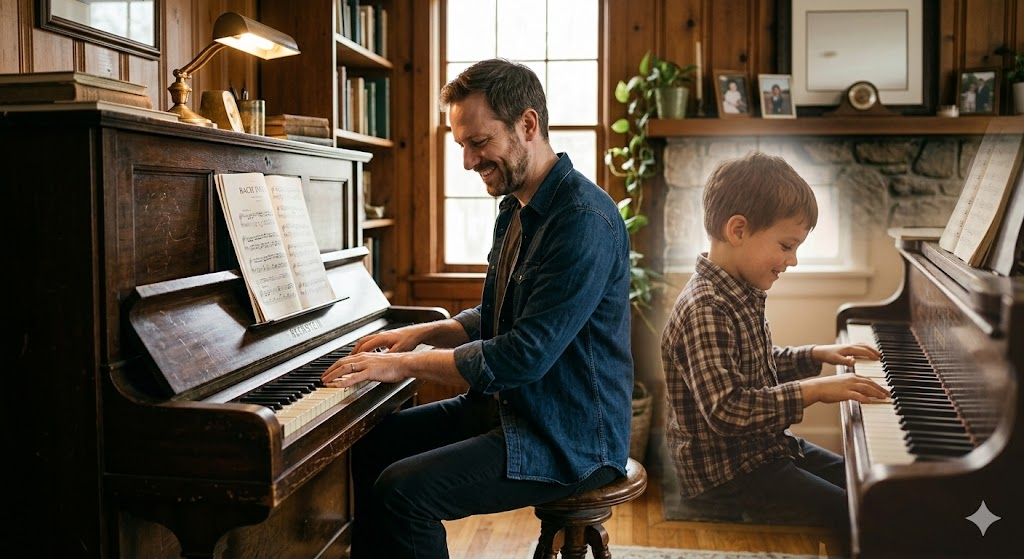
There’s also the quiet longing for continuity: to pick up a thread from childhood and see what it becomes in adulthood. Many adults who played as kids return not to become concert pianists, but to reclaim something they left behind. They don’t want perfection. They want presence.
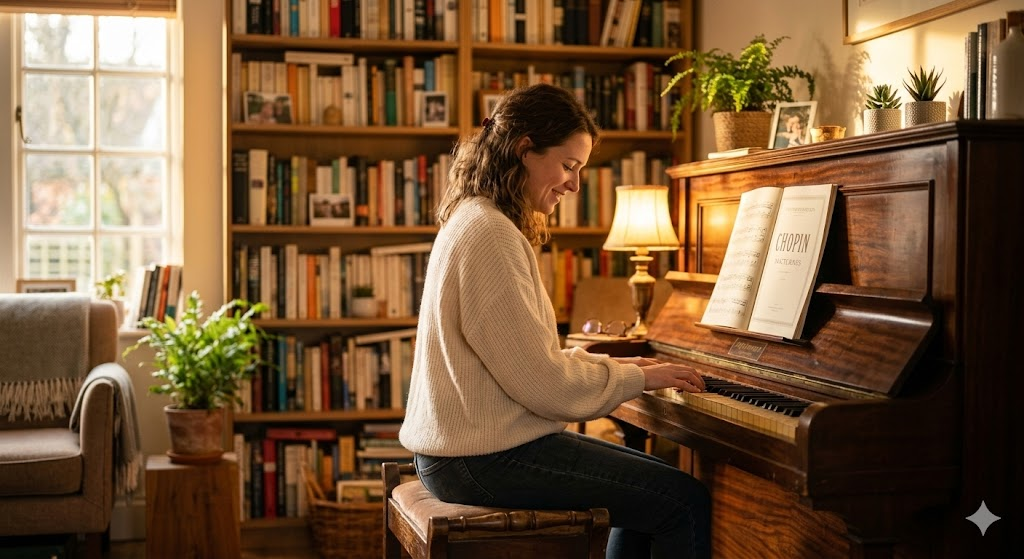
And piano offers that. It’s an instrument that meets you where you are, whether you’re chasing Chopin or just learning to play chords under your favorite songs.
Also Read: Best Classical pianists in music history
How to start again (without making it a whole dramatic project)
If you’re thinking about returning to piano, here are the most adult-friendly ways to begin:
- Choose a “why” that matters: Not “I should learn.” Pick “I want to play this song,” or “I want a creative practice,” or “I want to accompany myself.”
- Get the right setup: A full acoustic piano is amazing, but a good digital piano with weighted keys and a pedal is often the easiest way to start.
- Build a small practice habit: Ten minutes daily beats one hour once a week. Consistency creates momentum.
- Learn chords early: Even if you also want to read music, chords help you play real songs faster and stay motivated.
- Consider lessons that match your taste: Adults thrive when learning connects to music they actually love, whether that’s pop, jazz, classical, or film themes.
Because the truth is: adults don’t return to piano because it’s easy. They return because it’s worth it.