Balancing Performance and Pedagogy
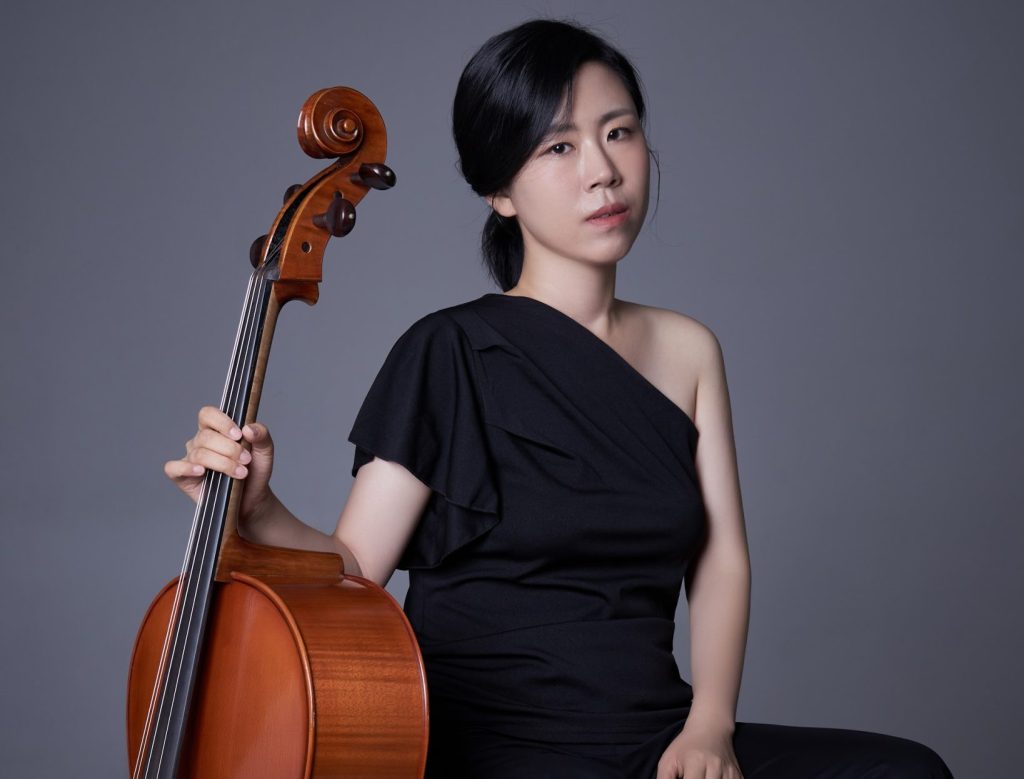
Cellist Jinhyun Kim has built a career defined by artistry, versatility, and a deep commitment to the musical community. Based in Michigan, she serves as Principal Cellist of the Lansing Symphony Orchestra and Assistant Principal Cellist of the Kalamazoo Symphony Orchestra while teaching as an adjunct professor at Albion College, Oakland University, and Spring Arbor University. Through performance and pedagogy, she mentors the next generation of musicians, many of whom pursue careers in performance, teaching, and community music.
Building a Career
A formative turning point came in 2016 when Kim was selected for the National Orchestral Institute + Festival at the University of Maryland—a nationally recognized program that admits a limited number of advanced young musicians each year. Working with conductors Teddy Abrams and Osmo Vänskä, she experienced the intensity and collaborative discipline of professional orchestral performance, solidifying her commitment to symphonic music while continuing to cultivate parallel paths in solo and chamber performance.
This orchestral foundation soon led to her leadership appointments as Principal Cellist of the Lansing Symphony Orchestra and Assistant Principal Cellist of the Kalamazoo Symphony Orchestra, positions earned through competitive auditions. Beyond her orchestral career, Kim also appeared twice at Carnegie Hall’s Weill Recital Hall in New York City as an international competition prizewinner—receiving first prize in the 2016 American Protégé International Piano and Strings Competition and first prize in the 2020 Golden Classical Music Awards.
Her work in higher education began in 2019, when she was invited to present a cello master class at Spring Arbor University. Following that invitation, she was appointed to the faculty, marking the beginning of her formal collegiate teaching career. Since then, performance and pedagogy have developed in tandem, shaping a professional life that bridges the concert stage and the classroom.
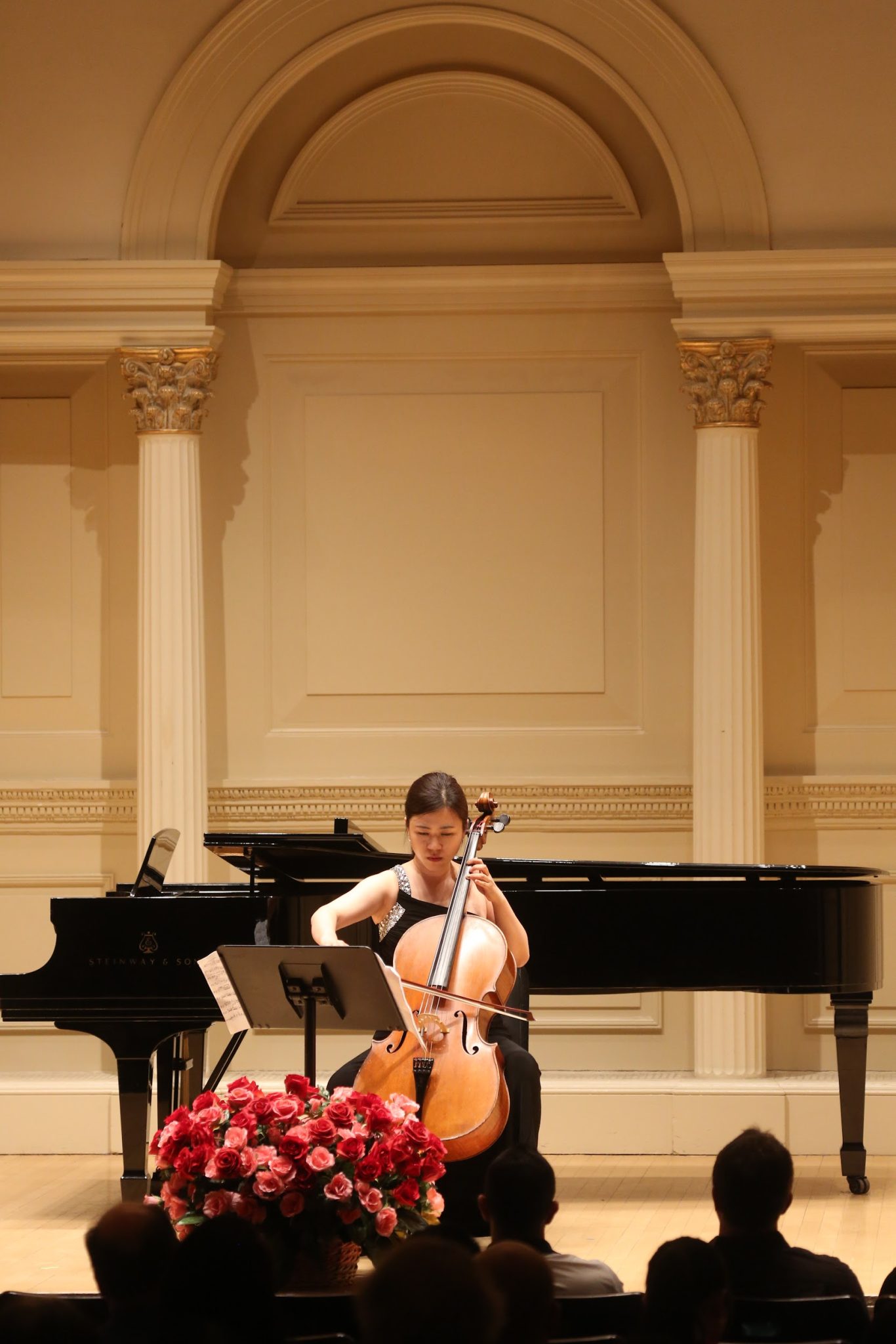
Jinhyun Kim’s performance in Carnegie Hall’s Weill Recital Hall (2016)
Innovation in a Time of Silence
A unique project took place in 2020, during the widespread shutdown of concert halls across the United States. Kim was invited to perform with Michigan Opera Theatre (now Detroit Opera) in its groundbreaking production Twilight: Gods, a site-specific adaptation of Wagner’s Götterdämmerung presented as a drive-through performance in a multi-story parking garage. The production attracted national critical attention, with reviews in The New York Times, The Wall Street Journal, Opera News, and The New Yorker, highlighting its innovative response to the pandemic.
High-Profile Collaborations
In January 2023, Kim performed the lyrical cello solo in Brahms’ Piano Concerto No. 1 with pianist Jon Nakamatsu and the Lansing Symphony Orchestra, preparing meticulously for the concerto’s exposed slow movement and its expressive demands. She looks forward to Nakamatsu’s return to Lansing in May 2026, when he is scheduled to perform Rachmaninoff’s Rhapsody on a Theme of Paganini with the Lansing Symphony Orchestra.
Another major milestone came in June 2025, when Yo‑Yo Ma appeared with the Kalamazoo Symphony Orchestra as the soloist in Elgar’s Cello Concerto. More than a decade earlier, during her doctoral studies, Kim had performed in a masterclass when Ma visited Michigan State University. Performing alongside him years later felt like a full-circle moment, bridging her student years with her professional orchestral career and reinforcing her belief that learning continues at every stage.
Teaching as an Extension of Performance
Teaching forms a central part of Kim’s artistic identity. At Albion College, Oakland University, and Spring Arbor University, she teaches private cello lessons and directs the Albion College string ensemble each spring semester, often performing with the students. This approach models professional rehearsal techniques and ensemble communication in real time. Her teaching emphasizes technical foundation alongside musical voice development, preparing students for auditions, ensemble playing, and artistic decision-making.
Beyond college classrooms, Kim works with local high schools and youth orchestras through sectional coaching and master classes.
Advocacy Through Chamber Music
In 2025, the ConTempus Quartet marked its tenth anniversary with the recording of its forthcoming album, Strings Intertwined, scheduled for release in 2026. The project reflects the ensemble’s long-standing commitment to discovering compelling repertoire, commissioning new works, and presenting performances that connect with audiences of all ages. The album features Fernande Decruck’s previously unpublished Suite dans le style ancien pour quatuor à cordes, Florence Price’s String Quartet No. 2, and Ivette Herryman Rodriguez’s String Quartet No. 1, a newly commissioned work for the ensemble. Together, these works highlight voices that have too often been overlooked while contributing to a broader and more inclusive string quartet canon.
Kim’s advocacy for underrepresented composers extends beyond recording projects. In November 2025, she and her colleagues presented at the College Music Society National Conference in Spokane, Washington, with a session titled “Rediscovering Fernande Decruck: Expanding the String Quartet Canon,” drawing attention to Decruck’s neglected chamber works and their place within the repertoire.
This commitment also extends to significant premiere performances. In 2023, the ConTempus Quartet gave the U.S. premiere of Camille Pépin’s Lyrae for string quartet, harp, and percussion in Jackson, Michigan. Earlier, in 2020, the ensemble performed Eduard Kiprský’s Elegiac Concertino for Harp and String Quartet in Lansing, Michigan, further demonstrating its commitment to introducing contemporary and lesser-known works to American audiences.
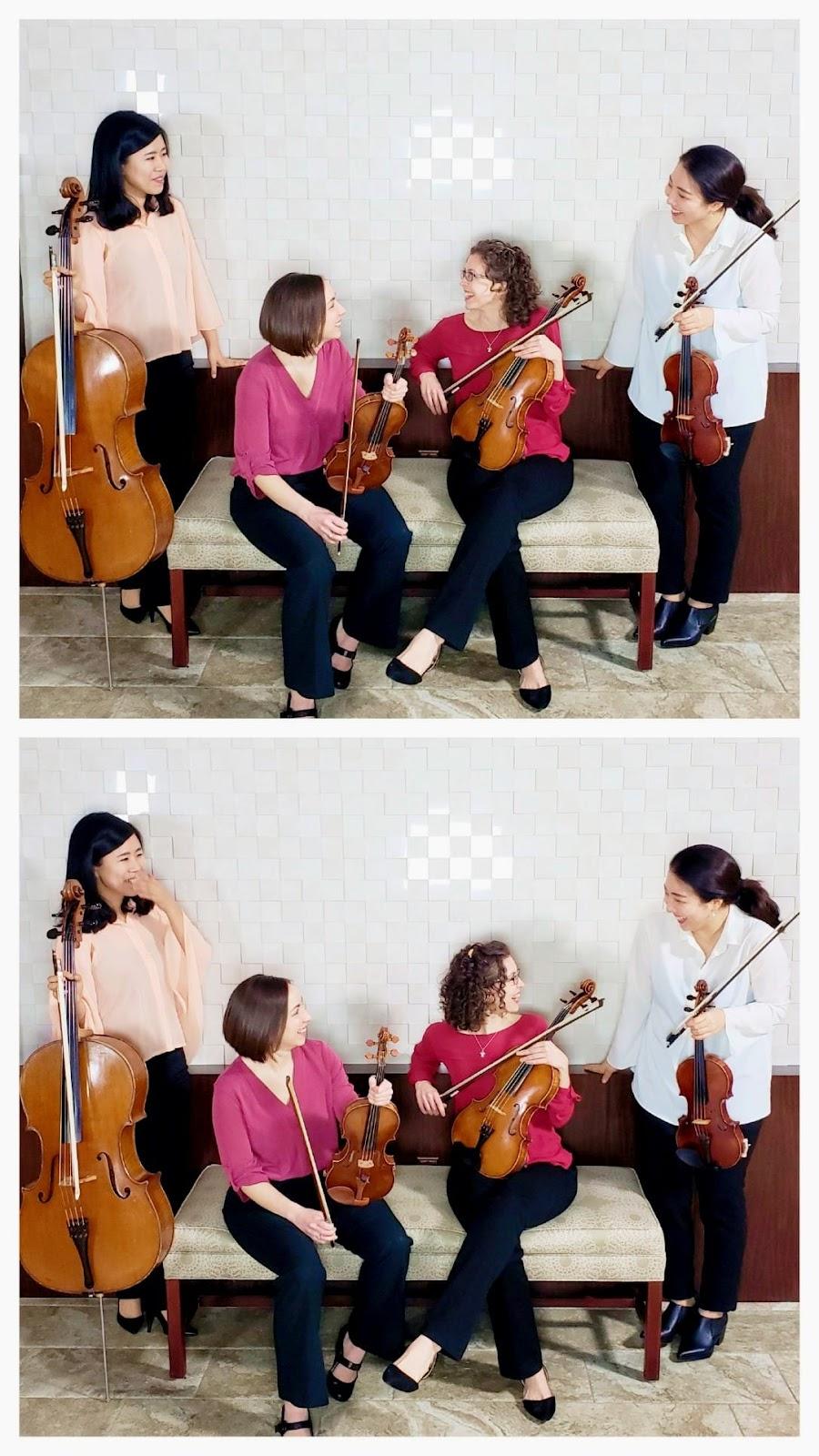
ConTempus Quartet – from left to right – Jinhyun Kim (cello), Sarah Patterson (violin 2), Christine Bastian (viola), and Ji Hyun Kim (violin 1)
A Career of Connection and Growth
Jinhyun Kim’s journey began not on a grand stage, but in her aunt’s living room. Her aunt, an active cellist, kept her instrument in a bright red cello case, and whenever Kim visited, she was irresistibly drawn to it—running her hands along its vivid surface and admiring its color. Through her aunt’s example, she was first introduced to the cello and grew increasingly curious about the instrument, seeking out its sound in recordings and live performances as she grew older. At age seven, her mother—who was also her piano teacher—encouraged her to learn a string instrument, and Kim chose the cello without hesitation. Shaped by those early impressions and her aunt’s quiet example, what began as a childhood fascination soon grew into a lifelong vocation.
From those beginnings to leadership roles in Michigan’s orchestras, Carnegie Hall performances, innovative pandemic-era projects, and mentorship of emerging musicians, Kim’s career reflects a conviction that true artistry extends beyond individual achievement. She approaches music as a collaborative force that connects generations and communities, demonstrating how a performer, teacher, and advocate can create lasting impact through curiosity, commitment, and connection.